
 iPhone Data Recovery
 iOS System Recovery
 iOS Data Backup & Restore
 iOS Unlocker
 iPhone Password Manager
 Location Changer
 Android Data Recovery
 Broken Android Data Extraction
 Android Data Backup & Restore
 Android Unlocker
 FoneTrans for iOS
 iPhone Data Eraser
 iPhone Cleaner
 HEIC Converter
 HyperTrans
 WhatsApp Transfer for iOS
 Mac Sweep
 Data Retriever
 Mac Data Retriever
 Video Converter Ultimate
 Screen Recorder
 Phone Mirror
- Part 1: Recover Deleted ZIP Files from a Backup
- Part 2: Restore a Corrupted ZIP to a Previous Version
- Part 3: Recover Lost ZIP Files with FoneLab Data Retriever
- Part 4: Why ZIP Files Get Lost or Corrupted
- Part 5: Check the Recycle Bin and Temp Folders First
- Part 6: Tips to Protect Your ZIP Files
- Part 7: FAQs About ZIP File Recovery
 Recover PC Data Now
Recover the lost/deleted data from computer, hard drive, flash drive, memory card, digital camera and more.
How to Recover Deleted or Corrupted ZIP Files in Windows
 Posted by Valyn Hua / September 09, 2026 18:00
ZIP files are the workhorse of file sharing — one archive bundles a dozen files into a single download, saves space, and keeps related documents together. So when a ZIP disappears — deleted by accident, emptied with the Recycle Bin, or corrupted until it won't open — the files inside feel doubly lost. The good news is that ZIP recovery on Windows usually works, and you have several routes to try before giving up.
This guide covers the three practical approaches in order of effort: restore from a backup if you have one, roll back to a previous version if system protection is on, and use recovery software when the file is gone with no backup. Start with the cheap options — they take minutes — and escalate only if you have to.

Guide List
- Part 1: Recover Deleted ZIP Files from a Backup
- Part 2: Restore a Corrupted ZIP to a Previous Version
- Part 3: Recover Lost ZIP Files with FoneLab Data Retriever
- Part 4: Why ZIP Files Get Lost or Corrupted
- Part 5: Check the Recycle Bin and Temp Folders First
- Part 6: Tips to Protect Your ZIP Files
- Part 7: FAQs About ZIP File Recovery
Part 1: Recover Deleted ZIP Files from a Backup
If you keep Windows backups — either the built-in File History or a full system backup — restoring a deleted ZIP is a few clicks. This is the cleanest recovery because it brings back the original file intact.
Step 1Open the Start menu and type backup in the search box.
Step 2Select Backup and Restore from the results.
Step 3Click Restore My Files.
Step 4In the restore dialog, use Search, Browse for Files, or Browse for Folders to find the ZIP.
Step 5Choose where to restore the file, then follow the wizard to finish.
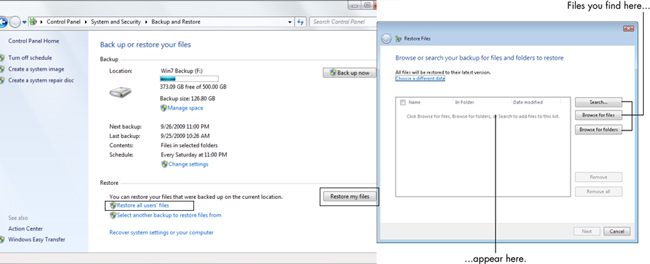
Backups only help if they exist and are recent. If you've never configured one, or the ZIP was created after your last backup, this route won't have the file — move on to the next method.
If the file never made it to a backup, checking the Recycle Bin recovery guide is a fast first step.
Part 2: Restore a Corrupted ZIP to a Previous Version
Windows keeps automatic "previous versions" of files when System Protection is enabled. If your ZIP was recently overwritten or corrupted, you can roll it back to an earlier, working copy.
Step 1Open Control Panel > System and Security > System.
Step 2Click System Protection in the left panel.
Step 3Select your drive and click Configure, then choose Restore System Settings and Previous Versions of Files and click OK.
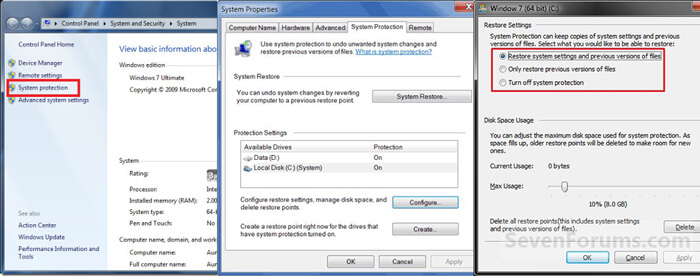
Once protection is on, previous versions are kept automatically. To use one:
Step 1Right-click the ZIP file and select Restore Previous Versions.
Step 2Pick a version from the list and click Open to check it's the right one.
Step 3Select the version and click Restore.
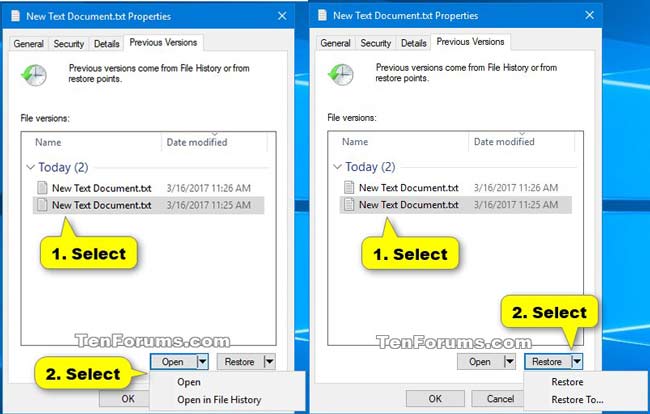
This works best when the file still exists but is broken — previous versions hold an earlier snapshot. If the ZIP was deleted entirely and nothing is in the list, recovery software is the next step.
A practical detail about previous versions: Windows only keeps them if System Protection was enabled before the file changed, and it stores them as part of restore points or File History. That means a ZIP you created today and corrupted today may not have an older snapshot yet — the previous version is only as fresh as the last restore point. If you're lucky, the file's original download folder still has the archive from before, which brings us back to the simplest fix: check whether the ZIP exists anywhere else on the system before you spend time on anything fancier.
It's also worth knowing that "restore previous version" works on folders, not just files. If you keep ZIPs inside a project folder, restoring the folder's previous version brings back the whole state from that point, which can be more useful than a single file when several files changed at once.
Repair a Corrupted ZIP with WinRAR
If the ZIP file exists but cannot be opened, WinRAR has a built-in repair tool that can fix minor corruption in the archive structure.
- Open WinRAR and navigate to the corrupted ZIP file.
- Select the file and click the Repair button in the toolbar.
- Choose a destination folder for the repaired archive and click OK.
- Once the repair finishes, try extracting the new file.
WinRAR can recover files from a partially damaged archive, but it cannot fix a ZIP that is missing large chunks of data. If the repair fails, a data recovery tool like FoneLab Data Retriever may be able to find an earlier, intact copy of the file on your drive.
Part 3: Recover Lost ZIP Files with FoneLab Data Retriever
When there's no backup and no previous version, a deleted ZIP is still usually recoverable — it just needs software that scans the drive for the file's leftover data. FoneLab Data Retriever handles exactly this: it finds deleted or corrupted ZIP files on your hard drive, external drives, memory cards, and USB sticks, and lets you preview before recovering.
FoneLab Data Retriever - recover the lost/deleted data from computer, hard drive, flash drive, memory card, digital camera and more.
- Recover photos, videos, contacts, WhatsApp, and more data with ease.
- Preview data before recovery.
- Recover photos, videos, documents, and more data with ease.
- Recover data from device, iCloud, and iTunes.
Step 1Download and install FoneLab Data Retriever, then launch it.
Step 2On the main screen, select the file types you want and choose the location where the ZIP was lost. If you're unsure, scan the Recycle Bin or the whole drive.
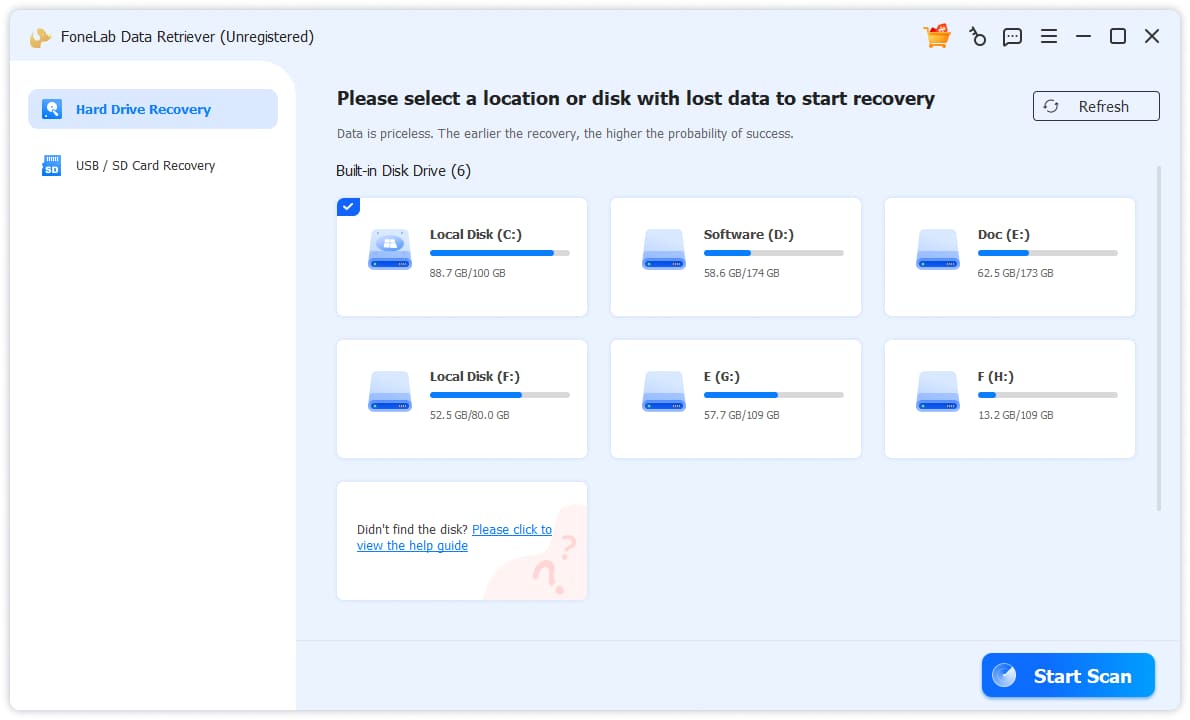
Step 3Click Scan to start. When the results appear, use the Filter bar to find ZIP files quickly.
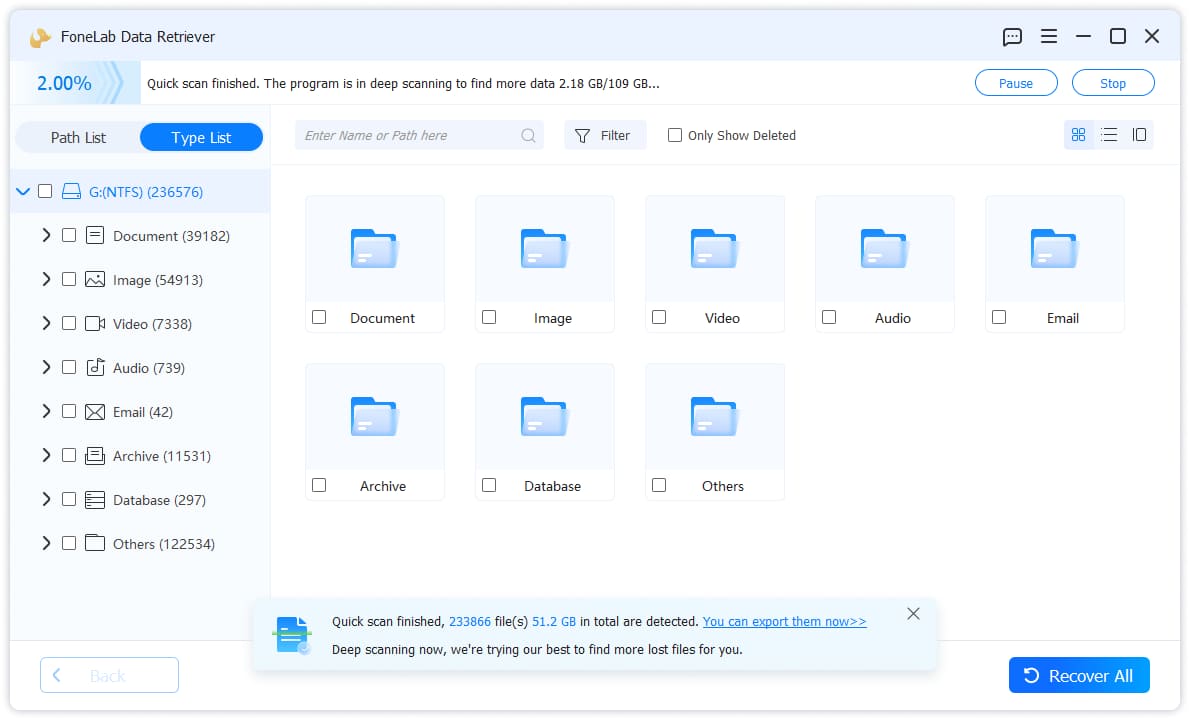
Step 4If the file isn't in the first pass, run Deep Scan — it takes longer but digs deeper.
Step 5Tick the ZIP file, click Recover, and save it somewhere other than the drive you scanned.
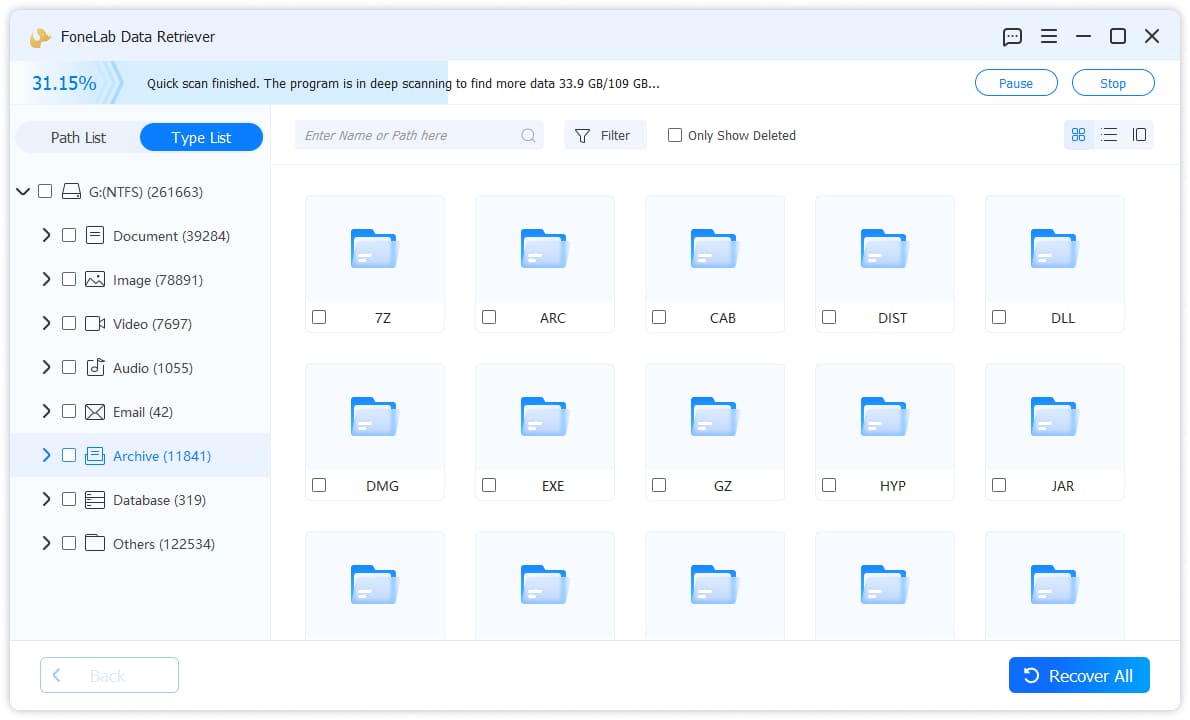
The same software also handles other lost files — documents, photos, videos, emails — so it's a reasonable tool to keep around for all recovery situations.
Part 4: Why ZIP Files Get Lost or Corrupted
- Accidental deletion: hitting Delete on the wrong file, or Shift+Delete which skips the Recycle Bin entirely.
- Emptying the Recycle Bin: the ZIP was there, but it's now flagged as free space.
- Interrupted download: a ZIP that cut off at 95% won't open and may look corrupted.
- Bad transfer: moving the archive over a flaky connection or drive can truncate it.
- Malware or system crash: either can damage the archive's structure.
- Drive failure: bad sectors can take out whatever is stored on them.
Knowing the cause tells you which recovery path fits. Deletion points to recovery software; a truncated download might just need a re-download; corruption on disk benefits from previous versions.
Here's a quick test to tell whether a ZIP that won't open is truly corrupted or just incomplete: check its file size against the size the source reports. If your copy is smaller, the download or copy failed partway, and re-downloading or re-transferring is faster than any recovery tool. If the size matches but Windows still says the archive is invalid, the data may have been damaged on disk, and previous versions or recovery software are the right next step.
You can also try a lightweight check with Windows' built-in tools: right-click the ZIP and choose Extract All. If it extracts most files but fails on one, the archive's structure is mostly intact and a repair tool may recover the rest. If it fails immediately, treat it as corrupted and go the recovery route.
For repairing a ZIP that opens but is broken, repairing a corrupted ZIP file has the dedicated steps.
Part 5: Check the Recycle Bin and Temp Folders First
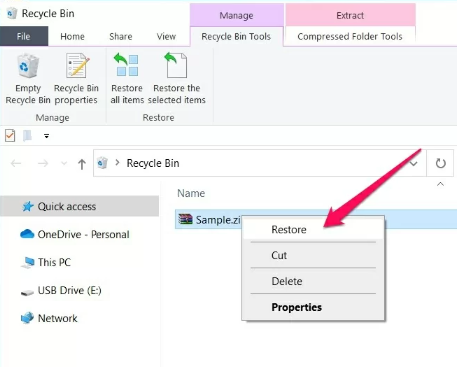
Before any recovery software, spend two minutes checking the obvious spots. If the ZIP was deleted normally (not Shift+Delete), it's sitting in the Recycle Bin — right-click it and choose Restore. Also look in your browser's default download folder and any temp directory, since an "incomplete" ZIP is often still there under a slightly different name. And if you sent the file by email or cloud link, check your Sent folder or the cloud trash — a copy may still exist server-side.
Part 6: Tips to Protect Your ZIP Files
- Turn on File History or a scheduled backup so recent versions always exist.
- Keep System Protection enabled for the drive where your archives live.
- Store important ZIPs in a dedicated folder and back it up to a second drive or cloud.
- Don't leave downloads half-finished — verify large archives open before deleting the source.
- Avoid Shift+Delete on files you might need; normal Delete keeps them in the Recycle Bin.
These habits cost almost nothing and turn a potential disaster into a minor hiccup.
For archives stored on a different disk, recovering ZIP files from a hard drive covers that case.
One more habit worth mentioning: name your ZIPs with dates (project-final-2026-09.zip instead of final.zip). When something does go wrong, a dated archive is far easier to identify in a scan result or a backup listing, and you'll know instantly which version you're looking at. It sounds trivial until you're staring at a list of twelve files called "archive.zip".
And if you're sending ZIPs by email or cloud storage, keep a copy on the local drive until the recipient confirms they received it. It's a small redundancy that avoids the "can you resend that?" loop and the scramble to recover something you never actually lost.
For really critical archives, a password-protected ZIP stored in two places — say, your Documents folder plus a cloud drive — is both a backup and a way to keep sensitive contents safer in transit.
That way a single disk failure or a deleted folder never costs you the only copy.
Part 7: FAQs About ZIP File Recovery
Can I recover a ZIP file after Shift+Delete?
Yes. The file isn't wiped instantly — its space is just marked free. Recovery software can usually find it if you act before the drive gets overwritten.
Why won't my ZIP file open?
It's usually an incomplete download, a corrupted archive, or a wrong file association. Re-download, try a repair tool, or recover an earlier version.
Is ZIP recovery software free?
Most tools offer a free trial scan so you can see what's recoverable. FoneLab Data Retriever lets you preview files before paying, so you only buy if your ZIP is actually there.
Conclusion
Lost ZIP files aren't usually gone for good. Restore from a backup if you have one, roll back to a previous version if System Protection is on, or scan the drive with FoneLab Data Retriever when the archive is truly gone. Start with the quick checks, escalate as needed, and get into the habit of keeping backups so next time is faster.
FoneLab Data Retriever - recover the lost/deleted data from computer, hard drive, flash drive, memory card, digital camera and more.
- Recover photos, videos, contacts, WhatsApp, and more data with ease.
- Preview data before recovery.
- Recover photos, videos, documents, and more data with ease.
- Recover data from device, iCloud, and iTunes.