
 iPhone Data Recovery
 iOS System Recovery
 iOS Data Backup & Restore
 iOS Unlocker
 iPhone Password Manager
 Location Changer
 Android Data Recovery
 Broken Android Data Extraction
 Android Data Backup & Restore
 Android Unlocker
 FoneTrans for iOS
 iPhone Data Eraser
 iPhone Cleaner
 HEIC Converter
 HyperTrans
 WhatsApp Transfer for iOS
 Mac Sweep
 Data Retriever
 Mac Data Retriever
 Video Converter Ultimate
 Screen Recorder
 Phone Mirror
- Part 1: Recover a WordPad Document with Previous Versions
- Part 2: Recover an Unsaved WordPad Document from Temp Files
- Part 3: Extract a WordPad File from a System Image Backup
- Part 4: Recover WordPad Documents with FoneLab Data Retriever
- Part 5: WordPad vs. Word: Which Documents Can You Recover
- Part 6: How to Avoid Losing WordPad Documents
- Part 7: FAQs About WordPad Document Recovery
 Recover PC Data Now
Recover the lost/deleted data from computer, hard drive, flash drive, memory card, digital camera and more.
How to Recover Deleted WordPad Documents from a Hard Drive
 Posted by Valyn Hua / September 09, 2026 11:00
WordPad files disappear more often than you'd expect. A program crash, a careless delete, a hard drive that stops being recognized — any of these can take your notes or drafts with it. The good news is that, in most cases, the document is still sitting on the drive, and you can get it back with the right approach.
WordPad is that middle-ground editor between Notepad and Word: simple, fast, and built into Windows. It saves in Rich Text Format, which keeps basic formatting. Because it's a plain file on your drive, recovery comes down to three things — previous versions, temp files, or a proper scan of the storage. Here's how to work through each.

Guide List
- Part 1: Recover a WordPad Document with Previous Versions
- Part 2: Recover an Unsaved WordPad Document from Temp Files
- Part 3: Extract a WordPad File from a System Image Backup
- Part 4: Recover WordPad Documents with FoneLab Data Retriever
- Part 5: WordPad vs. Word: Which Documents Can You Recover
- Part 6: How to Avoid Losing WordPad Documents
- Part 7: FAQs About WordPad Document Recovery
Part 1: Recover a WordPad Document with Previous Versions
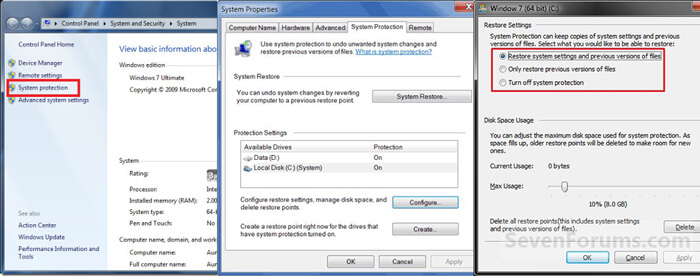
Windows keeps automatic copies of files and folders when System Protection is on. These "previous versions" are restore points for files that were changed or deleted by accident, and they're your first and easiest option. The catch: you need to remember the folder where the file lived.
If System Protection is off, turn it on for the future: Start > Control Panel > System and Security > System > System Protection.
Step 1Open This PC and go to the folder where the lost document was saved.
Step 2If the folder itself is gone, create a new folder with the same name — the contents don't matter, only the location.
Step 3Right-click the folder and choose Restore previous versions.
Step 4Pick a version from the list, open it to confirm your document is there, then drag it somewhere safe like the desktop.
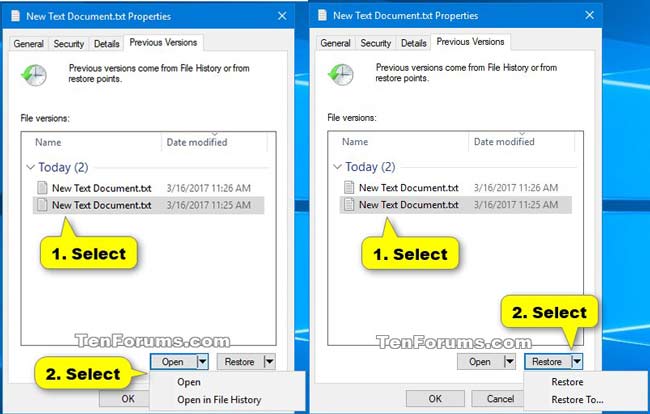
This method only works if a restore point exists from before the document went missing. If there's nothing in the list, move on to the next option.
One thing people often get wrong with previous versions: they look for the file's previous version, but the restore points are attached to the folder, not the file. That's why recreating the folder with the same name matters — Windows matches the version history to the folder path. If you're trying this on a file that was deleted from its original folder, stay in that same folder location and you'll see the version list appear.
Previous versions also come in handy when a document was saved over with a wrong draft. Right-click the folder, open an earlier version, and you can pull out the copy you meant to keep. It's not unlimited — Windows only keeps what fits the system protection settings — but for a recent loss it's often enough.
Part 2: Recover an Unsaved WordPad Document from Temp Files
Worked on a document for an hour and then the program crashed before you hit save? WordPad writes temporary files as you work, and those temp files often survive a crash. They're your best shot at recovering an unsaved draft.
Step 1Open the Start menu and type %appdata% in the search box, then press Enter.
Step 2Browse to the temp or recent documents folder, or search your whole user folder for files ending in .tmp that match the date and time you last edited the document.
Step 3When you find a candidate, copy it to the desktop.
Step 4Rename the file and change its extension from .tmp to .rtf, then double-click to open it in WordPad.
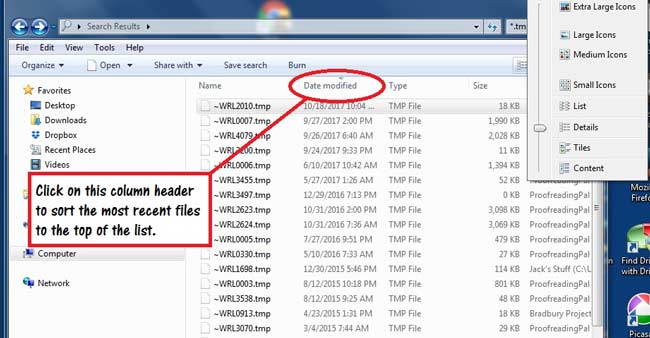
If the temp file opens and shows your text, save it as a proper document right away. If it opens as gibberish, it's the wrong file or it's too damaged — try a different one or use a scanner.
Part 3: Extract a WordPad File from a System Image Backup
If you back up your PC with a system image (Windows' built-in backup tool or third-party imaging software), you can pull a single file out of it — you don't have to restore the whole system. This is the option for people who have a backup but don't want to overwrite their current setup.
Step 1Open Disk Management by searching diskmgmt.msc in the Start menu.
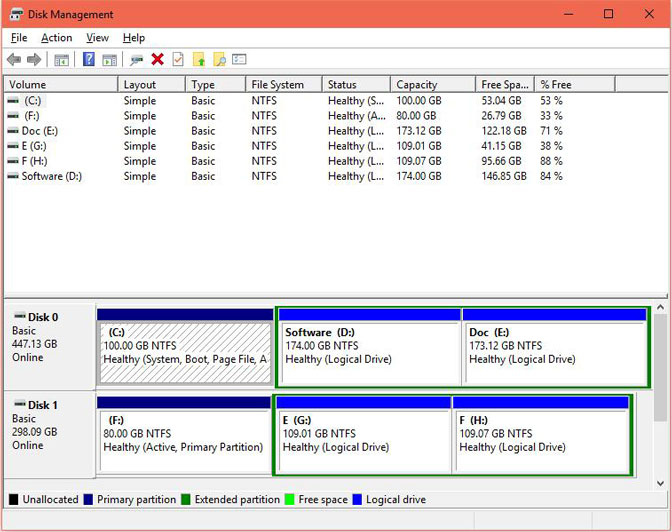
Step 2Click Action > Attach VHD, then Browse to the backup image and open it. Make sure Read-only stays checked so you don't modify the backup.
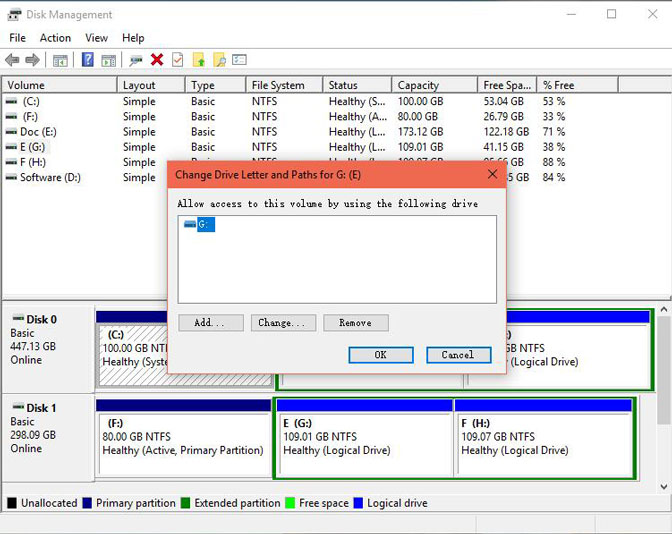
Step 3The image mounts as a drive. Browse to the folder with your WordPad document and copy it out to your normal drive.
This route is dependable but only helps if you actually have a system image from before the loss. Most people don't, which is why Part 4 is the one that saves the day.
Part 4: Recover WordPad Documents with FoneLab Data Retriever
When the easy options come up empty, the document isn't necessarily gone — it may just be marked as deleted on the drive, waiting to be overwritten. A data recovery tool scans the storage directly and rebuilds those files. That's where FoneLab Data Retriever comes in.
It reads hard drives, USB drives, and memory cards for deleted WordPad, Word, PDF, TXT, and image files, and it doesn't need a backup to work. The whole process is a few clicks, so you don't need to be technical.
FoneLab Data Retriever - recover the lost/deleted data from computer, hard drive, flash drive, memory card, digital camera and more.
- Recover photos, videos, contacts, WhatsApp, and more data with ease.
- Preview data before recovery.
- Recover photos, videos, documents, and more data with ease.
- Recover data from device, iCloud, and iTunes.
Step 1Download and install FoneLab Data Retriever, then launch it.
Step 2Select the file types you want — check Documents — and choose the drive where the WordPad file was.
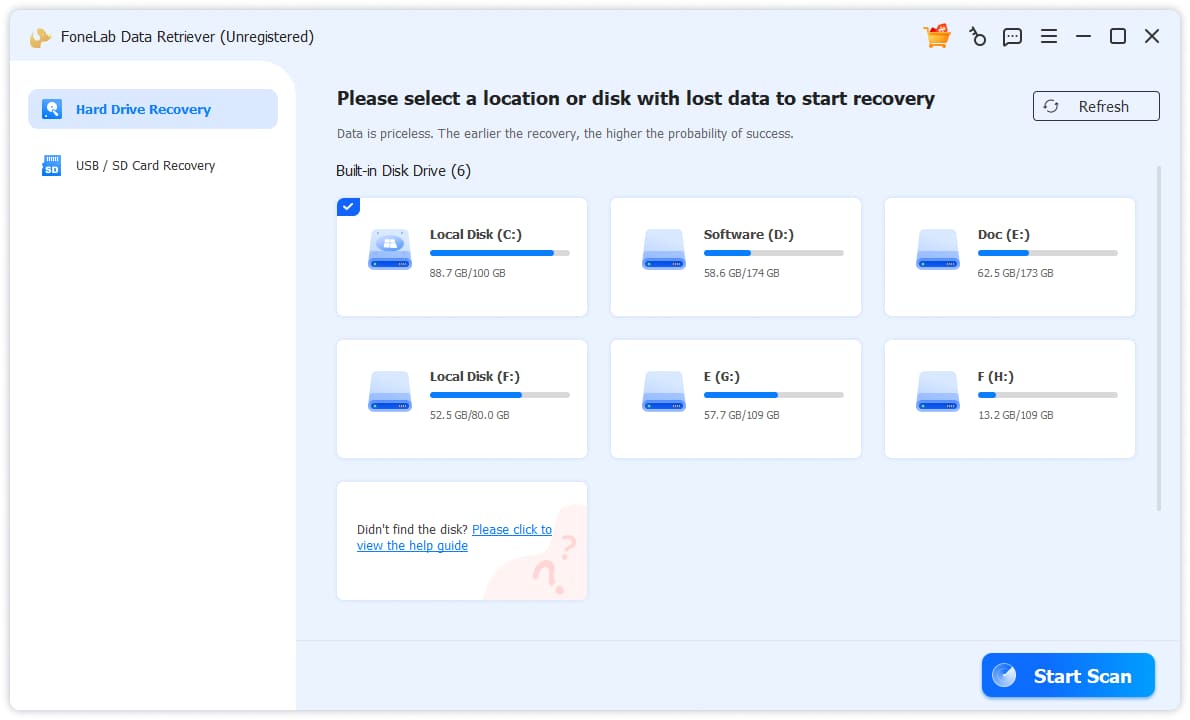
Step 3Click Scan. When the quick scan finishes, you can run a Deep Scan to find more.
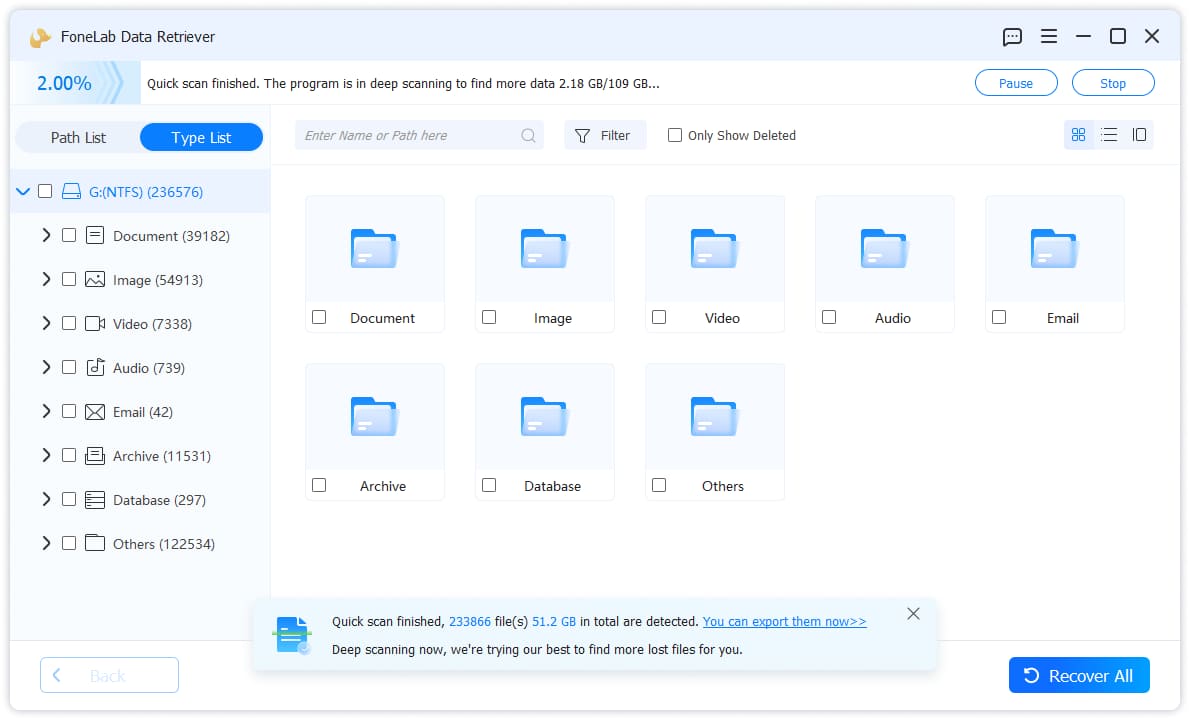
Step 4Use the search box or Filter to find your document by name or type.
Step 5Tick the file and click Recover to save it back to your computer.
Besides WordPad files, this tool also recovers PDF documents, TXT files, emails, photos, and more from the same drive — so a single scan covers everything you lost.
If your drive isn't showing up in the tool at all, check that it's connected properly and that Windows sees it in Disk Management. A drive that failed or went offline needs different treatment — the tool reads healthy and recently-deleted data best. For a drive that's clicking or not spinning up, stop using it and consider professional recovery, because a second scan on a failing drive can make things worse.
Also, recover to a different drive than the one you're scanning. If you save the recovered WordPad file back onto the same hard drive, the new file can overwrite the very blocks you're trying to rescue. Choose a different folder on another drive, or the desktop if it's on a separate disk, and your recovered document is safe.
Important: Unlike Microsoft Word, WordPad does not have an AutoRecover or autosave feature. If you close WordPad without saving, or if the program crashes, the unsaved content is gone unless Windows kept a temporary copy. This is why checking temp files (Part 2) matters for WordPad specifically.
Part 5: WordPad vs. Word: Which Documents Can You Recover
WordPad and Word save different file types, and it's worth knowing which one you're dealing with before you scan. WordPad's native format is RTF, though it can open and save plain text files too. Word uses DOCX (and older DOC). Both are recoverable with the methods above, but they show up differently in a scan.
- RTF files open in WordPad, Word, and most text editors — easy to preview and recover.
- DOCX files are Word's format and need Word (or a compatible editor) to open after recovery.
- TXT files are the simplest and recover cleanly from any scan.
In practice, if you're not sure what format the lost file was, run the scan with the Documents category selected and check the previews — the tool shows you the file type and content before you commit to recovery.
Part 6: How to Avoid Losing WordPad Documents
A few habits make WordPad document loss a rare event instead of a weekly panic:
- Save often with Ctrl+S, and give files clear names so they're easy to find later.
- Turn on System Protection so Windows keeps previous versions for you.
- Back up important documents to an external drive or cloud folder on a schedule.
- Before you reformat or replace a drive, copy your Documents folder somewhere safe.
- If you work on long drafts, save a copy under a new name every so often.
Backing up is the single most effective move. A document you've copied to the cloud is a document you can never truly lose.
If you regularly edit the same kinds of files — notes, drafts, lists — a tiny bit of routine saves the day later. Even a simple habit like saving a dated copy to a backup folder once a week means your worst case is losing a week of changes, not a year. That's the difference between a minor annoyance and a real loss.
Part 7: FAQs About WordPad Document Recovery
Can I recover a WordPad document I never saved?
Often yes. WordPad writes temp files as you type, and those .tmp files survive many crashes. Rename one to .rtf and open it to check.
Where does WordPad store its files?
WordPad saves documents wherever you choose. Its temp files go to the user's app data or temp folders, which is where crash recovery finds them.
Is WordPad still on Windows 11?
Microsoft removed WordPad from recent Windows 11 builds. If you upgraded, your old .rtf files still open in Word or other editors, and recovery methods still apply.
Conclusion
Losing a WordPad document is stressful but rarely permanent. Start with previous versions, then temp files, then a system image if you have one. When none of those pan out, FoneLab Data Retriever scans the drive directly and usually finds the file. And once it's back, make a backup so you never have to do this twice.
FoneLab Data Retriever - recover the lost/deleted data from computer, hard drive, flash drive, memory card, digital camera and more.
- Recover photos, videos, contacts, WhatsApp, and more data with ease.
- Preview data before recovery.
- Recover photos, videos, documents, and more data with ease.
- Recover data from device, iCloud, and iTunes.