
 iPhone Data Recovery
 iOS System Recovery
 iOS Data Backup & Restore
 iOS Unlocker
 iPhone Password Manager
 Location Changer
 Android Data Recovery
 Broken Android Data Extraction
 Android Data Backup & Restore
 Android Unlocker
 FoneTrans for iOS
 iPhone Data Eraser
 iPhone Cleaner
 HEIC Converter
 HyperTrans
 WhatsApp Transfer for iOS
 Mac Sweep
 Data Retriever
 Mac Data Retriever
 Video Converter Ultimate
 Screen Recorder
 Phone Mirror
 Recover PC Data Now
Recover the lost/deleted data from computer, hard drive, flash drive, memory card, digital camera and more.
A MiniTool Power Data Recovery Review with Alternatives
 Updated by
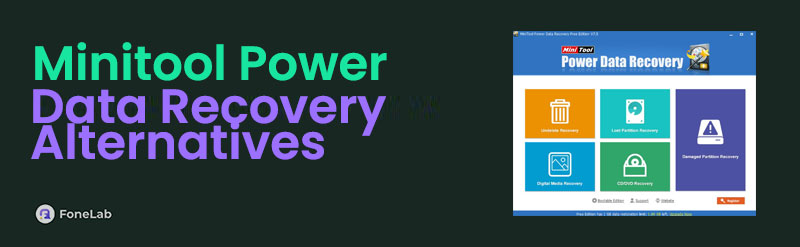
 MiniTool Power Data Recovery is a well-known name in Windows data recovery, offering solutions for accidentally deleted files, formatted drives, lost partitions, and other data loss scenarios. ✅ It is a good choice for many – especially first-time users – thanks to its painless recovery process and user-friendly interface. By browsing the review below, you'll discover more about this recovery program and how it can help you.
However, ease of use isn't the only factor to consider. After all, other functions are just as important for successful file recovery. So, it's smart to consider alternatives – no single recovery tool works perfectly for every situation. The following sections will give you a clear view of the top alternatives and their functions to help you choose the best one for your specific situation.

Guide List
Part 1. MiniTool Power Data Recovery Review
Before committing to the MiniTool Power Data Recovery program, it’s best to learn first what it is all about. To put it simply, it is a Windows-based file recovery tool for hard drives, SSDs, USB flash drives, memory cards, and CDs/DVDs. It has been around for over a decade and is aimed primarily at home users and small businesses.
The program offers a Free version(up to 1 GB recovery), a Pro version (unlimited capacity, plus dynamic disk recovery), a Pro Deluxe version (adds email recovery and remote assistance), and a Technician version (unlimited PC installations and command-line support).
Data Recovery Modes
- • Partition Recovery - for partitions that have been damaged or completely lost.
- • Digital Media Recovery - for memory cards, cameras, and other digital devices.
- • Hard Drive Recovery - for data saved locally on the computer hard drive.
- • CD/DVD Recovery - for scratched or unreadable optical discs.
Scanning Modes
- • Quick Scan - fast, works for recent deletions where the file table is still intact.
- • Deep Scan - slow but thorough, scans raw data and rebuilds files by signature.
- • Specific Location Scan - scan specific areas, such as the desktop, Recycle Bin, etc.
As you can see, the recovery program has its fair share of advantages. However, you should also be aware of its drawbacks. Starting with its supported operating systems. Unfortunately, it doesn’t support Linux and has no native macOS version. Also, as mentioned, the free version's 1 GB limit is fine for a few documents or photos but useless for video projects or large archives.
Part 2. MiniTool Power Data Recovery Alternatives
Now that you’re familiar with MiniTool Power Data Recovery, it’s time to acquire knowledge about its alternatives. Aside from this program and the official method to recover files from the Recycle Bin, the following tools are available to help you recover your desired files.
Option 1. FoneLab Data Retriever
FoneLab Data Retriever is a strong contender trusted by countless users for data recovery. Unlike the MiniTool, it is designed for both Windows and macOS and can restore lost data from hard drives, flash drives, memory cards, digital cameras, and more. It also supports a wide range of data types.
You can recover documents, photos, videos, emails, and more with FoneLab Data Retriever. Additionally, it handles various recovery scenarios – including unexpected power loss, accidental deletion, unintentional formatting, and more. Hence, feel free to recover files from PC or Mac, especially with its user-friendly functions and interface.
FoneLab Data Retriever - recover the lost/deleted data from computer, hard drive, flash drive, memory card, digital camera and more.
- Recover photos, videos, documents and more data with ease.
- Preview data before recovery.
Discern the painless steps below as a sample to learn the best MiniTool Power Data Recovery alternative, FoneLab Data Retriever:
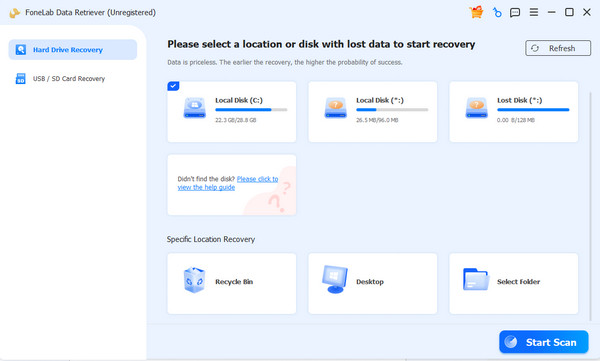
Step 1Select Free Download to secure a copy of the FoneLab Data Retriever file. Once it’s shown in the Downloads section, launch it for the initial setup and installation, showing the Start tab afterward. Click it, and once you see the interface, check the relevant drive or location.
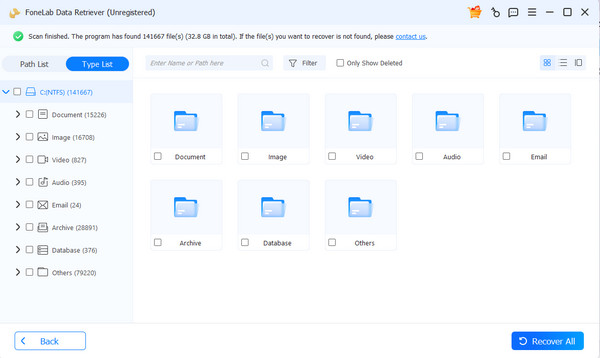
Step 2When ready, click Scan. Once scanned, the data type folders will be presented. Delve into them to find and mark your desired files. Finally, pick the Recover All option below to return the files to your computer.
Option 2. Disk Drill
Disk Drill is another popular recovery tool, available for both Windows and macOS users. The program offers a clean, modern interface that is easy to navigate – making it a good option for beginners. Additionally, it offers features like Recovery Vault, which helps prevent permanent data loss before it happens. However, it’s also important to know its disadvantages. The free version only recovers 500 MB, half of what MiniTool offers. Also, its deep scan sometimes flags files as recoverable when they are actually corrupted.
Follow the procedure below to use the MiniTool Power Data Recovery, Disk Drill:
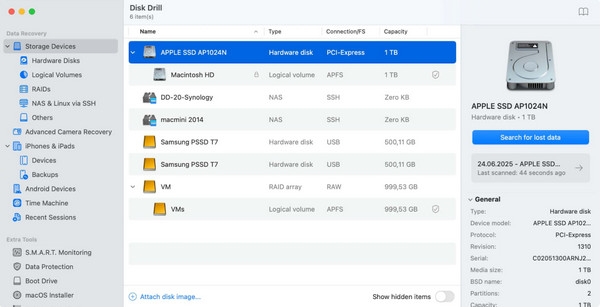
Step 1Download and install Disk Drill from the official CleverFiles website. Afterward, launch it immediately and select the drive where your lost files were formerly stored.
Step 2Next, click the Search for lost data button to start the scan. You can then preview the found data, and once you select your desired file, click Recover to restore it.
Option 3. EaseUS Data Recovery Wizard
Another recognizable name in data recovery is EaseUS Data Recovery Wizard. It supports a wide range of storage devices, including hard drives, SSDs, USB flash drives, and memory cards, and you can acquire it on both Windows and Mac. It’s known for its high success rate on formatted drives and emptied Recycle Bin files, but it also has disadvantages.The free trial frequently prompts you to upgrade, which can feel intrusive. Apart from that, its scan times are often slower than MiniTool's, especially on large drives.
Follow the instructions below to understand the MiniTool Power Data Recovery alternative, EaseUS Data Recovery Wizard:
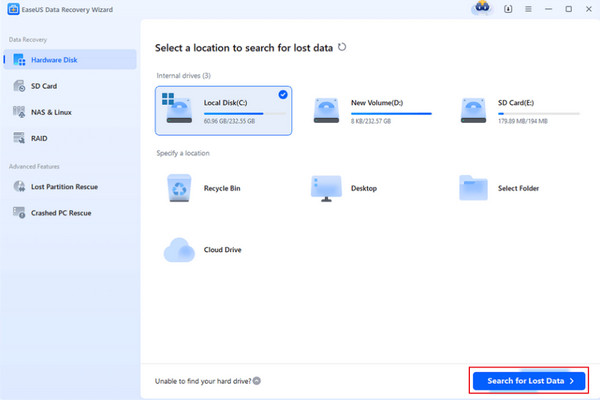
Step 1Like the previous tools, install EaseUS Data Recovery Wizard using the file you downloaded from its official website. Then, run the program on your desktop.
Step 2On the key interface, choose the drive that previously contained your file and click Search for Lost Data. After scanning, find your file to restore, then select Recover.
Part 3. Comparison of MiniTool Power Data Recovery and Its Alternatives
| Aspect | MiniTool Power Data Recovery | FoneLab Data Recovery | Disk Drill | EaseUS Data Recovery Wizard |
| Supported OS | Windows only | Windows & Mac | Windows & Mac | Windows & Mac |
| Deep Scan quality | Good | High success rate | Good, but false positives | High success rate |
| Preview before recovery | Yes | Yes | Yes | Yes |
| Email recovery | Yes (Pro Deluxe) | Yes | Yes | Yes |
| Ease of Use | Easy | Very Easy | Very Easy | Easy |
| Best for | Windows users needing modular scans | Beginners wanting simplicity | Cross-platform | High recovery limit on free trial |
Part 4. FAQs about MiniTool Power Data Recovery
Can MiniTool recover permanently deleted files?
Yes, the files haven't been overwritten by new data. The Deep Scan mode is designed for this.
How long does a scan take?
Quick Scan takes a few minutes. Deep Scan can take 20 minutes to several hours, depending on drive size.
If you need a simple, Windows-only recovery tool with basic options, MiniTool Power Data Recovery is a solid choice. But if you need more features or cross-platform support, one of its alternatives – especially FoneLab Data Retriever – may serve you better.