
 iPhone Data Recovery
 iOS System Recovery
 iOS Data Backup & Restore
 iOS Unlocker
 iPhone Password Manager
 Location Changer
 Android Data Recovery
 Broken Android Data Extraction
 Android Data Backup & Restore
 Android Unlocker
 FoneTrans for iOS
 iPhone Data Eraser
 iPhone Cleaner
 HEIC Converter
 HyperTrans
 WhatsApp Transfer for iOS
 Mac Sweep
 Data Retriever
 Mac Data Retriever
 Video Converter Ultimate
 Screen Recorder
 Phone Mirror
 Get Data Recovery Now
Recover the lost/deleted data from computer, hard drive, flash drive, memory card, digital camera and more.
Deleted SD Card Recovery: How to Recover Deleted Files from SD Card
 Updated by Valyn Hua / October 29, 2026 10:00
SD cards are tiny, fast, and everywhere: cameras, phones, drones, Nintendo Switch consoles, and Raspberry Pi projects all rely on them. That portability is also their weakness. A single accidental format, a corrupt file table, or pulling the card out too early can wipe every photo, video, document, and game save on it in seconds.
If you are here, your SD card files are probably missing right now. The good news is that most "deleted" SD card data is not truly gone. The card simply marks the space as free. As long as you have not overwritten it, you can get it back. In this guide I will show you how to recover deleted files from an SD card, from quick driver fixes all the way to a full deep scan.

Guide List
Part 1. How Files Go Missing on an SD Card
SD cards lose data in a few predictable ways. Knowing which one you are dealing with points you to the right fix.
- Deleted by mistake. You selected files and hit Delete, or told the device to format the card.
- Corrupted file system. A power loss, bad ejection, or cheap card makes the card show as RAW or unformatted.
- Not detected. The card reader or driver is the problem, not the files themselves.
- Virus. Malware hides or deletes files on removable drives.
- Wear and tear. SD cards have a finite lifespan and can fail silently.
The moment you realize files are missing, stop using the card. Do not take new photos, do not format it, and do not copy files onto it. Every write risks overwriting the very data you want back. Keep the card aside until you are ready to recover it.
Before jumping to recovery, narrow down what happened so you pick the right method. Plug the card into a reader and watch how the computer reacts. If the card opens normally and files are just missing, they were likely deleted or hidden, and the free methods in Parts 2 and 3 will probably bring them back. If Windows pops up "You need to format the disk before you can use it" or shows the card as RAW, the file table is damaged, but the photos and videos themselves are usually still on the chip. If the card is not recognized at all in any reader, the reader or the USB port may be the problem, not the card — try a different reader and a different port first. That distinction saves you from running a full scan when a simple Chkdsk would have fixed it.
You might see the missing files on one device but not another, which is normal. A phone may still show thumbnails in its gallery cache even after the underlying file is deleted, while a computer shows an empty folder. Do not rely on those cached thumbnails as proof the files are safe; they are not real copies. The sooner you run the recovery, the better the odds, because a card that keeps being used slowly buries the deleted data under new files.
FoneLab Data Retriever - recover the lost/deleted data from computer, hard drive, flash drive, memory card, digital camera and more.
- Recover photos, videos, documents and more data with ease.
- Preview data before recovery.
Part 2. Method 1: Check the Recycle Bin and the Card Reader
Before any deep recovery, rule out the simple stuff. Sometimes the files are not deleted at all, the computer just cannot see the card.

Step 1 Open the Recycle Bin on your desktop. If you recently deleted files while the card was mounted on Windows, they may be sitting there.
Step 2 Reinsert the card into a different reader or USB port. Try a built-in reader on a laptop if you have one.
Step 3 Right-click Start > Disk Management. If the card appears but has no drive letter, assign one with Change Drive Letter and Paths.
Step 4 If Windows still will not read it, open Device Manager, expand Disk drives, right-click the card reader, and choose Uninstall device, then restart to let Windows reinstall the driver.
These steps fix the majority of "missing card" cases without touching your data. If the card is now visible but the files are gone, move on.
Part 3. Method 2: Repair with Chkdsk (Without Formatting)
When the card is detected but shows errors or asks you to format it, Windows' built-in check tool can often repair the file table so your files reappear. The key is to repair before you ever click Format.
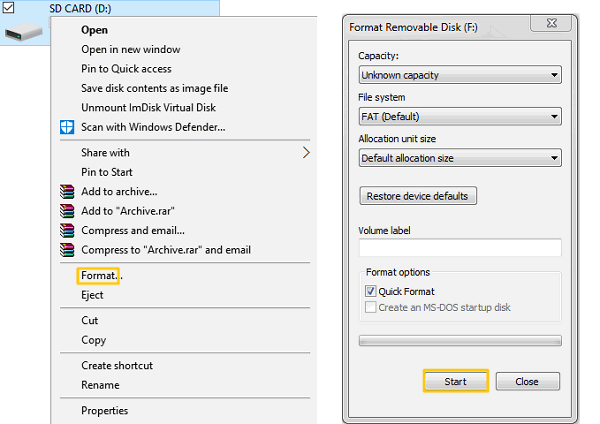
Step 1 Note the drive letter of the SD card in File Explorer, for example E:.
Step 2 Open Command Prompt as administrator.
Step 3 Type chkdsk E: /f and press Enter, replacing E: with your card's letter.
Step 4 Let it finish, then reopen the card. If Windows fixed the table, your folders should be visible again.
If you see the format prompt again after Chkdsk, resist it. Formatting wipes the file table and makes recovery harder. At that point, recovery software is the safer route, and it works on cards that Windows cannot read normally.
Part 4. Method 3: Recover with FoneLab Data Retriever
When files were deleted or the card was formatted, recovery software rebuilds the missing file entries. FoneLab Data Retriever has a dedicated USB/SD Card Recovery mode that scans the card sector by sector and restores photos, videos, documents, archives, and more. If the card lives inside an Android phone, you can also connect the phone and use FoneLab Android Data Recovery; otherwise the card reader path below is the simplest.
FoneLab Data Retriever - recover the lost/deleted data from computer, hard drive, flash drive, memory card, digital camera and more.
- Recover photos, videos, documents and more data with ease.
- Preview data before recovery.
Step 1 Put the memory card or SD card into a card reader connected to your computer, then launch FoneLab Data Retriever.
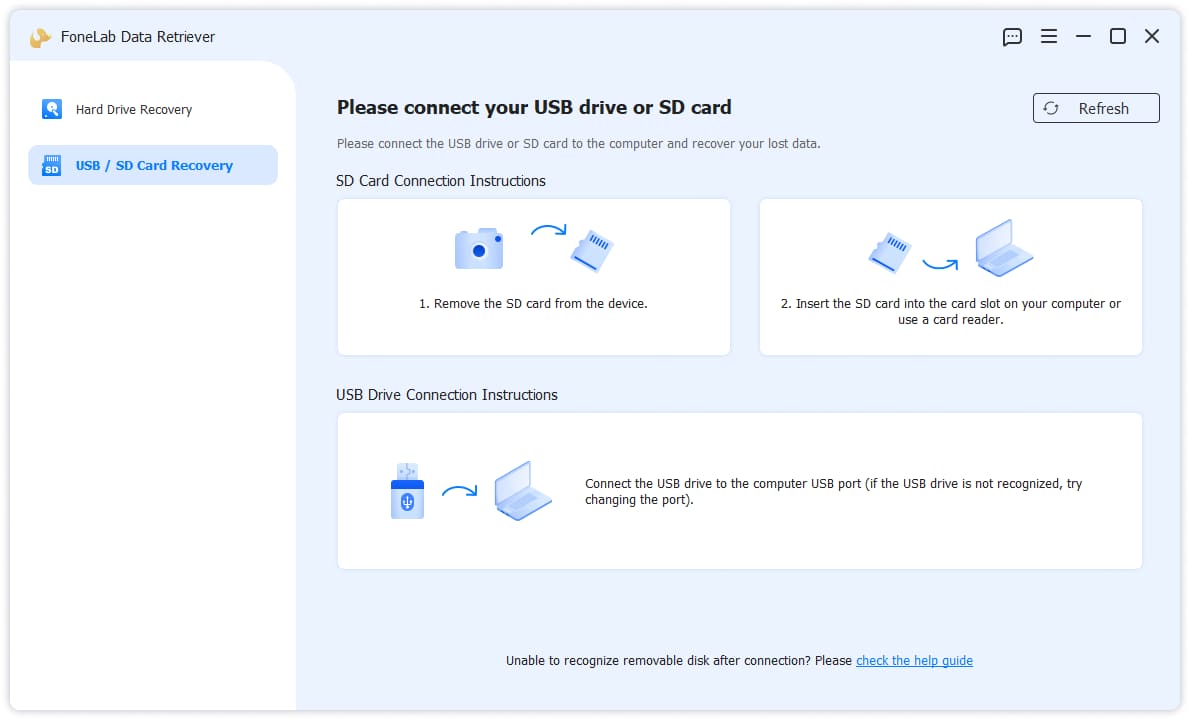
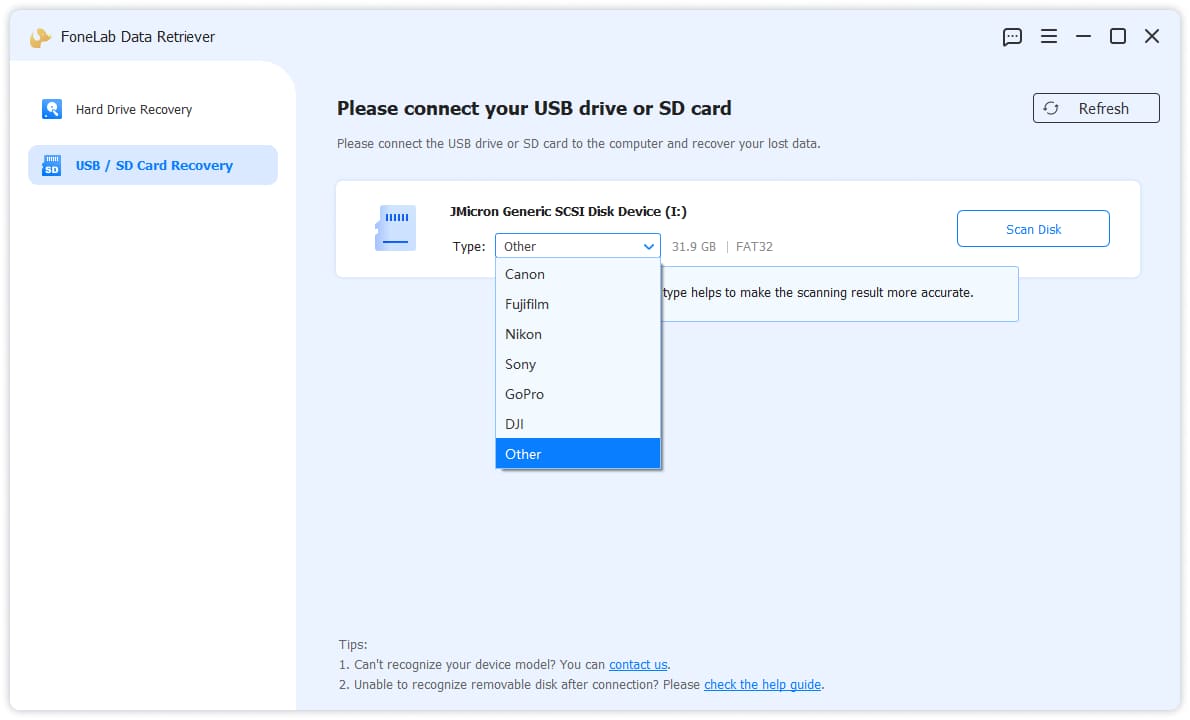
Step 2 On the left side, choose USB / SD Card Recovery, and let the program detect the inserted card.
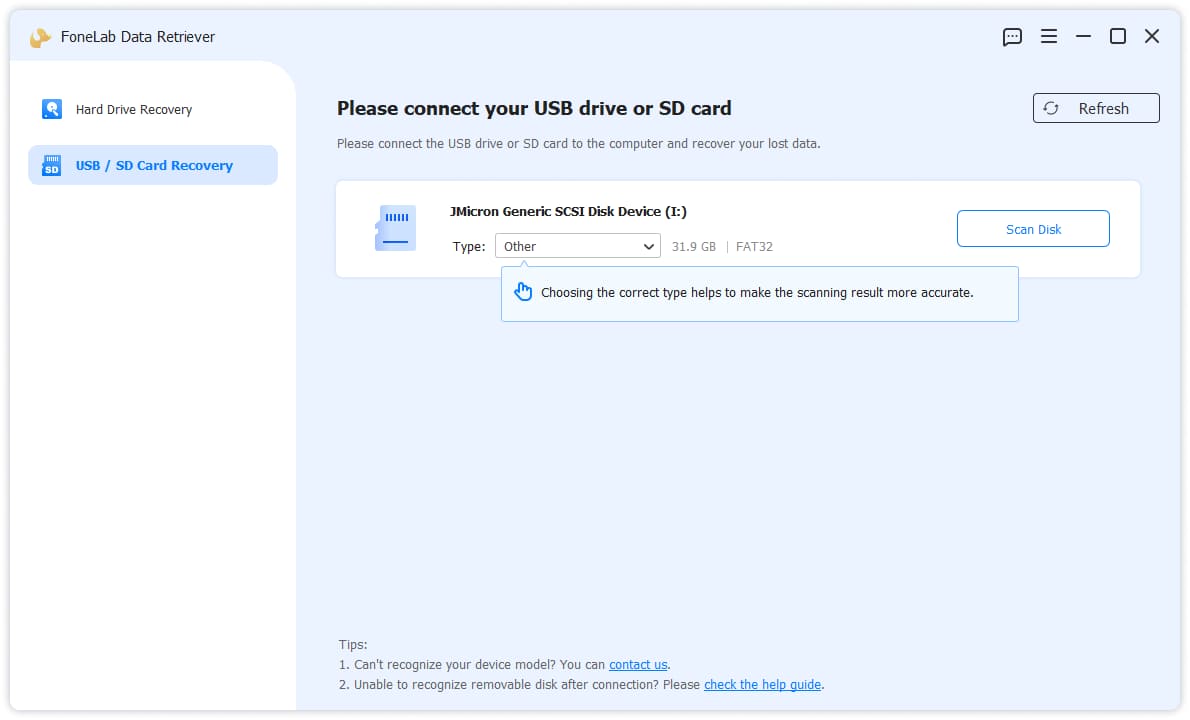
Step 3 Click Scan Disk, and choose the file type from the drop-down list so the scan targets the right kind of data. The software will then automatically run a deep scan to search for every recoverable file on the card, with no separate button to press.
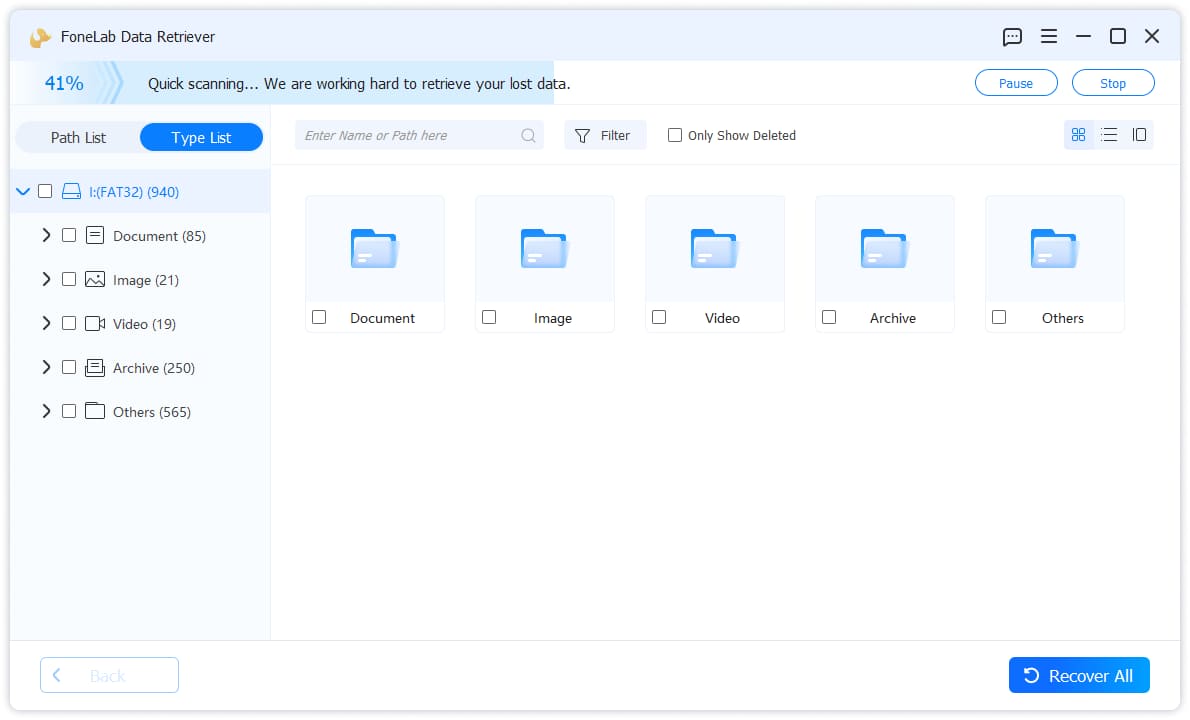
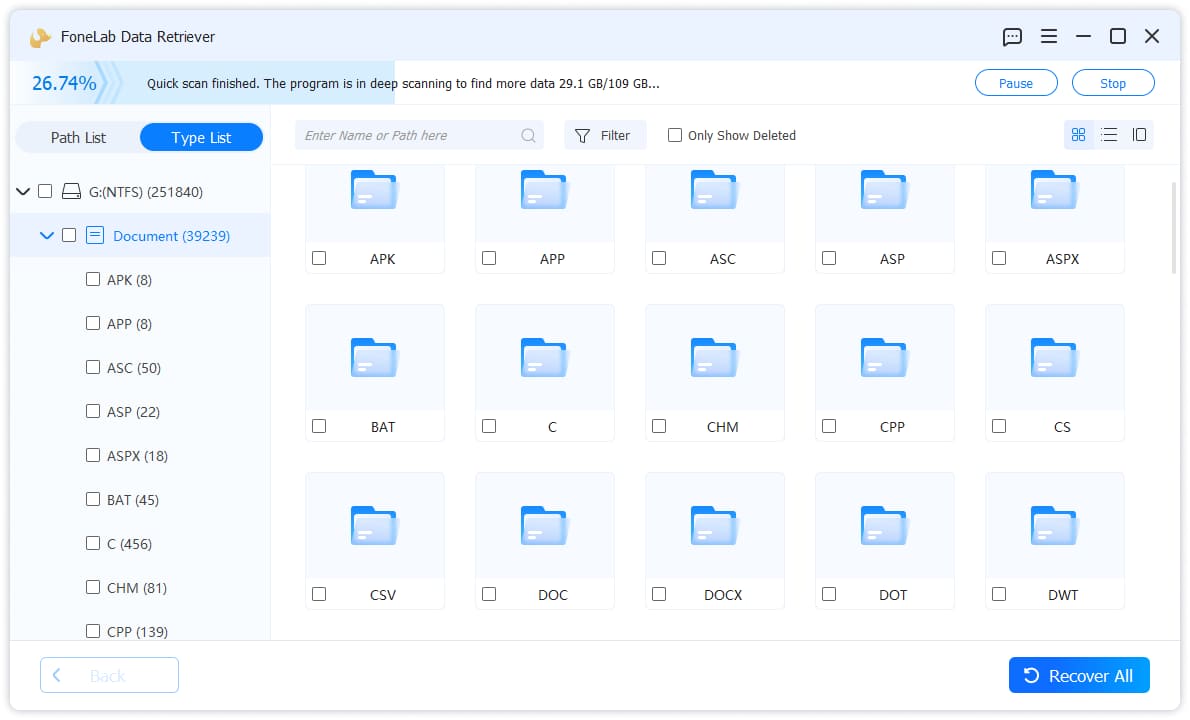
Step 4 When the scan finishes, click a file type and tick the boxes of the files you want. Use the filter or only show deleted option to locate them faster, and preview each file to confirm it opens.
Step 5 Click the blue Recover button in the bottom-right corner and save the recovered files to your computer's internal drive, never back onto the memory card.
Honest limits: this recovers data the card once held. It cannot rescue files that were overwritten by later use, and a card that is physically dead or not detected at all may need a clean-room repair. If your card is read by the computer at all, this tool has a strong chance.
During the scan, leave the card connected and do not let the computer sleep. A quick scan usually finishes in a couple of minutes, but the deep scan on a nearly full 128GB card can take close to an hour. When the results appear, you can switch between a path view and a type view: the path view mirrors your original folders, while the type view groups every JPG, MP4, and document together, which is handy when you do not remember where a file lived. The preview window is the fastest way to confirm a recovered photo or clip is not corrupted before you commit to saving it.
| Recycle Bin / Driver | Chkdsk | FoneLab Data Retriever | |
|---|---|---|---|
| Best for | Card not detected | Corrupted table | Deleted/formatted files |
| Cost | Free | Free | Free trial, paid license |
| Recovers deleted files | No | No | Yes |
| Works after format | No | Sometimes | Yes (automatic deep scan) |
Which method should you try first? Work through the free options in order: check the Recycle Bin or Trash and any backup, because restoring from a working backup is instant and risk-free. Reach for FoneLab Data Retriever when those come up empty, or when the drive was formatted, corrupted, or reinstalled. The comparison table above makes the trade-offs clear: backups are the safest option but require foresight, while the recovery tool works without a backup but cannot repair a physically failing drive.
If your recovery still fails, do not panic and do not keep writing to the disk. First confirm the drive is still readable in Disk Management on Windows or Disk Utility on Mac. If the drive is not detected at all, try a different cable, a different USB port, or plugging it into another computer. If files are found but will not open, they were likely partially overwritten, and a professional data recovery lab that works at the sector level may be your last resort. The earlier you stop using the disk, the more likely a normal software recovery succeeds.
If the card shows up as RAW or asks you to format it, do not format yet. That error usually means the file system table is damaged, not that the photos are gone. Run the deep scan first, and only format once your images are safely recovered, because formatting followed by immediate scanning can still succeed but writing new files in between cannot.
FoneLab Data Retriever - recover the lost/deleted data from computer, hard drive, flash drive, memory card, digital camera and more.
- Recover photos, videos, documents and more data with ease.
- Preview data before recovery.
Part 5. Avoid SD Card Data Loss
- Never format without a backup. Copy everything off first.
- Eject properly. Use the system "eject" before pulling the card.
- Buy reputable cards. Counterfeit microSD cards are a leading cause of sudden loss.
- Back up often. Mirror the card to a PC or cloud after important shoots.
- Replace old cards. If a card is years old, retire it before it fails on a shoot.
For photographers and videographers, the single best habit is to clear the card immediately after you have offloaded and verified the files on your computer. Reusing the same card across multiple cameras without formatting in-camera is a common cause of file-system mismatches. If a scan does recover your footage, save it to a computer or external drive first, then reformat the card inside the camera rather than on Windows, because in-camera formatting sets up exactly the file structure the camera expects. Treat a card that has failed once as a warning: keep it for low-value test shoots, not for events you cannot reshoot.
Part 6. Frequently Asked Questions
Can I recover files from a formatted SD card?
Yes. A normal format resets the file table rather than erasing the raw data. FoneLab Data Retriever runs an automatic deep scan after you click Scan Disk, so it usually restores the files, as long as you have not written new data to the card since formatting.
Why did my SD card delete everything by itself?
Usually this is file system corruption from a bad ejection or a low-quality card, not a deliberate deletion. Chkdsk or a recovery scan restores the files; afterward, back them up and consider replacing the card.
How long does an SD card recovery take?
A quick scan takes minutes. A deep scan on a 64GB or larger card can take 15 minutes to over an hour depending on health and speed. Let it finish rather than interrupting.
Can I recover files from an SD card that shows as RAW?
Yes. After you click Scan Disk, FoneLab Data Retriever runs an automatic deep scan that digs through the raw card. The RAW status means Windows cannot read the table, but the underlying data is often still there. Recover first, then format the card to make it usable again.
Losing SD card files is common and usually fixable. Rule out the reader and driver, repair the card with Chkdsk before formatting, and use FoneLab Data Retriever for deleted or formatted files. For more, see recovering deleted files from an SD card or formatted SD card recovery.
FoneLab Data Retriever - recover the lost/deleted data from computer, hard drive, flash drive, memory card, digital camera and more.
- Recover photos, videos, documents and more data with ease.
- Preview data before recovery.