
 iPhone Data Recovery
 iOS System Recovery
 iOS Data Backup & Restore
 iOS Unlocker
 iPhone Password Manager
 Location Changer
 Android Data Recovery
 Broken Android Data Extraction
 Android Data Backup & Restore
 Android Unlocker
 FoneTrans for iOS
 iPhone Data Eraser
 iPhone Cleaner
 HEIC Converter
 HyperTrans
 WhatsApp Transfer for iOS
 Mac Sweep
 Data Retriever
 Mac Data Retriever
 Video Converter Ultimate
 Screen Recorder
 Phone Mirror
- Part 1. The Science of Formatting: Why Your Data is Still on the SD Card
- Part 2. The Best Formatted SD Card Recovery Software: FoneLab Data Retriever
- Part 3. Step-by-Step Guide: How to Recover Your Formatted SD Card Safely
- Part 4. Device-Specific Recovery: Drones, GoPros, and Smartphones
- Part 5. FAQs about Recovering Formatted SD Card
 Recover PC Data Now
Recover the lost/deleted data from computer, hard drive, flash drive, memory card, digital camera and more.
Recover Formatted SD Card with a Powerful Technique
 Updated by
 Have you faced a situation where you need to learn how to recover formatted SD card? It happens more often than you might think, and it's completely understandable to feel alarmed. After all, one accidental click and you can lose all your precious photos, videos, or important documents. But even so, it’s critical not to let panic overwhelm you. Instead, remember the golden rule of recovery, which is to cease using the SD card immediately after formatting.
The good news is that formatting doesn’t mean permanent deletion. In most cases, your files are still there, just hidden from view, so data recovery is still possible. However, any new data written to it can overwrite your lost files, making recovery much harder. Thus, keep this rule in mind while finding and applying the appropriate solution. Don’t worry, though. We have already prepared the information and method you need below to ensure a smooth recovery process.

Guide List
- Part 1. The Science of Formatting: Why Your Data is Still on the SD Card
- Part 2. The Best Formatted SD Card Recovery Software: FoneLab Data Retriever
- Part 3. Step-by-Step Guide: How to Recover Your Formatted SD Card Safely
- Part 4. Device-Specific Recovery: Drones, GoPros, and Smartphones
- Part 5. FAQs about Recovering Formatted SD Card
Part 1. The Science of Formatting: Why Your Data is Still on the SD Card
To understand how you can recover formatted SD card, you first need to know what formatting actually does to the card. Many people assume it erases everything permanently, but in reality, formatting simply resets the card's file system so your device can write new data to it. Your files, including images, audio, documents, and more, will remain stored on the memory chips until they get overwritten. That’s why you can still restore your data with the right method.
Quick Format vs. Full Format Explained
Additionally, it helps to know that not all formatting is the same. A quick format only removes the file system's index, which keeps the files intact, making data recovery more straightforward. On the other hand, a full format scans the SD card’s bad sectors, completely wiping all your data. In this case, recovery can be more complicated, so using a powerful recovery solution is important. That said, knowing which type of formatting you performed on the SD card will help set expectations for your recovery process.
The Critical Mistake: Why You Must Stop Using the Card Right Now
As mentioned, the golden rule is to stop using the SD card immediately, as ignoring this rule can cost you all your files. If you continue using the formatted card—taking new photos, saving files, or even just plugging it into a different device—you will likely overwrite the old files, making them unrecoverable. So, we suggest putting it aside for now until you’re ready for the recovery process.
Part 2. The Best Formatted SD Card Recovery Software: FoneLab Data Retriever
Now that you understand how a formatted SD card recovery works and the golden rule, the next step is choosing the right tool. The good news is that you no longer have to spend time searching for and evaluating various programs, as FoneLab Data Retriever comes highly recommended. It is a user-friendly solution designed to handle formatted SD cards with ease, supporting a wide range of file types, from photos and audio to documents and emails.
Moreover, FoneLab Data Retriever doesn’t only focus on SD card data recovery. It is designed to handle various storage devices, including internal hard drives and other external drives. The program’s advanced features will also be helpful. For instance, its preview function allows you to ensure you’re recovering the right file, and the advanced search and filter help locate specific files more quickly. Moreover, it offers Deep Scan for thorough recovery.
Part 3. Step-by-Step Guide: How to Recover Your Formatted SD Card Safely
FoneLab Data Retriever - recover the lost/deleted data from computer, hard drive, flash drive, memory card, digital camera and more.
- Recover photos, videos, documents and more data with ease.
- Preview data before recovery.
Although FoneLab Data Retriever is a professional-grade tool, you don’t have to be intimidated by its process, as it is designed to be beginner-friendly. It doesn’t require technical knowledge, so as long as you perform the straightforward steps, you will be able to bring your SD card files back safely. That said, see the instructions below to learn how to recover formatted SD card using FoneLab Data Retriever:
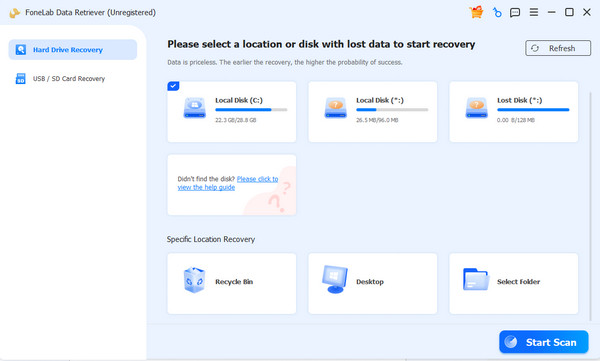
Step 1Start by clicking the Free Download button to acquire a copy of FoneLab Data Retriever’s file. Once it’s downloaded to your Downloads folder, use it for the installation of the program, then launch it on your desktop. Ensure your SD card is linked to the computer using a card reader so that the storage will appear on the interface. Choose it from there, then tick Start Scan.
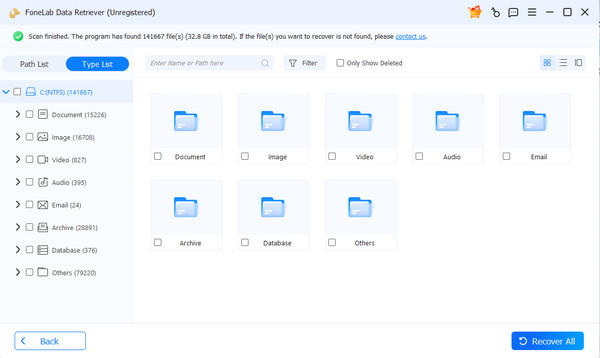
Step 2After the scanning process, the data type folders containing your formatted SD card's deleted files will appear on the screen. Access each to find all the data you hope to recover. You can select them by checking their boxes, and once you're satisfied, click Recover All. The tool will then shortly restore your files.
Part 4. Device-Specific Recovery: Drones, GoPros, and Smartphones
Meanwhile, not all devices handle data the same way, and each one may offer its own built-in recovery option. For instance, smartphones have a Recycle Bin or Trash folder that lets you view recently deleted files, giving you a chance to recover them. However, note that this option is only available for a limited time—typically 30 days—for each file. Once the designated time passes, your deleted files will be permanently removed.
On the other hand, Drones and GoPros don't usually have Recycle Bins or Trash folders. Instead, they use proprietary file systems that require specific recovery methods. Some drone models have a built-in repair feature that can fix corrupted video files. GoPro users can try using the camera's built-in recovery function, which attempts to salvage incomplete or damaged recordings. However, if these built-in methods don't work or aren't available, you can eject the SD cards and use FoneLab Data Retriever via a computer instead.
Part 5. FAQs about Recovering Formatted SD Card
Can I recover my files from my SD card used in a smartphone?
Yes, you can. If you check your phone's recycle bin or recently deleted folder and don’t find your files saved in SD card, it’s possible to eject it from the device and connect it to the computer instead. This way, you can use FoneLab Data Retriever for data recovery.
Can I recover my files from a corrupted SD card?
Yes, you can. In many cases, corruption only affects the file system and not the files themselves. So, recovery tools can bypass the corruption and extract your data.
Formatting an SD card doesn't have to mean permanently losing your precious files. By remembering the golden rule and acting quickly to follow the right recovery approach, you’ll have the best chance to get your data back safely and successfully.