
 iPhone Data Recovery
 iOS System Recovery
 iOS Data Backup & Restore
 iOS Unlocker
 iPhone Password Manager
 Location Changer
 Android Data Recovery
 Broken Android Data Extraction
 Android Data Backup & Restore
 Android Unlocker
 FoneTrans for iOS
 iPhone Data Eraser
 iPhone Cleaner
 HEIC Converter
 HyperTrans
 WhatsApp Transfer for iOS
 Mac Sweep
 Data Retriever
 Mac Data Retriever
 Video Converter Ultimate
 Screen Recorder
 Phone Mirror
 Recover PC Data Now
Recover the lost/deleted data from computer, hard drive, flash drive, memory card, digital camera and more.
[4 Ways] How to Recover a Lost Email Account
 Updated by Valyn Hua / October 10, 2026 10:00
You type your email and the password, and nothing works. Or the account still exists but half the inbox has vanished. Losing access to an email account is stressful because that address is usually the key to everything else — social media, banking, and password resets all flow through it.
I want to be straight with you about what is and is not recoverable, because a lot of the advice online is misleading. A recovery tool on your computer cannot reset your password or pull mail off the provider's server. That part only the provider's own account-recovery flow can do. What a disk recovery tool can do is bring back the local copies of your emails — the PST, EML, and OLM files that Outlook and other mail apps store on your machine.
So we split this into two jobs. First, get back into the account through the official provider route. Second, if the emails themselves were deleted or the local mail files are gone, recover those from disk. I walk through both below, starting with the free built-in options before touching any software.


Guide List
Part 1. Reset the Password with Your Email Provider
If you are locked out, the only real fix is the provider's official sign-in recovery. Do not trust random "account unlock" websites — most are phishing. Go straight to the official sign-in page for Gmail, Outlook/Hotmail, Yahoo, or your hosting provider.
Walk the official account recovery
Step 1On the sign-in screen, click Forgot password or Need help, then enter your email address.
Step 2Choose a verification method the provider can reach — a recovery phone number, an alternate email, or a 2FA code. Have that device or mailbox open before you start.
Step 3Enter the code, then set a new password. Store it in a password manager rather than reusing an old one.
If you no longer control the recovery phone number or alternate email, you will have to answer the account-recovery questions as accurately as possible — when the account was created, frequent contacts, old passwords. The more correct details you give, the more likely the provider restores access. This is a same-day process; keep trying the supported verification channels rather than opening unknown third-party "hacker" tools.
Part 2. Restore Deleted Messages from Webmail Trash
If you can still sign in but the inbox looks empty, the messages are usually one folder away. Most webmail providers keep deleted mail in a Trash or Deleted Items folder for days, and some can even restore mail that was removed from the trash.
Restore from the trash folder
Step 1Open your provider's webmail and click Trash or Deleted Items in the left folder list.

Step 2Search or scroll for the messages, select them, and use Move > Inbox or Restore.
Step 3If the trash is empty, look for a Recover Deleted Items option. Outlook and Yahoo both keep a deeper recovery layer for around 7–30 days.

This webmail restore works only on the provider's server, and only within the retention window. Once that window passes, the messages are gone from the server side — which is exactly when you check whether a local copy exists on your own computer, which is what Part 3 is for.
Part 3. Recover Local Email Files with FoneLab Data Retriever
Here is the honest limit again: FoneLab Data Retriever cannot reset your password or log into your account, and it cannot reach mail on the provider's server. What it does is scan your own Windows or Mac disk for the local email files that Outlook, Apple Mail, and other clients store — PST, EML, and OLM files — and bring back ones that were deleted. It runs on Windows and Mac, and after you choose the drive and start, it performs an automatic deep scan with no separate Deep Scan button to hunt for.
FoneLab Data Retriever - recover the lost/deleted data from computer, hard drive, flash drive, memory card, digital camera and more.
- Recover photos, videos, documents and more data with ease.
- Preview data before recovery.
Scan for PST / EML / OLM files
Step 1Launch FoneLab Data Retriever, tick Email under file types, and pick the drive where your mail client stores its data.
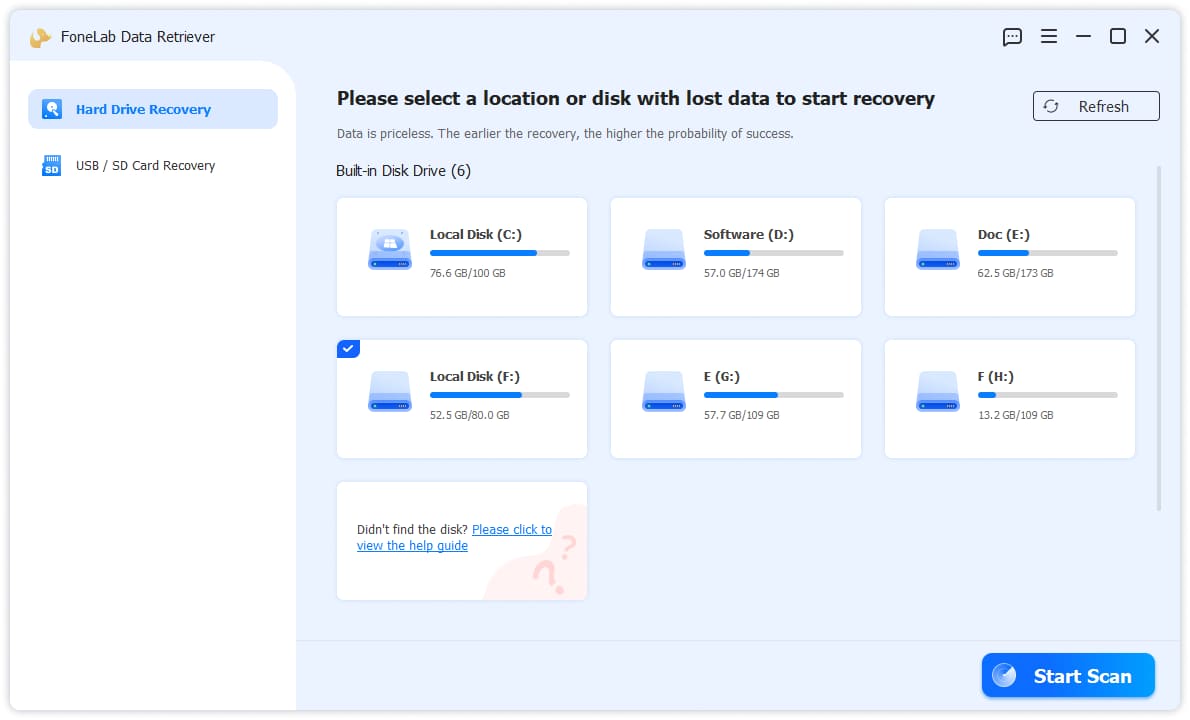
Step 2Click Start Scan. It runs an automatic deep scan and groups recoverable files by type.
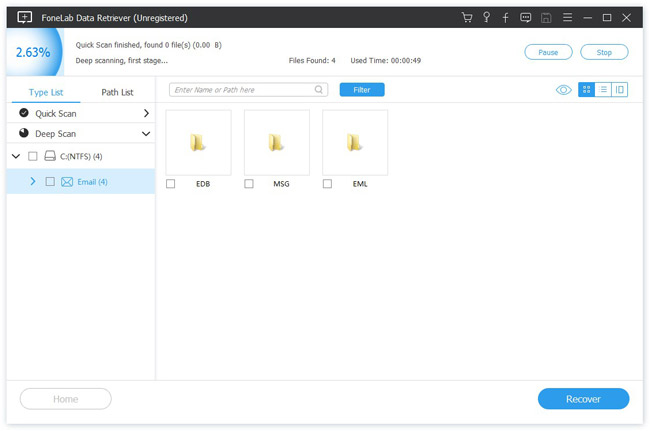
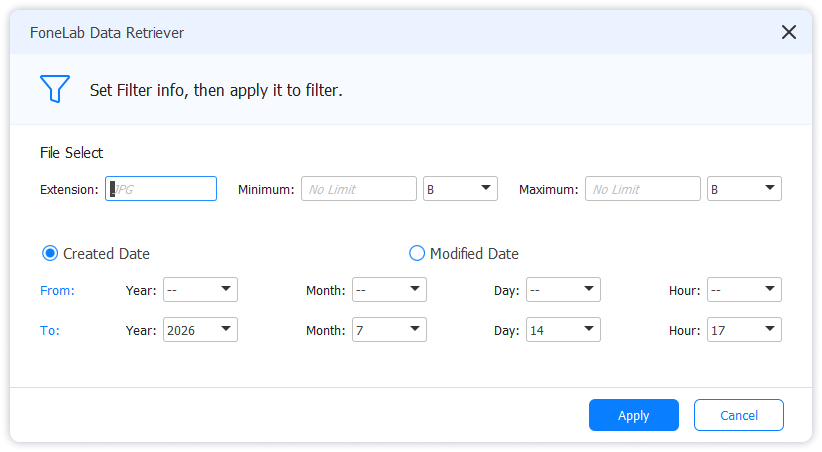
Step 3Open the Email category, look for .pst, .eml, or .olm, and use Filter by date. Preview to confirm the mailbox is the right one.
Step 4Tick the mail files you want and click Recover, saving them to a different drive.
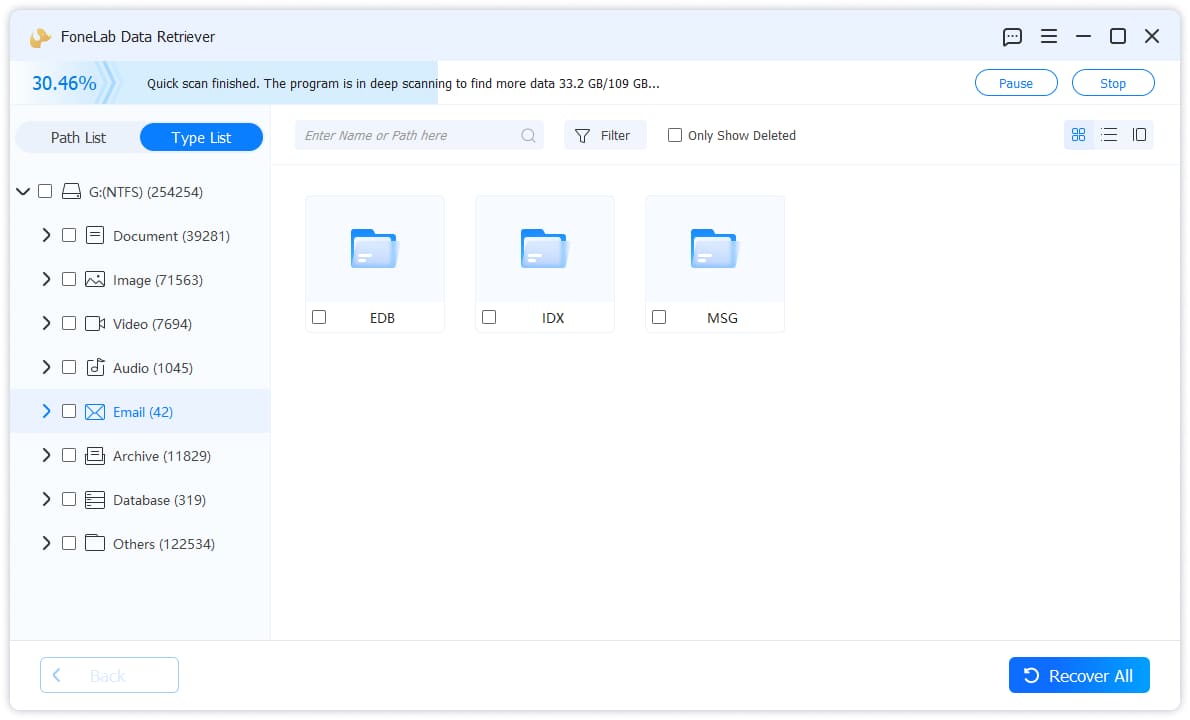
Once the local PST or OLM file is back, you can open it in Outlook or Apple Mail and read the messages offline. For a web-only account with no local file, this step will not find anything, which is why the provider-side restore in Parts 1 and 2 comes first. For coverage on other lost file types, the same tool handles photos and documents described in our guides to recovering images from a hard drive and recovering deleted Word documents.
FoneLab Data Retriever - recover the lost/deleted data from computer, hard drive, flash drive, memory card, digital camera and more.
- Recover photos, videos, documents and more data with ease.
- Preview data before recovery.
Part 4. Quick Comparison of the Methods
| Method | Free? | Restores Access | Brings Back Local Mail Files | Best For |
|---|---|---|---|---|
| Provider password reset | Yes | Yes | No | Locked out, forgot password |
| Webmail trash restore | Yes | Already signed in | No (server-side) | Deleted within retention window |
| FoneLab Data Retriever | Free to preview | No | Yes (PST/EML/OLM) | Deleted local mail files, no backup |
Part 5. Tips to Protect Your Email
- Turn on two-step verification so a stolen password alone cannot lock you out.
- Keep the recovery phone number and alternate email current — an outdated recovery channel is the #1 reason resets fail.
- Never enter your password on a site that did not come from the official sign-in page; phishing clones are how accounts get taken over.
- If you use Outlook or Apple Mail, back up the PST/OLM file periodically so a local copy always exists.
- After recovering, check the forwarding rules and auto-reply, because a hijacked account often quietly forwards your mail out.
- Use a password manager so you are never one "forgot password" moment away from a lockout again.
Part 6. Frequently Asked Questions
Can data recovery software get my account password back?
No. A disk tool reads files on your own computer; it cannot touch the provider's login system. Reset the password only through the official account-recovery flow for Gmail, Outlook, Yahoo, or your host.
What email files can FoneLab Data Retriever recover?
It scans for local mail files such as Outlook PST and EML, and Mac OLM. It recovers files already saved on the disk, not live messages on the webmail server.
How long does webmail keep deleted messages?
Usually around 7–30 days in the trash, and some providers offer a deeper "recover deleted items" layer after that. Once that window closes, server-side restore is no longer possible.
Does it work on Mac?
Yes. FoneLab Data Retriever has a Mac build that scans internal and external drives and recovers OLM and EML mail files with an automatic deep scan.
To wrap up: a lost email account has two halves. Recover access through the official provider password reset, and restore missing messages from the webmail trash within the retention window. If the local mail files themselves were deleted, FoneLab Data Retriever scans your Windows or Mac disk for PST, EML, and OLM files and previews them before recovery — but it is not a password tool, and it never will be.
Once you are back in, spend ten minutes on two-step verification and a current recovery phone number. Most locked-out accounts are not a hack but an out-of-date recovery channel, so fixing that now means the next emergency is a two-click reset instead of a scramble.
What to do when the provider recovery fails
Sometimes the password reset stalls because you no longer have the recovery phone or alternate email. In that case, work through the provider's account-recovery questions slowly and honestly: when you created the account, frequent contacts, old passwords you have used, and recent subjects. Guessing wildly hurts more than admitting what you are unsure of. Open the reset from a browser and device you have used to sign in before, because a familiar location and device helps the provider trust the request.
If the account was taken over rather than forgotten, check the side effects before anything else: a forwarding rule that sends your mail out, an unfamiliar auto-reply, and a changed recovery phone. Remove those, then change the password. Otherwise you win the account back and the attacker quietly takes it again the same day.
Where local email files actually live
On Windows, Outlook keeps mail in a .pst file; on Mac, Apple Mail and Outlook for Mac use .olm and .eml. These are the files a disk scan looks for. If you only ever read mail in a browser tab, those files may never have existed, and the provider-side restore is your only route. Knowing that up front saves you from running a scan that cannot possibly find anything.
A final practical note: once you are back in, export a backup of your mailbox at least once a year. Most webmail providers let you download an archive, and keeping that archive on an external drive means the next lockout is a nuisance rather than a crisis.
FoneLab Data Retriever - recover the lost/deleted data from computer, hard drive, flash drive, memory card, digital camera and more.
- Recover photos, videos, documents and more data with ease.
- Preview data before recovery.
Recovering the account versus the mailbox
It helps to separate two things people lump together as "recovering the account." Access recovery is about proving you own the login, and only the provider can do that. Mail recovery is about the messages themselves, which live either on the provider's servers or in local files on your computer. A disk tool only touches the second half. Keep that split in mind and you will not waste hours on software that was never going to reset your password.
If you use two-step verification, make sure at least one backup method still works before you need it. A lot of lockouts happen because someone got a new phone and never updated the number on file. Ten minutes checking your recovery settings today can save you days of account recovery later.
Remember that a healthy account depends on habits you build now. Keep a recovery phone that still works, a backup email you check, and a password written down somewhere safe. Most locked accounts are not a hack but an outdated recovery channel, so ten minutes of setup today removes the whole class of problem.