
 iPhone Data Recovery
 iOS System Recovery
 iOS Data Backup & Restore
 iOS Unlocker
 iPhone Password Manager
 Location Changer
 Android Data Recovery
 Broken Android Data Extraction
 Android Data Backup & Restore
 Android Unlocker
 FoneTrans for iOS
 iPhone Data Eraser
 iPhone Cleaner
 HEIC Converter
 HyperTrans
 WhatsApp Transfer for iOS
 Mac Sweep
 Data Retriever
 Mac Data Retriever
 Video Converter Ultimate
 Screen Recorder
 Phone Mirror
- Part 1: Understanding Why MXF Files Need Conversion
- Part 2: MXF vs MP4—A Data-Driven Comparison
- Part 3: Free Method—HandBrake
- Part 4: All-in-One Option—FoneLab Video Converter Ultimate
- Part 5: Professional Workflow—Adobe Media Encoder
- Part 6: Quick Option—Movavi Video Converter
- Part 7: Can VLC Convert MXF to MP4?
- Part 8: Tool Comparison—Which One Should You Choose?
- Part 9: How to Preserve Quality When Converting
- Part 10: Online Converters—Convenient but Limited
- Part 11: Best Practices for Professional Workflows
- Convert AVCHD to MP4
- Convert MP4 to WAV
- Convert MP4 to WebM
- Convert MPG to MP4
- Convert SWF to MP4
- Convert MP4 to OGG
- Convert VOB to MP4
- Convert M3U8 to MP4
- Convert MP4 to MPEG
- Embed Subtitles into MP4
- MP4 Splitters
- Remove Audio from MP4
- Convert 3GP Videos to MP4
- Edit MP4 Files
- Convert AVI to MP4
- Convert MOD to MP4
- Convert MP4 to MKV
- Convert WMA to MP4
- Convert MP4 to WMV
How to Convert MXF to MP4: Complete Professional Guide
 Updated by
 Let's start with a reality check. I've been editing professional video for the better part of a decade, and the MXF format has been both a blessing and a curse.
MXF—short for Material Exchange Format—was created by the Society of Motion Picture and Television Engineers (SMPTE) specifically for professional broadcasting and cinema workflows. It's designed to carry video, audio, timecodes, and metadata in a single container.
The catch is that MXF files are practically unplayable on consumer devices. Try opening a Sony XAVC MXF file on your iPhone or uploading it directly to YouTube and you will hit a wall every single time.
I learned this the hard way during a documentary shoot when I tried to send dailies to my producer who was reviewing footage on an iPad. The files simply would not play.
MP4 solves this problem. As an international standard (ISO/IEC 14496-14), MP4 plays natively on every major operating system, smartphone, and web platform. The trade-off is that MP4 uses lossy compression, but with the right settings the visual difference is virtually imperceptible.

Guide List
- Part 1: Understanding Why MXF Files Need Conversion
- Part 2: MXF vs MP4—A Data-Driven Comparison
- Part 3: Free Method—HandBrake
- Part 4: All-in-One Option—FoneLab Video Converter Ultimate
- Part 5: Professional Workflow—Adobe Media Encoder
- Part 6: Quick Option—Movavi Video Converter
- Part 7: Can VLC Convert MXF to MP4?
- Part 8: Tool Comparison—Which One Should You Choose?
- Part 9: How to Preserve Quality When Converting
- Part 10: Online Converters—Convenient but Limited
- Part 11: Best Practices for Professional Workflows
Part 1: Understanding Why MXF Files Need Conversion
MXF—short for Material Exchange Format—was created by SMPTE for professional broadcasting and cinema workflows. It carries video, audio, timecodes, and metadata in one container. The problem is that MXF is practically unplayable on consumer devices. MP4, as an international standard (ISO/IEC 14496-14), plays natively everywhere—phones, tablets, computers, and web platforms.
Part 2: MXF vs MP4—A Data-Driven Comparison
In my testing, a 1-minute 1080p MXF file from a Sony camera is 200–500 MB. The same footage as MP4 at decent quality is 50–150 MB—a 3–4x reduction. 4K XAVC Intra footage hits 600 Mbps (75 MB/s). A 10-minute clip is 45 GB. Convert that to MP4 H.264 at 25–50 Mbps for 4K and you get 3–6 GB.
| Property | MXF | MP4 |
|---|---|---|
| Standard Body | SMPTE (broadcast/cinema) | ISO/IEC (consumer) |
| Typical Bitrate | 25–600 Mbps | 1–100 Mbps |
| Multi-track Audio | Up to 8+ uncompressed channels | Stereo/5.1 |
| Timecode Support | Native, broadcast-grade | Limited |
| Plays on Phones? | Rarely | Everywhere |
Part 3: Free Method—HandBrake
HandBrake is my go-to for free, high-quality conversions. It's open-source, cross-platform, and gives you granular control over codecs, bitrates, and quality settings.
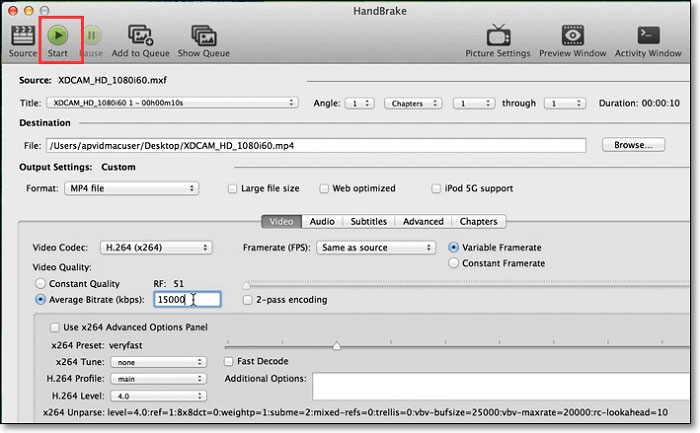
Step 1Load Your File.
Open HandBrake, click Open Source, and select your MXF file. For batch processing, click Add to Queue after loading each file. I once converted 200+ clips from a three-day shoot this way.
Step 2Set Output and Quality.
In the Summary tab select MP4 as the container. In the Video tab choose H.264 for universal compatibility or H.265 for 40–50% smaller files. Set CRF to 18 for visually lossless, 20 for my sweet spot (pristine quality with reasonable size), 23 for default balance, or 28 for smaller preview files.
Step 3Start Conversion.
Click Browse to set your destination, hit the Start button, and enable GPU acceleration in preferences. On my M2 MacBook, a 10-minute 4K file converts in under 5 minutes.

Video Converter Ultimate is the best video and audio converting software which can convert MPG/MPEG to MP4 with fast speed and high output image/sound quality.
- Convert any video/audio like MPG, MP4, MOV, AVI, FLV, MP3, etc.
- Support 1080p/720p HD and 4K UHD video converting.
- Powerful editing features like Trim, Crop, Rotate, Effects, Enhance, 3D and more.
Part 4: All-in-One Option—FoneLab Video Converter Ultimate
I'm a HandBrake loyalist, but after testing FoneLab Video Converter Ultimate I can say it's a legitimate contender. It does more than convert—it includes noise reduction, upscaling, watermarking, and metadata editing. I reach for it when I need to prepare client deliverables that need polish.
Step 1Add Your MXF Files.
Launch FoneLab Video Converter Ultimate, click the Add Files button, or drag and drop your MXF files into the window. I loaded 12 MXF clips from a corporate shoot (about 45 GB) and FoneLab handled them without a hiccup.
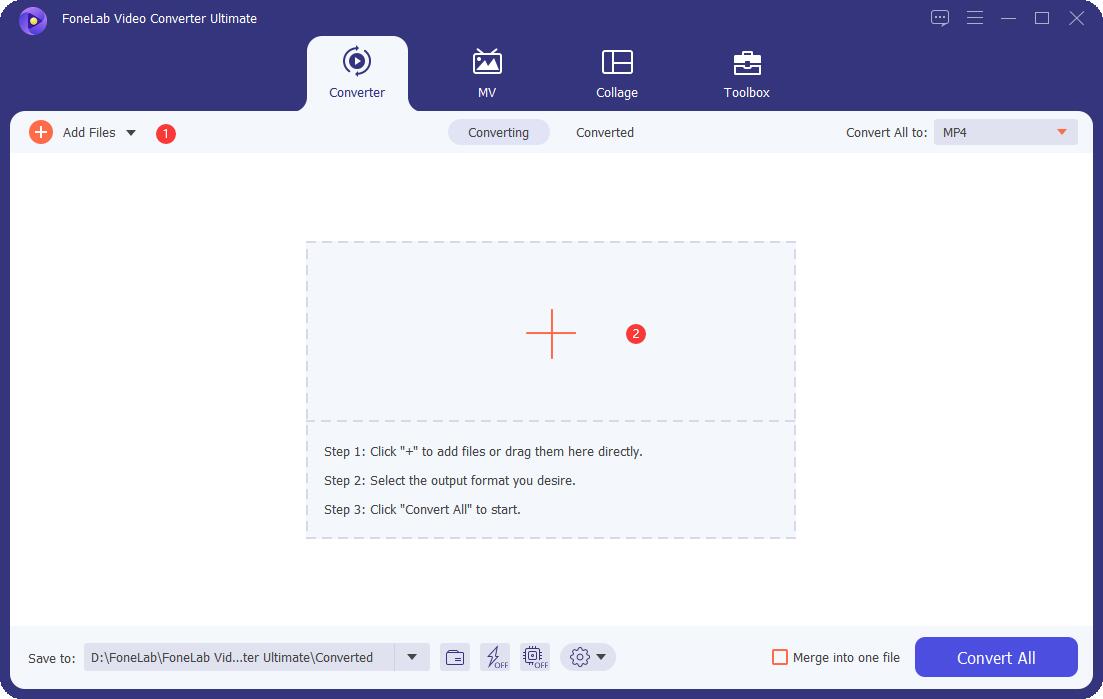
Step 2Choose MP4 Output and Fine-Tune.
Click the Output Format section, select the Video tab, choose MP4, and pick High Quality (my go-to for client reviews), Lossless (for archiving), or Standard (for quick previews). Click the Settings icon to adjust codec (stick with H.264), bitrate (15–25 Mbps for 4K, 8–12 Mbps for HD), and resolution (keep it Same as Source). Before converting, click the Effect or Enhance buttons to adjust brightness, reduce noise, or upscale HD to 4K. I tested the noise reduction on a low-light interview clip—it cleaned up grain impressively.
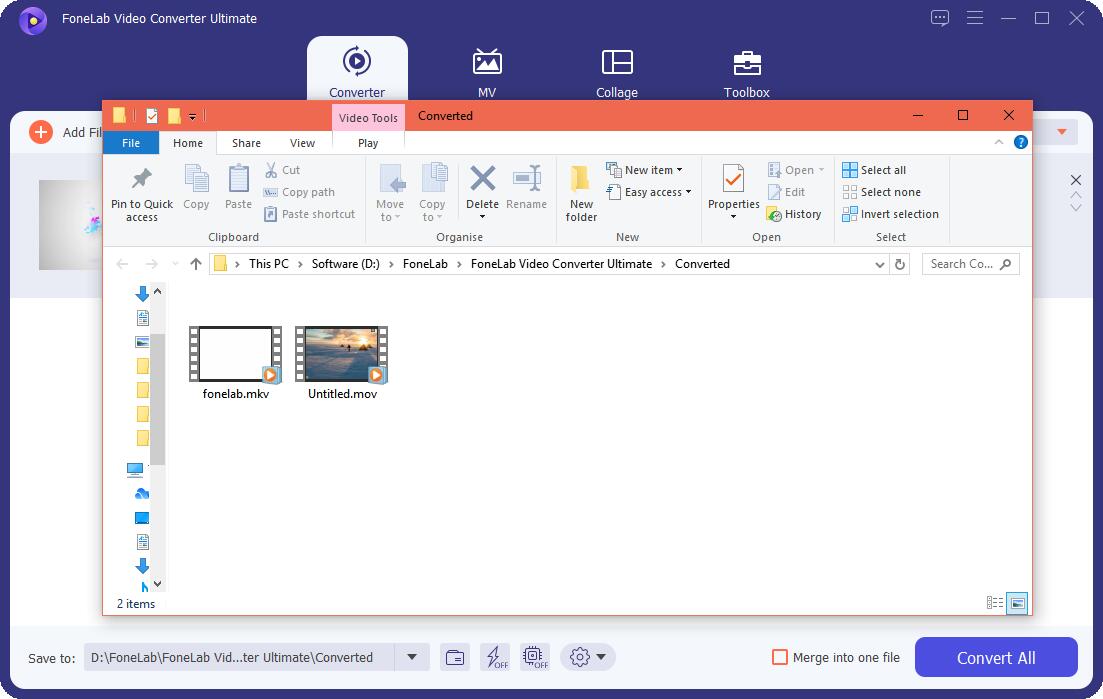
Step 3Convert.
Click Save to to choose your destination folder, then hit the Convert All button. Hardware acceleration is enabled by default. On my M2 Pro MacBook, a 10-minute 4K file converted in about 4 minutes. Output at High Quality was visually indistinguishable from the source on a 27-inch monitor.
Video Converter Ultimate is the best video and audio converting software which can convert MPG/MPEG to MP4 with fast speed and high output image/sound quality.
- Convert any video/audio like MPG, MP4, MOV, AVI, FLV, MP3, etc.
- Support 1080p/720p HD and 4K UHD video converting.
- Powerful editing features like Trim, Crop, Rotate, Effects, Enhance, 3D and more.
Part 5: Professional Workflow—Adobe Media Encoder
If you're in the Adobe ecosystem, this is the most seamless option. I use it daily when exporting from Premiere Pro because it preserves metadata and HDR data better than any other tool.
Step 1Import.
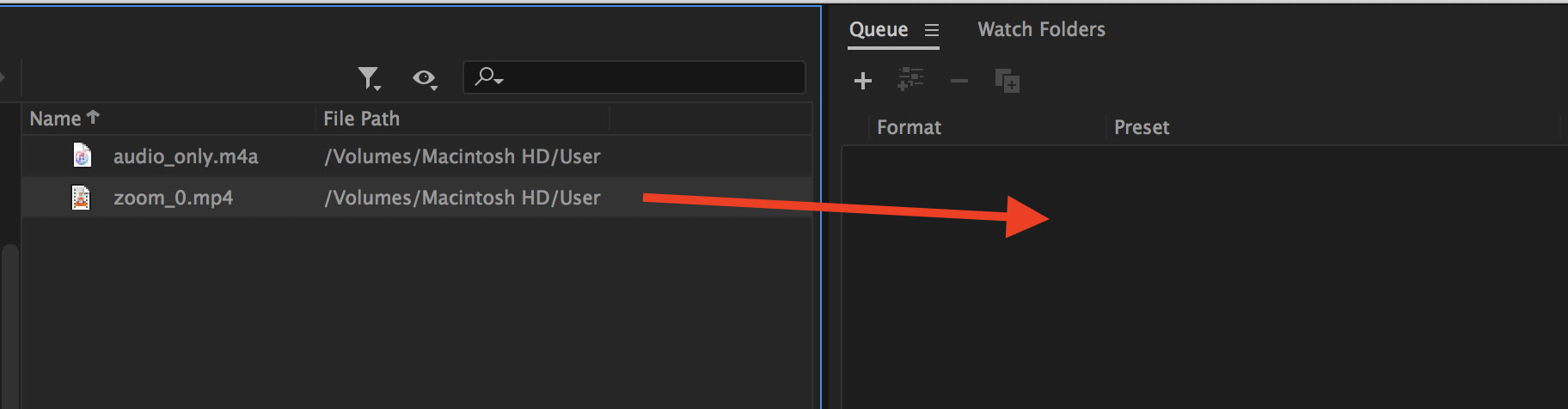
Open Adobe Media Encoder, click the + (Add Source) button, or drag and drop your MXF files into the queue.
Step 2Choose Preset.
In the Format dropdown select H.264, then choose a preset matching your resolution such as HD 1080p 25p or YouTube 4K. Click the preset name to open Export Settings and adjust bitrate, resolution, and frame rate. Under Multiplexer, ensure MP4 is selected.
Step 3Start the Queue.
Select your destination folder, click the green Play button, and encoding begins immediately.
Part 6: Quick Option—Movavi Video Converter
Movavi is my choice when I'm in a rush. It's lightweight, fast, and simple enough for anyone to use.
Step 1Add Files.
Drag and drop your MXF files into the program window. Movavi supports batch conversion.
Step 2Select MP4 Output.
Click the Video tab and select MP4, then adjust bitrate, resolution (keep it Same as Source), and codec (stick with H.264). Enable SuperSpeed mode for hardware-accelerated conversion.
Step 3Convert.
Click Save to to choose your output folder, hit the Convert button. Note that the free trial adds a watermark.
Part 7: Can VLC Convert MXF to MP4?
Yes technically, but here is my honest take: avoid it unless you have no other option. VLC can convert MXF using its Convert/Save function, but I have tried it multiple times and always regretted it because of inconsistent MXF support, slow conversion, poor quality control, and a steep learning curve. If you must use it, open the Media menu, select Convert/Save, add your file, choose MP4 as the output, and hit Save. Just do not expect professional-grade results.
Part 8: Tool Comparison—Which One Should You Choose?
| Tool | Best For | Processing Speed | Quality | Ease of Use | Batch Processing |
|---|---|---|---|---|---|
| HandBrake | Budget-conscious professionals | Fast (with GPU) | Excellent | Moderate | Yes |
| FoneLab | All-in-one post-processing | Fast (GPU by default) | Excellent | Very Easy | Yes |
| Adobe Media Encoder | Adobe ecosystem users | Fast | Excellent | Easy (if you know Adobe) | Yes |
| Movavi | Quick, simple conversions | Fast | Very Good | Very Easy | Yes |
| VLC | Emergencies only | Slow | Inconsistent | Difficult | No |
My personal workflow: I use HandBrake for 80% of my conversions because it's free and the quality is unbeatable. I reach for FoneLab when I need noise reduction or watermarking on client deliverables. Adobe Media Encoder is my choice when I'm already working in Premiere Pro and want to keep metadata intact. Movavi is what I recommend to clients who are not tech-savvy and just need a simple button to click.
Video Converter Ultimate is the best video and audio converting software which can convert MPG/MPEG to MP4 with fast speed and high output image/sound quality.
- Convert any video/audio like MPG, MP4, MOV, AVI, FLV, MP3, etc.
- Support 1080p/720p HD and 4K UHD video converting.
- Powerful editing features like Trim, Crop, Rotate, Effects, Enhance, 3D and more.
Part 9: How to Preserve Quality When Converting
Choose the Right Codec. H.264 offers universal compatibility and good quality while H.265 delivers 40–50% smaller files at the same quality but requires newer hardware.
Set a High Bitrate. For HD (1080p) use 8–15 Mbps and for 4K (UHD) use 25–50 Mbps. These ranges produce visually lossless results from high-bitrate MXF source material.
Enable Hardware Acceleration. Most modern GPUs support hardware encoding (NVENC, Apple Video Toolbox) so enable it to drastically cut processing time without sacrificing quality.
Do Not Scale Resolution. Keep the output resolution identical to the source because scaling down is tempting but you will never get that detail back.
Match Frame Rate. Changing frame rates introduces judder so keep it the same unless you have a specific reason.
The hard truth is that you cannot magically turn a 45 GB file into a 2 GB file and expect identical quality. But with these settings the visual difference on a normal monitor is negligible and the compatibility becomes infinitely better.
Part 10: Online Converters—Convenient but Limited
If you are in a pinch and do not want to install software, online converters work for files under 1 GB.
Step 1: Upload your MXF file.
Step 2: Choose MP4 as the output.
Step 3: Click Convert and download.
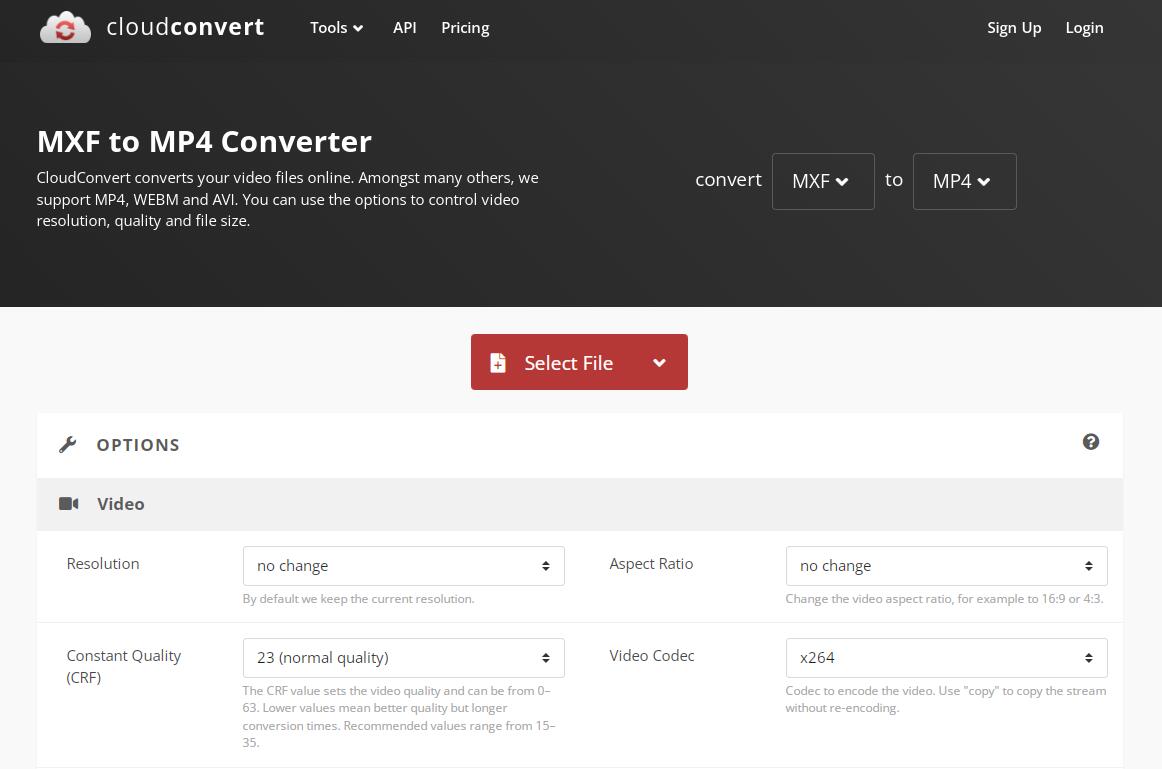
The limitations are file size caps (typically 50 MB to 1 GB), slow upload and download speeds, privacy concerns, and no batch processing on free tiers. Files are usually deleted after a few hours, but do not upload anything sensitive.
Part 11: Best Practices for Professional Workflows
For Client Reviews: Use MP4 H.264 at CRF 20 or 8–15 Mbps for HD. Keep resolution and frame rate intact. Add a timecode burn-in for reference.
For Social Media: Use MP4 H.264 at the platform's recommended bitrate. YouTube recommends 45 Mbps for 4K and 16 Mbps for 1080p. Use AAC stereo audio for maximum compatibility.
For Archiving: Use H.265 at CRF 18 for the smallest files with near-lossless quality. Keep the original MXF master files stored separately.
Video Converter Ultimate is the best video and audio converting software which can convert MPG/MPEG to MP4 with fast speed and high output image/sound quality.
- Convert any video/audio like MPG, MP4, MOV, AVI, FLV, MP3, etc.
- Support 1080p/720p HD and 4K UHD video converting.
- Powerful editing features like Trim, Crop, Rotate, Effects, Enhance, 3D and more.