
 iPhone Data Recovery
 iOS System Recovery
 iOS Data Backup & Restore
 iOS Unlocker
 iPhone Password Manager
 Location Changer
 Android Data Recovery
 Broken Android Data Extraction
 Android Data Backup & Restore
 Android Unlocker
 FoneTrans for iOS
 iPhone Data Eraser
 iPhone Cleaner
 HEIC Converter
 HyperTrans
 WhatsApp Transfer for iOS
 Mac Sweep
 Data Retriever
 Mac Data Retriever
 Video Converter Ultimate
 Screen Recorder
 Phone Mirror
- Part 1: What Is an M4P File and Why Convert It to MP3
- Part 2: Convert M4P to MP3 with FoneLab Video Converter Ultimate
- Part 3: Convert M4P to MP3 with VLC Media Player
- Part 4: Convert M4P to MP3 with Audacity
- Part 5: Convert M4P to MP3 with iTunes
- Part 6: Comparison: FoneLab vs VLC vs Audacity vs iTunes
- Part 7: FAQs About Converting M4P to MP3
- Convert AVCHD to MP4
- Convert MP4 to WAV
- Convert MP4 to WebM
- Convert MPG to MP4
- Convert SWF to MP4
- Convert MP4 to OGG
- Convert VOB to MP4
- Convert M3U8 to MP4
- Convert MP4 to MPEG
- Embed Subtitles into MP4
- MP4 Splitters
- Remove Audio from MP4
- Convert 3GP Videos to MP4
- Edit MP4 Files
- Convert AVI to MP4
- Convert MOD to MP4
- Convert MP4 to MKV
- Convert WMA to MP4
- Convert MP4 to WMV
How to Convert M4P to MP3: Best Methods
 Updated by
 Last month, a friend handed me a USB stick full of M4P tracks she had bought from the iTunes Store years ago. She wanted them on her Android phone, but the phone simply refused to play a single one. That is the wall every M4P owner eventually hits: the format is locked to Apple's ecosystem. After converting her whole library and testing every tool I could find along the way, I put this guide together so you can do the same in a few minutes.
Before we get to the methods, one thing is worth knowing: M4P is not just another audio codec you can rewrap. The audio inside is AAC-encoded, but the file itself is wrapped in Apple's FairPlay DRM. That is why the extension exists at all — a DRM-free AAC file carries the M4A extension instead. MP3, on the other hand, is the encoding defined by the MPEG-1 Audio Layer III standard (ISO/IEC 11172-3), which makes it one of the most widely supported audio formats ever created. Nearly every media player, car stereo, and smartphone can read it — which is exactly why converting M4P to MP3 is the practical move.
Here is the short version: you have four solid routes. FoneLab Video Converter Ultimate is the one I recommend for batch conversion and full control over output quality. VLC Media Player and Audacity are completely free, and iTunes is the official route inside Apple's ecosystem. The guide starts with the most reliable option; if you are in a hurry, jump straight to Part 2.

Guide List
- Part 1: What Is an M4P File and Why Convert It to MP3
- Part 2: Convert M4P to MP3 with FoneLab Video Converter Ultimate
- Part 3: Convert M4P to MP3 with VLC Media Player
- Part 4: Convert M4P to MP3 with Audacity
- Part 5: Convert M4P to MP3 with iTunes
- Part 6: Comparison: FoneLab vs VLC vs Audacity vs iTunes
- Part 7: FAQs About Converting M4P to MP3
Part 1: What Is an M4P File and Why Convert It to MP3
M4P stands for iTunes Music Store Audio File. When you purchased a song from the iTunes Store in the early years, the file you got was an AAC-encoded track locked with FairPlay DRM — and that protected container is exactly what the M4P extension marks. Apple launched the iTunes Store in 2003, and for years every track sold there carried FairPlay. According to Apple, the store later moved to DRM-free iTunes Plus tracks, but a huge amount of older purchased music is still sitting in M4P form on people's hard drives.
The problem is that FairPlay only grants playback to Apple devices authorized with the Apple ID that bought the song. Your Android phone, your Kindle, your smart speaker, and most car stereos will simply skip the file. Converting to MP3 removes the restriction by decoding the audio and re-encoding it into the open format. In my own test, a 4-minute M4P track became a 3.7 MB MP3 at 320 kbps with no audible difference.
Before you pick a tool, take thirty seconds to diagnose your file. Open the track in iTunes or Apple Music. If it plays there, any method in this guide will work. If it will not play even inside iTunes, the copy itself may be damaged, and converting will not fix it — you may want to re-download it from your purchase history first. And if your files turn out to be M4A rather than M4P (the DRM-free version Apple sells now), the same steps apply, but you can also check our guide on how to convert M4A to MP3.
Part 2: Convert M4P to MP3 with FoneLab Video Converter Ultimate
FoneLab Video Converter Ultimate is the tool I reach for first whenever more than a couple of files need converting. It reads M4P input, lets you pick MP3 as the output, and processes an entire folder at once. In my test, I dropped in 40 M4P tracks, set the output to 320 kbps MP3, and the software finished the whole batch in just over two minutes. The output played everywhere I tried it.
The program runs on both Windows and Mac and is not limited to audio — the same interface converts video formats too. For this task, though, it is simple: add files, choose MP3, convert.

Video Converter Ultimate is the best video and audio converting software which can convert MPG/MPEG to MP4 with fast speed and high output image/sound quality.
- Convert any video/audio like MPG, MP4, MOV, AVI, FLV, MP3, etc.
- Support 1080p/720p HD and 4K UHD video converting.
- Powerful editing features like Trim, Crop, Rotate, Effects, Enhance, 3D and more.
What sets FoneLab Video Converter Ultimate apart:
- Batch conversion. Add dozens of M4P files at once and convert them all to MP3 in a single pass — no need to queue tracks one by one.
- Hardware-accelerated speed. GPU acceleration is used where available — a 5-minute track finished in a few seconds in my test.
- Full control over output quality. Set the MP3 bitrate from 128 kbps to 320 kbps, choose the sample rate, and adjust the channel layout.
- Built-in trimming. The Scissor tool lets you cut a segment of a track before conversion, so you can turn a long podcast episode into a short MP3 clip.
- Careful audio pipeline. The AAC audio is decoded and re-encoded cleanly, so a 320 kbps MP3 sounds effectively identical to the source.
- Works on Windows and Mac. The same clean workflow runs on both, which matters if your music lives on more than one machine.
Here is how I convert M4P to MP3 with FoneLab Video Converter Ultimate:
Step 1Download and install FoneLab Video Converter Ultimate, then launch it on your computer.
Step 2Click Add Files at the top left, or drag and drop your M4P tracks into the interface — it accepts many at once.
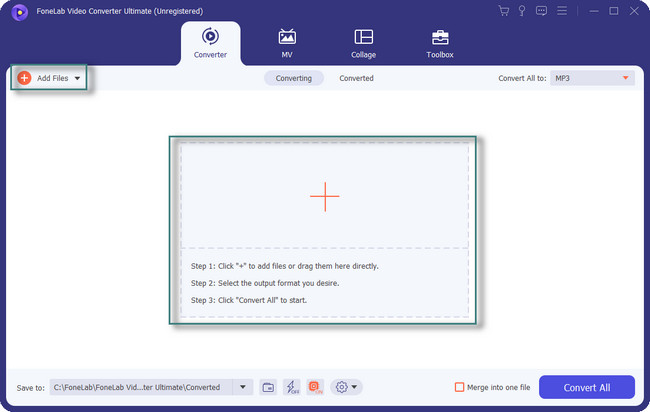
Step 3Open the Output Format panel at the bottom, click the Audio tab, and choose MP3 from the list.
Step 4Click the gear icon next to MP3 to open the settings, then set the bitrate, sample rate, and channels. I usually pick 320 kbps for music I want to keep.
Step 5If you only need part of a track, click the Scissor icon, drag the handles to select the segment, and confirm the cut.
Step 6Click Convert All at the bottom right and wait for the progress bar to finish. Your MP3 files land in the output folder you chose.
That is the whole workflow. If you only need to convert one song once in a while, the free tools below will do the job — but if your library is full of M4P files, the batch approach saves you an afternoon.
Video Converter Ultimate is the best video and audio converting software which can convert MPG/MPEG to MP4 with fast speed and high output image/sound quality.
- Convert any video/audio like MPG, MP4, MOV, AVI, FLV, MP3, etc.
- Support 1080p/720p HD and 4K UHD video converting.
- Powerful editing features like Trim, Crop, Rotate, Effects, Enhance, 3D and more.
Part 3: Convert M4P to MP3 with VLC Media Player
VLC Media Player is the open-source media player maintained by the VideoLAN project. The project reports that VLC has been downloaded more than 3.5 billion times, and for good reason — it plays nearly everything, and it also includes a converter built right into the menus. If the M4P file plays in VLC on your machine, you can convert it to MP3 without installing anything else.
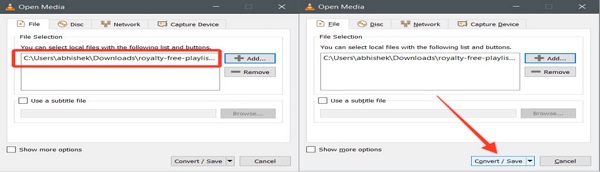
One honest note: VLC can only read M4P files authorized to your Apple ID. If the track plays in VLC, you are set. The converter works well, though its settings are less polished than a dedicated tool.
Step 1Launch VLC Media Player and open the Media menu at the top. Choose Convert / Save from the drop-down list.
Step 2Click Add in the File tab and select your M4P file. You can add more than one track here if you want.
Step 3Click Convert / Save at the bottom of the window.
Step 4In the Convert window, pick Audio - MP3 from the Profile drop-down, adjusting the bitrate via the settings icon if you want.
Step 5Choose a destination file name and folder, then click Start. VLC will process the track and save the MP3.
In my test, VLC produced a clean 256 kbps MP3 from an M4P source. It is a great free fallback that doubles as your everyday media player, and the same Convert window can extract WAV audio from MP4.
Part 4: Convert M4P to MP3 with Audacity
Audacity is a free, open-source audio editor that has been around for decades. It is a favorite among podcasters and hobbyists because it combines recording, editing, and exporting in one package. To export MP3, Audacity relies on the LAME encoder, which you may need to point it to on the first run — the program walks you through it.
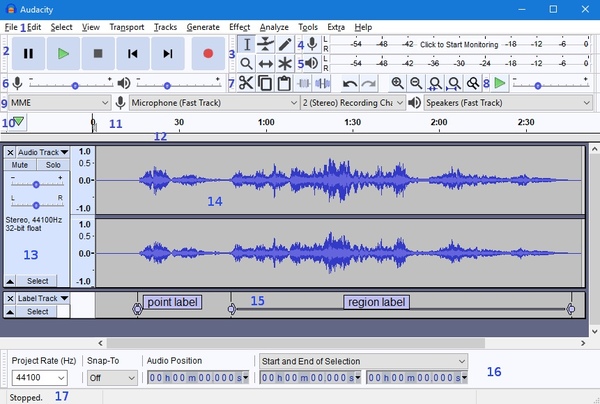
Audacity is slower than the other routes because it loads the whole track into an editable project before exporting. Use it when you also want to edit the audio — trimming silence, for example — rather than for a 40-track library.
Step 1Open Audacity and go to File > Open. Select your M4P file — if Audacity asks about the LAME encoder, follow the prompt and locate it.
Step 2The track appears as an editable waveform. You can select a region and delete it, or apply effects, before you export.
Step 3Go to File > Export > Export as MP3.
Step 4Choose the bitrate mode and quality in the export options, then click Save.
The resulting file is a true MP3. Audacity's editing features are the real reason to choose it — if you need to trim an intro, fade the ending, or boost the volume while you convert, this is the tool.
Video Converter Ultimate is the best video and audio converting software which can convert MPG/MPEG to MP4 with fast speed and high output image/sound quality.
- Convert any video/audio like MPG, MP4, MOV, AVI, FLV, MP3, etc.
- Support 1080p/720p HD and 4K UHD video converting.
- Powerful editing features like Trim, Crop, Rotate, Effects, Enhance, 3D and more.
Part 5: Convert M4P to MP3 with iTunes
If you would rather stay inside Apple's ecosystem, iTunes — or its successor, the Apple Music app on Mac — can convert M4P to MP3 directly. You tell it which encoder to use, then create an MP3 version of any track. The steps are identical in iTunes and Apple Music.
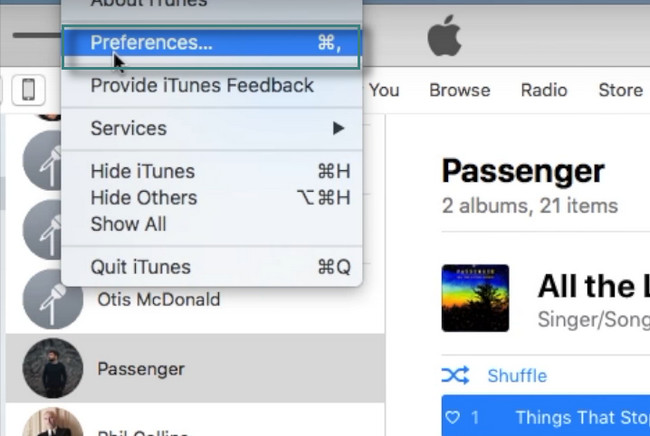
The catch, and I hit this myself during testing, is that iTunes will only convert tracks authorized to your Apple ID. You can convert your own purchases, but not a friend's M4P file. It also converts one track at a time, which makes a large library a slow project. Still, for the occasional song it is the most obvious option.
Step 1Open iTunes on Windows or Apple Music on Mac. Go to Edit > Preferences (on Mac, iTunes > Preferences).
Step 2Click General, then Import Settings.
Step 3Next to Import Using, choose MP3 Encoder. You can adjust the quality setting below it. Click OK.
Step 4Select the M4P track in your library, then go to File > Convert > Create MP3 Version. The MP3 copy appears right next to the original.
Note that the original M4P stays in your library — you get a new MP3 copy alongside it, a nice safety net. If you often move music between devices, this same library is also the starting point for converting MP4 video to MP3.
Part 6: Comparison: FoneLab vs VLC vs Audacity vs iTunes
All four methods convert M4P to MP3, but they are not equal. Here is how they compare in the areas that actually matter, based on the testing I did while preparing this guide:
| Comparison Dimension | FoneLab Video Converter Ultimate | VLC Media Player | Audacity | iTunes / Apple Music |
|---|---|---|---|---|
| Cost | Free download | Free | Free | Free |
| Batch Conversion | Yes, whole folders at once | Yes, multiple files | No, one file at a time | No, one track at a time |
| Audio Settings | Bitrate, sample rate, channels | Limited profile presets | Full control while editing | Encoder quality setting |
| Editing Tools | Trim, cut, effects | None | Full editor | None |
| Platform | Windows & Mac | Windows, Mac, Linux | Windows, Mac, Linux | Windows & Mac |
| Best For | Fast, high-quality batch conversion | Quick one-off free conversion | Editing while converting | Staying inside Apple's ecosystem |
If you are converting more than a handful of songs, my recommendation is clear: FoneLab Video Converter Ultimate. It is the fastest and most convenient of the four, with batch conversion, bitrate control, and a built-in trimmer in one window. If you convert rarely and want to spend nothing, VLC is the best free fallback, and Audacity earns its place when editing matters too. iTunes suits only quick, occasional conversions of tracks you own.
The same software also converts video — you can convert AVI to MP3 with the identical workflow. That is one more reason to keep a single tool around.
Part 7: FAQs About Converting M4P to MP3
Can I convert M4P to MP3 without buying any software?
Yes. VLC Media Player and Audacity are both completely free, and iTunes converts M4P to MP3 at no cost. A dedicated converter like FoneLab Video Converter Ultimate adds batch processing and bitrate control, and it can be downloaded for free to try.
Why won't M4P files play on my Android phone or MP3 player?
Because M4P files are protected by Apple's FairPlay DRM. Playback is restricted to devices authorized with the Apple ID that purchased the track. Converting M4P to MP3 removes that restriction, which is why the converted file plays on Android, Windows, and nearly every other player.
Can VLC convert M4P to MP3?
Yes. VLC includes a Convert / Save feature under the Media menu, and as long as the M4P file plays in VLC you can convert it without installing anything else. The one limitation: VLC cannot bypass FairPlay, so a track that does not play in VLC cannot be converted by it either.
What is the best bitrate when converting M4P to MP3?
For music you want to keep, 320 kbps preserves the most detail from the AAC source. For everyday listening, 192 to 256 kbps balances quality and file size. In my test, a 4-minute track at 320 kbps came out at roughly 3.7 MB.
Is converting M4P to MP3 legal?
Converting tracks you purchased for your own personal use is widely accepted as fair use, provided you keep them for yourself and do not distribute them. If a track was rented through a subscription rather than bought, converting it for offline storage can break the subscription terms, so check your Apple Music agreement.
Ready to free your music? Download FoneLab Video Converter Ultimate now and convert your whole M4P library to MP3 — it is free to try.
Video Converter Ultimate is the best video and audio converting software which can convert MPG/MPEG to MP4 with fast speed and high output image/sound quality.
- Convert any video/audio like MPG, MP4, MOV, AVI, FLV, MP3, etc.
- Support 1080p/720p HD and 4K UHD video converting.
- Powerful editing features like Trim, Crop, Rotate, Effects, Enhance, 3D and more.