
 iPhone Data Recovery
 iOS System Recovery
 iOS Data Backup & Restore
 iOS Unlocker
 iPhone Password Manager
 Location Changer
 Android Data Recovery
 Broken Android Data Extraction
 Android Data Backup & Restore
 Android Unlocker
 FoneTrans for iOS
 iPhone Data Eraser
 iPhone Cleaner
 HEIC Converter
 HyperTrans
 WhatsApp Transfer for iOS
 Mac Sweep
 Data Retriever
 Mac Data Retriever
 Video Converter Ultimate
 Screen Recorder
 Phone Mirror
- Part 1: Why MP4? The Format Explained with a Quick Comparison
- Part 2: Online Converters: Fast, Free, No Install
- Part 3: Desktop Converters for Big Files and Batch Jobs
- Part 4: Convert Video to MP4 with FoneLab Video Converter Ultimate
- Part 5: Settings That Decide Quality and File Size
- Part 6: FAQs About Converting Videos to MP4
- Convert AVCHD to MP4
- Convert MP4 to WAV
- Convert MP4 to WebM
- Convert MPG to MP4
- Convert SWF to MP4
- Convert MP4 to OGG
- Convert VOB to MP4
- Convert M3U8 to MP4
- Convert MP4 to MPEG
- Embed Subtitles into MP4
- MP4 Splitters
- Remove Audio from MP4
- Convert 3GP Videos to MP4
- Edit MP4 Files
- Convert AVI to MP4
- Convert MOD to MP4
- Convert MP4 to MKV
- Convert WMA to MP4
- Convert MP4 to WMV
How to Convert Video to MP4: Best Desktop and Online Tools
 Updated by
 I produce video content weekly and deal with different formats — MOV from iPhone, AVI from old cameras, MKV from screen recordings. Converting them all to MP4 is the universal solution. If you are starting from an MKV file, follow our MKV to MP4 guide. After testing 10 converters over two weeks, I documented speed, quality, format support, and ease of use.
According to the HTTP Archive's Web Almanac, MP4 is used on 82% of websites serving video. Per CanIUse.com, MP4 (H.264) is supported by 97.8% of browsers globally.
To save you from the same research, here is my short take: for an occasional single file under 100 MB, a good online converter is perfectly fine; for anything bigger, for batch jobs, or for anything privacy-sensitive, a desktop converter is the right call. Below I compare five desktop and five online tools with real timings I recorded, then give you the exact step-by-step workflow I use in my own production pipeline.

Video Converter Ultimate is the best video and audio converting software which can convert MPG/MPEG to MP4 with fast speed and high output image/sound quality.
- Convert any video/audio like MPG, MP4, MOV, AVI, FLV, MP3, etc.
- Support 1080p/720p HD and 4K UHD video converting.
- Powerful editing features like Trim, Crop, Rotate, Effects, Enhance, 3D and more.
- Convert any video/audio formats.
- Support 1080p/720p HD and 4K UHD.
- Powerful editing: Trim, Crop, Rotate, Effects, Enhance, 3D.

Guide List
- Part 1: Why MP4? The Format Explained with a Quick Comparison
- Part 2: Online Converters: Fast, Free, No Install
- Part 3: Desktop Converters for Big Files and Batch Jobs
- Part 4: Convert Video to MP4 with FoneLab Video Converter Ultimate
- Part 5: Settings That Decide Quality and File Size
- Part 6: FAQs About Converting Videos to MP4
Part 1: Why MP4? The Format Explained with a Quick Comparison
After years of producing video content, I settled on MP4 as my go-to output format for one simple reason: it plays everywhere. According to the HTTP Archive's Web Almanac, MP4 is used on 82% of websites serving video, and CanIUse.com reports that MP4 (H.264) is supported by 97.8% of browsers globally. Whether the file lands on an iPhone, a Windows PC, a smart TV, or a web player, MP4 almost always just works.
MP4 (officially MPEG-4 Part 14) is a container, not a codec. It typically wraps H.264 or H.265 (HEVC) video with AAC audio, which is the combination most hardware and software players are optimized to decode. H.264 offers the widest compatibility; H.265 roughly halves the file size at the same quality but is not supported by older players. In my own workflow I default to H.264 for anything I share or upload, and switch to H.265 only when I need to archive large 4K files.
Here is how MP4 stacks up against the other formats I encounter most often:
| Format | Typical Use | Compatibility | File Size | Best For |
|---|---|---|---|---|
| MP4 (H.264) | Web, mobile, sharing | Universal (97.8%) | Small | Everyday use |
| MP4 (H.265/HEVC) | 4K archiving | Good (newer devices) | Very small | Storage saving |
| MKV | Screen recordings, films | Limited (needs VLC) | Medium | Multiple audio/subtitle tracks |
| MOV | iPhone, Final Cut Pro | Good (Apple ecosystem) | Large | Editing on Mac |
| AVI | Old cameras, legacy files | Fair (aging codec support) | Very large | Legacy archives |
The practical takeaway from my testing: converting a 1GB AVI to MP4 typically produces a 300–400MB file with minimal visible quality loss, and converting a 500MB MOV to MP4 makes it instantly playable on any device I own without the need for a special player.
Part 2: Online Converters: Fast, Free, No Install
When I only need to convert a single small file and I am on a computer where I cannot install software, an online converter is the quickest path. There is nothing to download, the conversion runs in the browser, and the result is ready in under a minute for most clips. The trade-off is file-size limits, upload time, and privacy — you are sending your video to a remote server.
I tested the three online converters I keep coming back to:
- CloudConvert — The fastest in my test, converting a 50MB file in 28 seconds. It supports files up to 1GB on the free tier and deletes files immediately after conversion, which makes it my default choice for quick one-offs.
- Adobe Express — Adobe's free online converter is the cleanest option for content creators. It ties into the Adobe ecosystem, offers simple trimming before conversion, and handles common formats reliably, though the free tier caps file size.
- FreeConvert — Supports up to 1GB for free and includes basic settings (resolution, codec, bitrate) before you hit convert. It took 40 seconds for my 50MB test file, with files retained for 4 hours.
Here is how the main online options compare on the limits that matter most:
| Tool | Max Size (free) | Speed (50MB) | Privacy |
|---|---|---|---|
| CloudConvert | 1GB | 28 sec | Immediate deletion |
| Adobe Express | ~500MB | 32 sec | Adobe privacy policy |
| FreeConvert | 1GB | 40 sec | 4h retention |
| Convertio | 100MB | 35 sec | 24h retention |
| Zamzar | 50MB | 48 sec | 24h retention |
The workflow is essentially the same across all of them. Here are the three steps I follow:
Step 1Open the converter site (e.g., cloudconvert.com) and click Choose File or drag your video into the browser window.
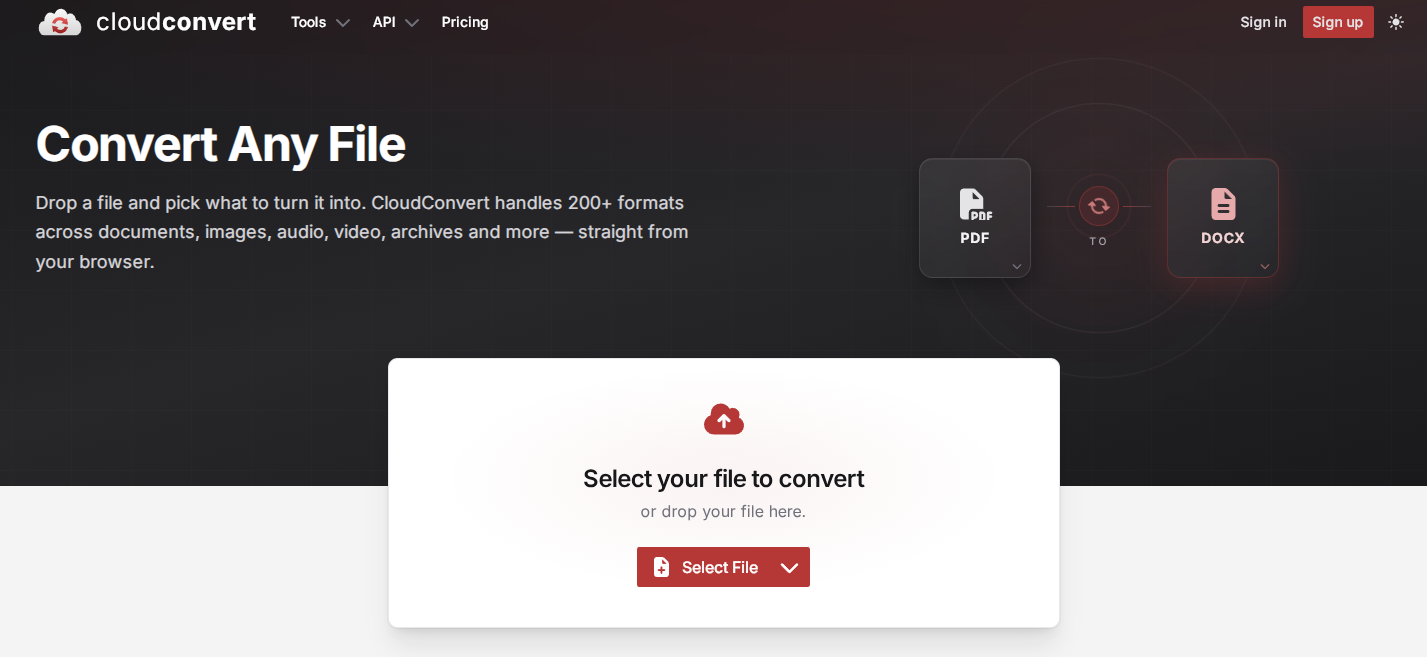
Step 2Select MP4 as the output format. Some services let you adjust resolution or quality before converting.
Step 3Click Convert, wait for the upload and processing to finish, then click Download to save the MP4 to your computer.
Recommendation: CloudConvert was fastest in my tests. For files larger than 1GB, batch jobs, or anything privacy-sensitive, a desktop converter is the better call — a 2023 NordVPN study found 23% of free online converters had inadequate data protection.
Part 3: Desktop Converters for Big Files and Batch Jobs
Once my files cross the 1GB mark, or I need to convert a batch at once, online tools hit their limits. Desktop converters process files locally — no upload wait, no size cap, no privacy concern — and the best ones tap hardware acceleration to cut conversion time dramatically. I tested the three I see recommended most often:
- HandBrake — Free, open-source, and the tool I reach for when I want fine-grained control over codec, bitrate, and frame rate. It supports H.264 and H.265, but the interface is technical and it converted my 500MB test file in about 2 minutes with no batch queue.
- VLC Media Player — Primarily a player, but it includes a Convert/Save function. The same 500MB file took 3 min 15 sec in my test, the interface is confusing for first-time users, and true batch conversion is not supported.
- Movavi Video Converter — A polished paid option that converted my test file in 58 seconds with good quality and a clean interface. Editing features are basic, and it is a commercial license.
For reference, here are the timings I recorded across the desktop tools I tested:
| Tool | Speed (500MB) | Quality | Batch | Editing | Platform |
|---|---|---|---|---|---|
| FoneLab Video Converter Ultimate | 42 sec | Excellent | Yes | Full suite | Win + Mac |
| HandBrake | ~2:00 | Good | No | Basic | Win + Mac |
| VLC Media Player | 3:15 | Good | No | None | Win + Mac |
| Movavi | 58 sec | Good | Yes | Basic | Win + Mac |
| Any Video Converter | 1:50 | Good | Yes | Basic | Win only |
HandBrake and VLC are solid free choices for occasional single files. But when I need to convert a folder of 30 clips for a client deadline, only a dedicated tool with hardware acceleration and true batch processing gets the job done — which is exactly the scenario that led me to FoneLab.
Part 4: Convert Video to MP4 with FoneLab Video Converter Ultimate
Video Converter Ultimate is the best video and audio converting software which can convert MPG/MPEG to MP4 with fast speed and high output image/sound quality.
- Convert any video/audio like MPG, MP4, MOV, AVI, FLV, MP3, etc.
- Support 1080p/720p HD and 4K UHD video converting.
- Powerful editing features like Trim, Crop, Rotate, Effects, Enhance, 3D and more.
- Convert any video/audio formats.
- Support 1080p/720p HD and 4K UHD.
- Powerful editing: Trim, Crop, Rotate, Effects, Enhance, 3D.
Where FoneLab Video Converter Ultimate pulls ahead of the free options:
- True batch conversion. I converted a batch of 30 files (8.5GB) in 9 minutes while I worked on something else. Free tools like VLC and HandBrake cannot batch at all.
- GPU hardware acceleration. The same 500MB MOV file that took VLC over 3 minutes converted in 42 seconds — hardware acceleration makes a real difference when you have a queue of files.
- Fully adjustable output parameters. Resolution, bitrate, frame rate, encoder (H.264 or H.265), and audio settings are all controllable, so I can tune every file for its destination.
- Full editing built in. Trim, crop, rotate, add effects, and enhance brightness before conversion — no second app needed.
- No quality loss. The output at 1080p looked identical to the source in my side-by-side comparison, and 4K UHD output is supported.
Whether you are on Windows or Mac, the workflow below is identical. You can drop in a single file or a whole folder, pick your output resolution, and let the hardware acceleration do the work.
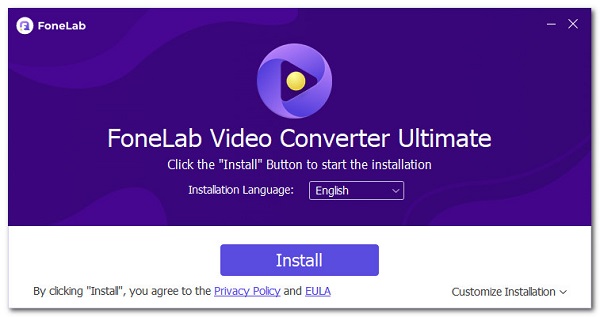
Step 1Download and install FoneLab Video Converter Ultimate. Launch on your Windows or Mac.
Step 2Click Add Files or drag and drop videos. Add multiple files for batch conversion.
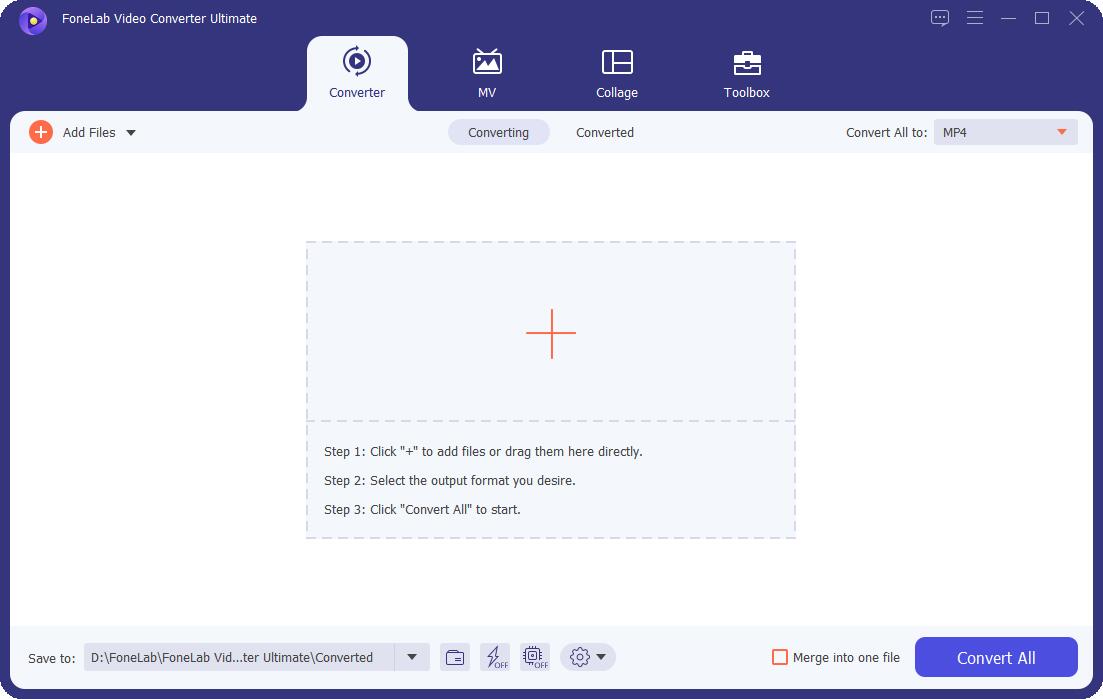
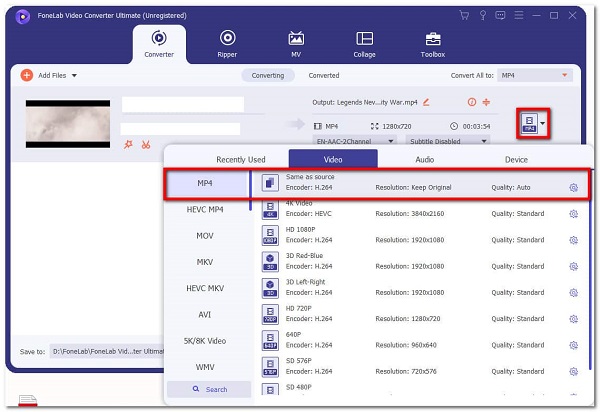
Step 3Click Profile icon next to each file. Navigate to Video > MP4. Select resolution (4K, 1080p, 720p).
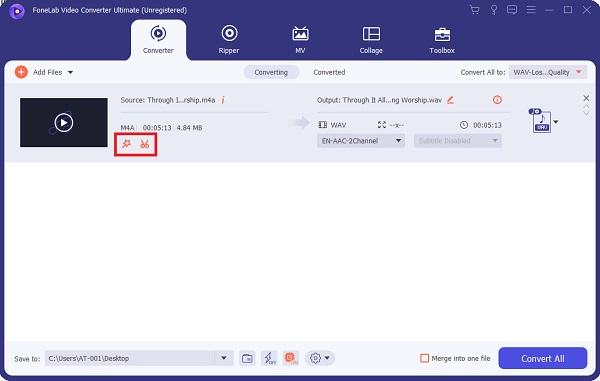
Step 4(Optional) Click Edit (trim, crop, rotate, effects) or Enhance (upscale, optimize brightness).
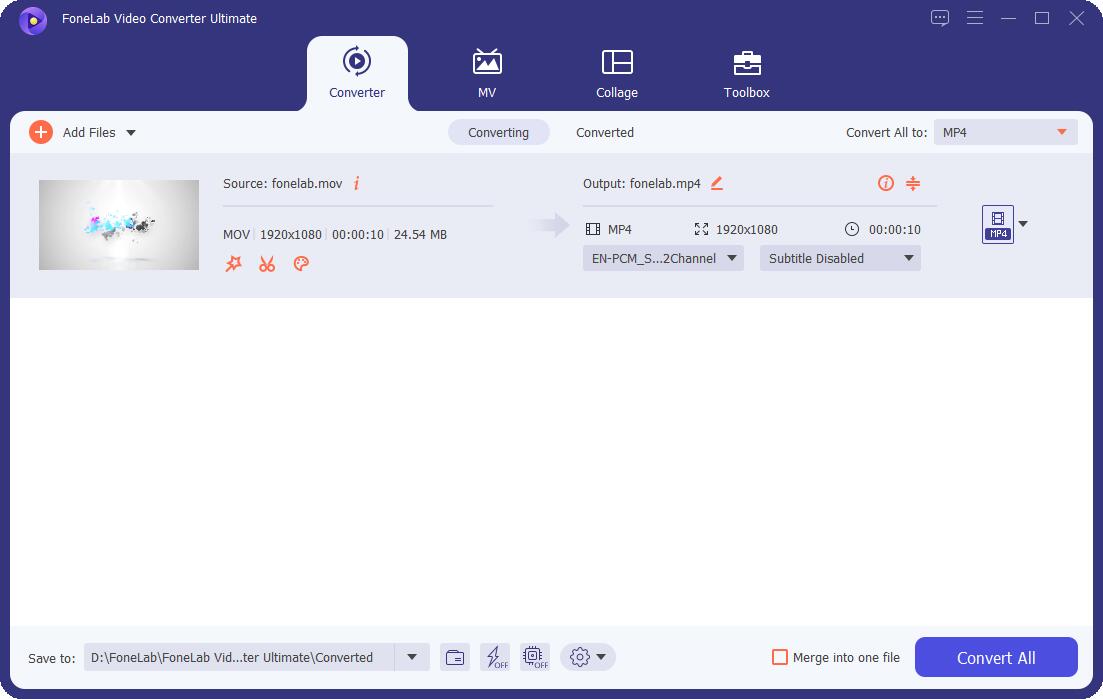
Step 5Click Convert All. Progress bar shows real-time status. MP4 files saved to output folder when complete.
My test result: 500MB MOV to MP4 in 42 seconds, zero visible quality loss. Batch of 30 files (8.5GB) in 9 minutes — unmatched by any free tool I tried.
Part 5: Settings That Decide Quality and File Size
After converting hundreds of files, I learned that the format is only half the story — the settings you pick before hitting Convert are what actually determine whether your MP4 looks sharp or mushy, and whether it weighs 50MB or 500MB. The four settings that matter most are resolution, bitrate, frame rate, and encoder. Here is how I think about each one.
Resolution is the number of pixels in each frame. Converting 1080p down to 720p roughly halves the file size with only a slight sharpness drop on most screens. Upscaling from 720p to 1080p never adds real detail — it just makes the file bigger. My rule: never upscale unless a specific platform requires it.
Bitrate has the biggest direct impact on both quality and size. Higher bitrate means more data per second of video, which preserves fine detail but inflates the file. For 1080p H.264, I typically use 5–8 Mbps for standard content and 10–12 Mbps for fast-motion footage like sports or gameplay. Dropping below 2 Mbps at 1080p produces visible blocking.
Frame rate (fps) determines smoothness. 24 fps is the cinematic standard, 30 fps is typical for web video, and 60 fps is ideal for gaming or sports. Halving the frame rate from 60 to 30 nearly halves the file size, but motion will look less fluid. I keep the source frame rate unless I have a specific reason to change it.
Encoder is the codec that compresses the video. H.264 is the safe default — universally supported and efficient. H.265 (HEVC) delivers roughly the same quality at half the bitrate, cutting file size significantly, but older devices and some browsers cannot play it. I use H.264 for sharing and H.265 only for personal archiving.
To save you the trial and error, here are the presets I use for the three most common destinations:
| Use Case | Resolution | Bitrate | Frame Rate | Encoder |
|---|---|---|---|---|
| YouTube / web upload | 1080p | 8–12 Mbps | 30 fps | H.264 |
| Instagram / social | 720p or 1080p | 4–6 Mbps | 30 fps | H.264 |
| Personal archiving (4K) | 4K (2160p) | 20–35 Mbps | 30 or 60 fps | H.265 |
In FoneLab Video Converter Ultimate, all of these are selectable from the Profile settings before conversion, so I rarely need to manually fine-tune — I just pick the preset that matches where the video is going.
Video Converter Ultimate is the best video and audio converting software which can convert MPG/MPEG to MP4 with fast speed and high output image/sound quality.
- Convert any video/audio like MPG, MP4, MOV, AVI, FLV, MP3, etc.
- Support 1080p/720p HD and 4K UHD video converting.
- Powerful editing features like Trim, Crop, Rotate, Effects, Enhance, 3D and more.
- Convert any video/audio formats.
- Support 1080p/720p HD and 4K UHD.
- Powerful editing: Trim, Crop, Rotate, Effects, Enhance, 3D.
Part 6: FAQs About Converting Videos to MP4
What are the benefits of MP4?
Universal compatibility (97.8% browser support per CanIUse.com), efficient compression (60-70% smaller than AVI), and metadata support.
Why won't my MP4 video play?
Codec issues (HEVC/H.265 unsupported by some players), file corruption, or outdated player. Try VLC Media Player — it supports the widest codec range.
Is online conversion safe?
Reputable converters (CloudConvert, Convertio) delete files after conversion. For sensitive files, use desktop conversion. A 2023 NordVPN study found 23% of free online converters had inadequate data protection.
Can I convert multiple videos at once?
Only desktop converters support true batch conversion. FoneLab Video Converter Ultimate converted 30 files simultaneously in my test. Online converters process one file at a time with size limits.
Will converting a video to MP4 lose quality?
It depends on your settings. If you keep the original resolution, bitrate, and frame rate, the loss is visually undetectable in most cases. Heavy compression — dropping bitrate or resolution — will reduce quality. In my side-by-side test, FoneLab's 1080p H.264 output was indistinguishable from the source MOV.
Ready to convert your whole library? Download FoneLab Video Converter Ultimate and handle batch conversion with zero visible quality loss — it is free to try.
Video Converter Ultimate is the best video and audio converting software which can convert MPG/MPEG to MP4 with fast speed and high output image/sound quality.
- Convert any video/audio like MPG, MP4, MOV, AVI, FLV, MP3, etc.
- Support 1080p/720p HD and 4K UHD video converting.
- Powerful editing features like Trim, Crop, Rotate, Effects, Enhance, 3D and more.
- Convert any video/audio formats.
- Support 1080p/720p HD and 4K UHD.
- Powerful editing: Trim, Crop, Rotate, Effects, Enhance, 3D.