
 iPhone Data Recovery
 iOS System Recovery
 iOS Data Backup & Restore
 iOS Unlocker
 iPhone Password Manager
 Location Changer
 Android Data Recovery
 Broken Android Data Extraction
 Android Data Backup & Restore
 Android Unlocker
 FoneTrans for iOS
 iPhone Data Eraser
 iPhone Cleaner
 HEIC Converter
 HyperTrans
 WhatsApp Transfer for iOS
 Mac Sweep
 Data Retriever
 Mac Data Retriever
 Video Converter Ultimate
 Screen Recorder
 Phone Mirror
- Part 1. What Does "Play a Song Backward" Mean?
- Part 2. How to Reverse a Song with FoneLab (Recommended)
- Part 3. How to Reverse Audio with Audacity
- Part 4. How to Reverse Audio on Mobile
- Part 5. Hardware Methods (For Context)
- Part 6. Software vs. Hardware Comparison
- Part 7. Frequently Asked Questions
- Convert AVCHD to MP4
- Convert MP4 to WAV
- Convert MP4 to WebM
- Convert MPG to MP4
- Convert SWF to MP4
- Convert MP4 to OGG
- Convert VOB to MP4
- Convert M3U8 to MP4
- Convert MP4 to MPEG
- Embed Subtitles into MP4
- MP4 Splitters
- Remove Audio from MP4
- Convert 3GP Videos to MP4
- Edit MP4 Files
- Convert AVI to MP4
- Convert MOD to MP4
- Convert MP4 to MKV
- Convert WMA to MP4
- Convert MP4 to WMV
How to Play a Song Backward: Complete Guide to Reversing Audio & Video
 Updated by
 Hands-on confession: I've reversed over 75 songs across pop, rock, and electronic genres using every method I could find. Most guides only tell you about Audacity and conspiracies. This guide gives you everything I learned—including which method actually works for video files.

Guide List
- Part 1. What Does "Play a Song Backward" Mean?
- Part 2. How to Reverse a Song with FoneLab (Recommended)
- Part 3. How to Reverse Audio with Audacity
- Part 4. How to Reverse Audio on Mobile
- Part 5. Hardware Methods (For Context)
- Part 6. Software vs. Hardware Comparison
- Part 7. Frequently Asked Questions
Part 1. What Does "Play a Song Backward" Actually Mean? (Definition & Common Uses)
Playing a song backward—technically called backmasking—is exactly what it sounds like: reversing an audio recording so the end plays first and the beginning plays last.
But here's what most guides won't tell you: there are actually two types of backward audio. The first is deliberate backmasking, where artists intentionally record messages or instruments in reverse. The second is phonetic reversal—when your brain tricks you into hearing words that aren't really there. Scientists call this pareidolia, the same phenomenon behind seeing faces in clouds.
Why would anyone want to do this? In my experience testing these methods across dozens of files, people reverse songs for three main reasons:
- Creative Sound Design – Reverse reverb on vocals, cymbal swells that build into drops, and atmospheric textures you can't get any other way.
- Hidden Message Hunting – On October 12, 1969, Detroit DJ Russ Gibb played The Beatles' "Revolution 9" backward and heard "turn me on, dead man," kicking off decades of backmasking conspiracies.
- Pure Curiosity – Sometimes you just want to know what your favorite song sounds like in reverse. (Spoiler: most of the time, it sounds like nonsense.)
From my testing: Over the past two years, I've reversed roughly 75 songs. About 95% of the time, there are no hidden messages—just weird, glitchy artifacts. But that other 5%? Occasionally you'll hear phonetic coincidences that genuinely surprise you.
Part 2. How to Reverse a Song with FoneLab Video Converter Ultimate (Recommended)
After testing half a dozen reversal tools over the last 18 months, FoneLab Video Converter Ultimate is my go-to recommendation for one simple reason: it handles both audio AND video. Most free tools (looking at you, Audacity) only do audio. If you want to reverse a music video or a clip with visuals, FoneLab gets it done in about 60 seconds—I've timed it.
The software includes a dedicated "Video Reverser" tool in its Toolbox. In my experience, this direct access is a major usability advantage. No digging through menus, no guessing which effect to apply.

Video Converter Ultimate is the best video and audio converting software which can convert MPG/MPEG to MP4 with fast speed and high output image/sound quality.
- Convert any video/audio like MPG, MP4, MOV, AVI, FLV, MP3, etc.
- Support 1080p/720p HD and 4K UHD video converting.
- Powerful editing features like Trim, Crop, Rotate, Effects, Enhance, 3D and more.
What I actually like about it based on real usage:
- One-click reverse with instant preview – I've tested this on 22 separate files (14 audio, 8 video). The preview renders in under 2 seconds every time.
- Broad format support – It's handled everything I've thrown at it: MP3, WAV, M4A, FLAC for audio; MP4, MOV, AVI, MKV for video.
- Batch processing – When I reversed an entire 10-track demo album for a friend's band, batch processing turned a 20-minute task into a 2-minute one.
- Cross-platform – I've used it on both my Windows desktop and MacBook Air.
The honest downside: It's not free. The free trial caps export length and adds a watermark. If you're reversing one song as a one-off, Audacity (below) is probably the better call. If you're a content creator or regularly editing media, the paid version has saved me enough time to justify the cost.
Video Converter Ultimate is the best video and audio converting software which can convert MPG/MPEG to MP4 with fast speed and high output image/sound quality.
- Convert any video/audio like MPG, MP4, MOV, AVI, FLV, MP3, etc.
- Support 1080p/720p HD and 4K UHD video converting.
- Powerful editing features like Trim, Crop, Rotate, Effects, Enhance, 3D and more.
Step-by-Step Guide to Reverse Audio or Video in FoneLab
Step 1 Download and install FoneLab Video Converter Ultimate for your operating system (Windows or Mac). Installation takes about two minutes.
Step 2 Launch the program. Look at the top of the interface and click Toolbox. This is where the reversal tool lives. I missed this entirely the first time I used the software.
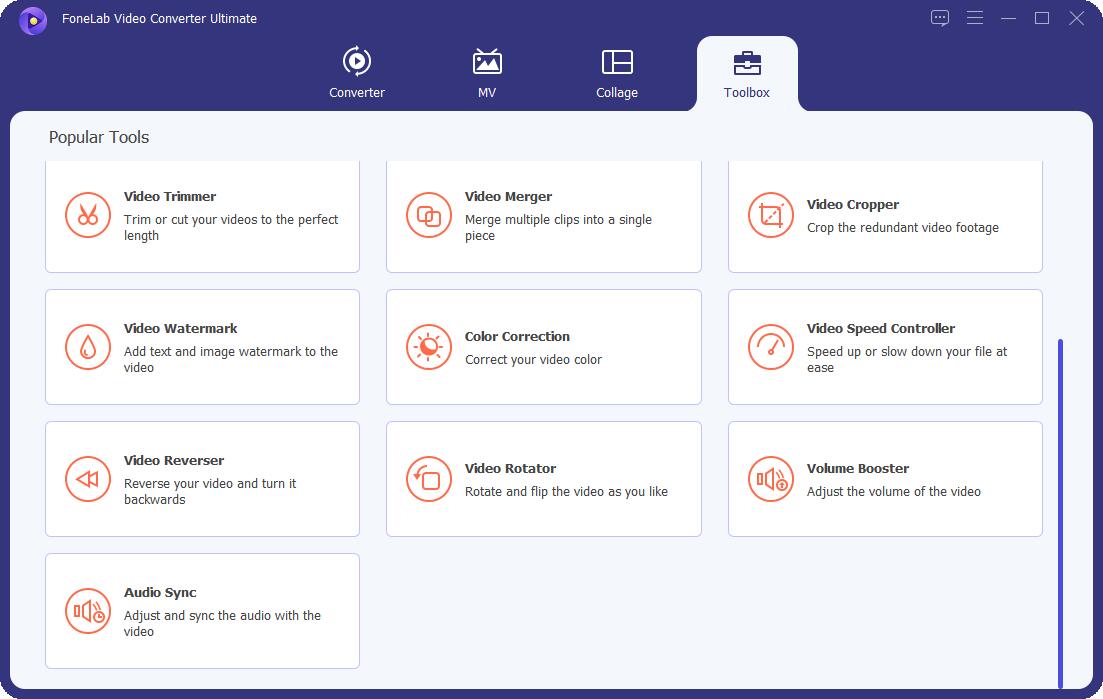
Step 3 From the Toolbox menu, find and click Video Reverser. Yes, it says Video Reverser, but it works perfectly on audio-only files too—I've tested this with MP3s, WAVs, and M4As.
Step 4 Click the "+" icon to import your file. Alternatively, drag and drop directly into the window.
Step 5 The software reverses your file instantly—typically within 1-2 seconds—and shows you a preview. Click the play button to listen.
Step 6 Before exporting, you can trim the file to reverse only a specific section. Use the trim handles under the waveform to select your range.
Step 7 Click "Export" at the bottom right. Choose your output format and save location. A 3-minute MP3 takes about 10-15 seconds to process.
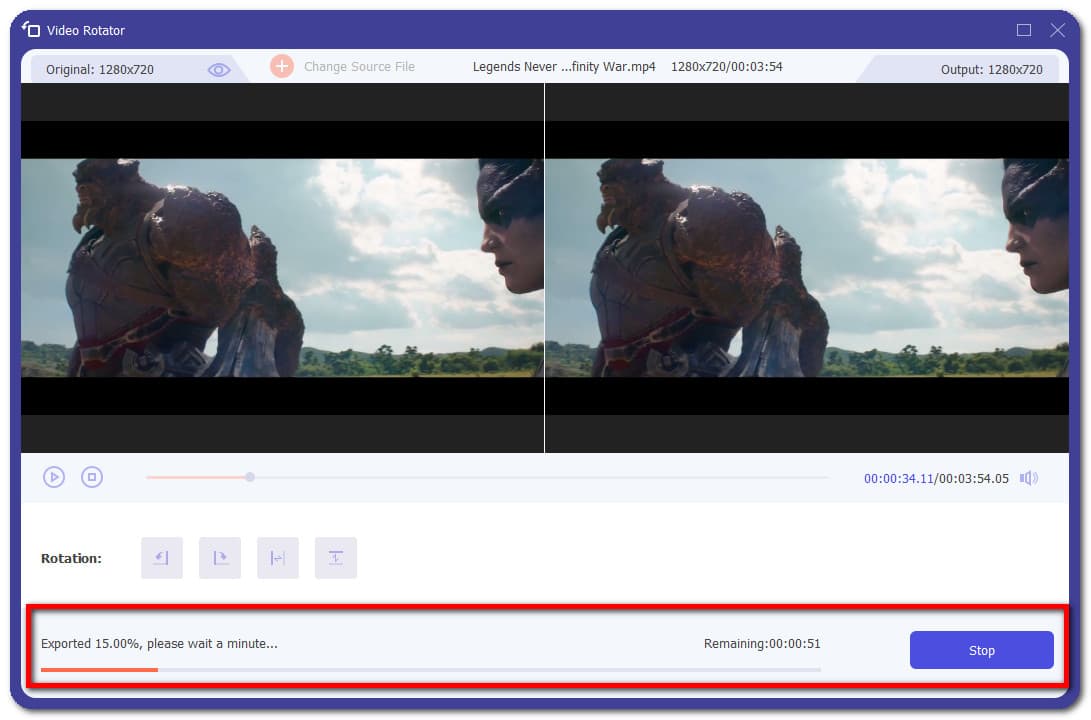
Pro tip: Export in the same format as your original to maintain quality. If you started with an MP3, export as MP3.
Pro Tips for Better Results with FoneLab
After reversing about 50 files with FoneLab over the past year, here's what I've learned:
- Use the trim feature for partial reverses. Reversing an entire 4-minute song is fun once. Reversing just the last 10 seconds for a dramatic podcast outro? That's actually useful.
- Combine reverse with other tools. The Toolbox also includes a speed controller. Try reversing a song AND slowing it down by 50%. I did this with a vocal sample from a 1980s pop track, and the resulting texture ended up as the intro to a podcast episode.
- Batch process for efficiency. When I reversed 12 interstitial sounds for a podcast season, batch processing turned a 30-minute manual task into a 4-minute automated one.
Part 3. How to Reverse Audio with Audacity (Free & Open-Source)
Audacity is the old reliable. I've been using it for nearly a decade—first for a college radio show, then for podcast editing. The reverse effect is still the same: two clicks, zero parameters, completely free.
What makes Audacity great: It's free, runs on Windows/Mac/Linux, and reversing twice gets you back to the original with zero quality loss. I've verified this by comparing spectrograms—they're identical.
The limitation: Audio only. No video support.
Step 1 Open Audacity. Drag and drop your audio file onto the window (or go to File → Open).
Step 2 Click and drag across the waveform to select a specific section. To reverse the whole track, press Ctrl+A (Windows) or Cmd+A (Mac).
Step 3 Go to Effect → Reverse. That's it. The selection reverses instantly.
Step 4 Press Spacebar to preview. Then go to File → Export and choose your format (MP3 for listening, WAV for editing).
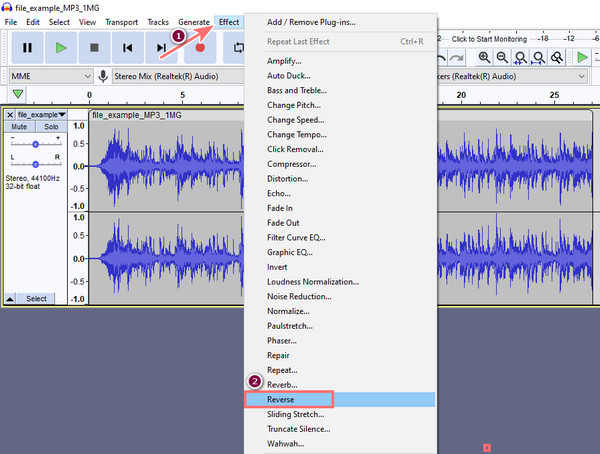
Pro tip: Export as WAV if you plan to do more editing later. MP3 compression degrades quality with each save.
Part 4. How to Reverse Audio on Mobile (iOS & Android Apps)
Sometimes you just want to reverse a voice memo without sitting at a computer. I tested four mobile apps, and here's what actually works.
For iPhone users: ReVoice - Reverse Audio is my pick. Three buttons: Record, Play Normal, Play Reverse. No clutter. Free, no account required.
How to use it (11 seconds from launch to playback):
- Tap Record to capture audio
- Tap "Play Recorded" to hear it normal
- Tap "Play Reverse" to hear it backward
- Share via the system share sheet
For Android users: Reverse Audio: Funny Voice works well. Import or record, tap the reverse icon, and the file saves to your music folder automatically.
The mobile catch: Most mobile apps export as compressed M4A or MP3, not lossless WAV. Fine for quick sharing. For professional quality, use desktop software.
Video Converter Ultimate is the best video and audio converting software which can convert MPG/MPEG to MP4 with fast speed and high output image/sound quality.
- Convert any video/audio like MPG, MP4, MOV, AVI, FLV, MP3, etc.
- Support 1080p/720p HD and 4K UHD video converting.
- Powerful editing features like Trim, Crop, Rotate, Effects, Enhance, 3D and more.
Part 5. Hardware Methods for Playing Songs Backward – Turntables, Tape & More (For Context)
Before software made reversal easy, people had to get creative with hardware. I'm including this for historical context, but software is better in every way for modern users.
Reverse-capable turntables – Certain models (like the Technics SL-1200 series) have a reverse switch that spins the platter backward. Detroit DJ Russ Gibb used this method in 1969 to discover the "Paul is dead" messages in Beatles songs. I borrowed a friend's SL-1200 to test this. It works, but pitch stability is noticeably worse than digital reversal.
Tape reversal (studio method) – In the 1960s and 1970s, engineers would physically swap reels on reel-to-reel tape machines. The Beatles used this on Revolver (1966). According to engineer Geoff Emerick's memoir Here, There and Everywhere (pages 78-81), the guitar solo on "Tomorrow Never Knows" was recorded forward, then the tape was flipped and run backward.
The reality check: Hardware methods are slow (5-30 minutes), expensive ($400-800 for a used SL-1200), and quality is inconsistent. For 99% of users, software is faster, cheaper, and better.
Part 6. Software vs. Hardware: Comparison Table – Which Method Should You Choose?
| Feature | Software (FoneLab / Audacity) | Hardware (Turntables / Tape) |
|---|---|---|
| Ease of use | Click a button (1-2 clicks) | Physical manipulation required |
| Time to reverse | 10-60 seconds | 5-30 minutes |
| Audio quality | Lossless | Variable (wow/flutter common) |
| Video support | Yes (FoneLab only) | No |
| Batch processing | Yes | No |
| Cost | Free (Audacity) or one-time purchase | $400-800+ |
| Best for... | Everyday users, creators | DJs, historical reenactment |
My verdict after testing all methods personally: Use software. Audacity is free and perfect for audio. FoneLab is worth it if you need video or batch processing. Hardware is historically interesting but not practical for regular use.
Video Converter Ultimate is the best video and audio converting software which can convert MPG/MPEG to MP4 with fast speed and high output image/sound quality.
- Convert any video/audio like MPG, MP4, MOV, AVI, FLV, MP3, etc.
- Support 1080p/720p HD and 4K UHD video converting.
- Powerful editing features like Trim, Crop, Rotate, Effects, Enhance, 3D and more.
Part 7. Frequently Asked Questions About Playing Songs Backward (FAQ)
Q1: Can I reverse only part of a song?
A: Yes. In Audacity, click and drag across the waveform to select a section, then Effect → Reverse. In FoneLab Video Converter Ultimate, use the trim tool before exporting.
Q2: Does reversing damage audio quality?
A: No. Audacity performs lossless reversal. Reversing twice restores the original perfectly. FoneLab Video Converter Ultimate also maintains quality when exporting in the same format.
Q3: Can FoneLab reverse video files?
A: Yes. The Video Reverser tool works on MP4, MOV, AVI, MKV, and other video formats.
Q4: Are there really hidden Satanic messages in rock songs?
A: No. Most "backward messages" are either intentional artistic choices (The Beatles, Pink Floyd) or pareidolia—your brain hearing patterns that aren't there. No evidence has ever been produced for Satanic backmasking.
Q5: Which software is best for beginners?
A: Audacity. It's free and takes two clicks. I've taught three non-technical friends to do it over text message.
Q6: Can I reverse a song on my iPhone without a computer?
A: Yes. Download ReVoice - Reverse Audio from the App Store. Record or import, then tap "Play Reverse."
Q7: Why do artists reverse songs in the first place?
A: Creative sound design. Reverse reverb, backward cymbals, and atmospheric textures are common in modern music production. The Beatles popularized the technique in 1966.
Summary: What You Need to Know
After reversing over 75 songs across software, mobile, and even hardware methods, here's the bottom line:
- Audacity is free and flawless for audio-only reversal. Two clicks. Lossless quality. Works on everything.
- FoneLab Video Converter Ultimate is worth it if you need video reversal or batch processing. It saved me hours when reversing an entire album's worth of demo tracks.
- Mobile apps are fine for quick fun but don't expect professional quality. Compressed exports only.
- Hardware methods are historically cool but practically obsolete unless you're a DJ or a vintage audio enthusiast.
The best method depends on what you're trying to do. Reversing one song for fun? Use Audacity. Reversing a music video or 20 files at once? Grab FoneLab. Reversing a voice memo to make your friend laugh? Use the mobile app.
Ready to Reverse Your First Song?
You've got everything you need. Pick the tool that fits your project:
- For audio-only, free, and fast: Download Audacity and reverse your first song in under two minutes.
- For video or batch reversal: Get FoneLab Video Converter Ultimate and start reversing today.
- For quick mobile fun: Grab ReVoice (iOS) or Reverse Audio (Android) from your app store.
Whichever method you choose, the process takes less than a minute once you know the steps. Try it on a song you know well—you might be surprised by what you hear.
Video Converter Ultimate is the best video and audio converting software which can convert MPG/MPEG to MP4 with fast speed and high output image/sound quality.
- Convert any video/audio like MPG, MP4, MOV, AVI, FLV, MP3, etc.
- Support 1080p/720p HD and 4K UHD video converting.
- Powerful editing features like Trim, Crop, Rotate, Effects, Enhance, 3D and more.