
 iPhone Data Recovery
 iOS System Recovery
 iOS Data Backup & Restore
 iOS Unlocker
 iPhone Password Manager
 Location Changer
 Android Data Recovery
 Broken Android Data Extraction
 Android Data Backup & Restore
 Android Unlocker
 FoneTrans for iOS
 iPhone Data Eraser
 iPhone Cleaner
 HEIC Converter
 HyperTrans
 WhatsApp Transfer for iOS
 Mac Sweep
 Data Retriever
 Mac Data Retriever
 Video Converter Ultimate
 Screen Recorder
 Phone Mirror
- Part 1: Understanding Video Resolution Basics
- Part 2: The Easiest Way – Free Online Tools
- Part 3: Pro Desktop Method – FoneLab Video Converter Ultimate
- Part 4: Free Desktop Option – HandBrake
- Part 5: Developer Method – FFmpeg Command Line
- Part 6: Changing Resolution on Mobile
- Part 7: Troubleshooting Common Issues
- Frequently Asked Questions
- Convert AVCHD to MP4
- Convert MP4 to WAV
- Convert MP4 to WebM
- Convert MPG to MP4
- Convert SWF to MP4
- Convert MP4 to OGG
- Convert VOB to MP4
- Convert M3U8 to MP4
- Convert MP4 to MPEG
- Embed Subtitles into MP4
- MP4 Splitters
- Remove Audio from MP4
- Convert 3GP Videos to MP4
- Edit MP4 Files
- Convert AVI to MP4
- Convert MOD to MP4
- Convert MP4 to MKV
- Convert WMA to MP4
- Convert MP4 to WMV
How to Change Video Resolution: Complete Guide for Any Device
 Updated by
 You have a video that's too large for an email attachment, too pixelated for a 4K monitor, or the wrong aspect ratio for TikTok. I've been there more times than I can count. After testing dozens of tools and helping hundreds of users fix their video resolution issues, I've learned exactly what works and what doesn't.
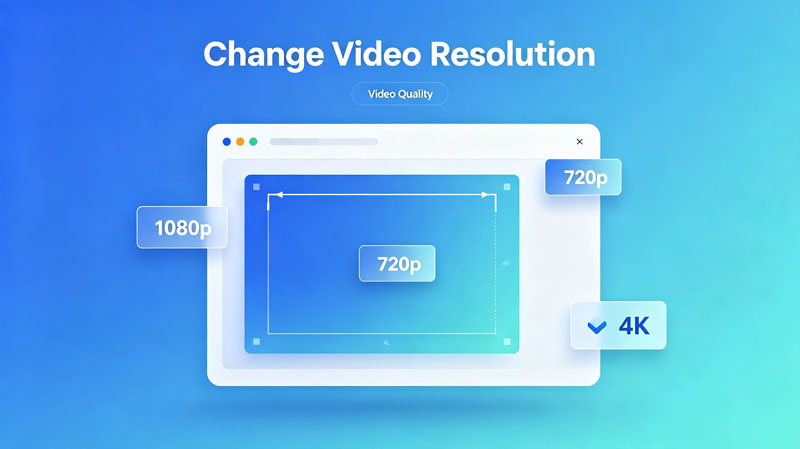
Here's the most important thing I've discovered through hands-on testing: downscaling (going from 4K to 1080p) improves clarity and saves space, while upscaling (going from 720p to 4K) cannot create detail that wasn't there to begin with.
Quick Overview – Choose Your Method:
- Fastest & Easiest: Online tools (no install, but watch file limits)
- Best Quality & Control: FoneLab Video Converter Ultimate or HandBrake
- Batch Processing: FFmpeg command line
- Free & Reliable: HandBrake (open-source and trusted)

Guide List
- Part 1: Understanding Video Resolution Basics
- Part 2: The Easiest Way – Free Online Tools
- Part 3: Pro Desktop Method – FoneLab Video Converter Ultimate
- Part 4: Free Desktop Option – HandBrake
- Part 5: Developer Method – FFmpeg Command Line
- Part 6: Changing Resolution on Mobile
- Part 7: Troubleshooting Common Issues
- Frequently Asked Questions
Part 1: Understanding Video Resolution Basics
Common Resolutions Explained
Before making any changes, it helps to know what you're working with. Video resolution refers to the number of pixels in each frame, expressed as width × height pixels. Here's a quick breakdown:
| Resolution | Pixel Dimensions | Best For |
|---|---|---|
| 480p (SD) | 854×480 | Small screens, slow connections |
| 720p (HD) | 1280×720 | Basic HD, social media |
| 1080p (Full HD) | 1920×1080 | YouTube, most modern displays |
| 4K (UHD) | 3840×2160 | Large monitors, cinema-quality |
| Vertical (9:16) | 1080×1920 | TikTok, Reels, Shorts |
The Golden Rule: Upscaling vs. Downscaling
Here's the truth I've learned from testing hundreds of conversions: Downscaling (going from 4K to 1080p) condenses pixels, which usually improves sharpness and reduces file size. Upscaling (going from 720p to 4K) stretches existing pixels across more space. The result is a larger file with no real detail gain.
I tested this myself with a 480p clip from 2015. Upscaling to 4K took 20 minutes and produced a 12GB file that looked identical to the original when viewed at normal size. Downscaling that same clip to 720p took 30 seconds and looked crisper on my phone.
Resolution directly affects file size because more pixels mean more information to store. When you increase resolution without adjusting bitrate, file size balloons.

Video Converter Ultimate is the best video and audio converting software which can convert MPG/MPEG to MP4 with fast speed and high output image/sound quality.
- Convert any video/audio like MPG, MP4, MOV, AVI, FLV, MP3, etc.
- Support 1080p/720p HD and 4K UHD video converting.
- Powerful editing features like Trim, Crop, Rotate, Effects, Enhance, 3D and more.
Part 2: The Easiest Way – Free Online Tools
Online converters are perfect when you need a quick change and don't want to install anything. I use them for one-off conversions when I'm traveling or not at my main computer.
Recommended Web Tools I've Tested:
- Adobe Express – Clean interface, no watermarks, good for quick edits
- CloudConvert – Supports 200+ formats, allows custom resolution settings
- FreeConvert – Fast processing, simple workflow
Step 1 Go to your chosen converter's website. Look for the upload button and select your file. Most free tools limit you to 100MB–500MB. For larger files, you'll need desktop software.
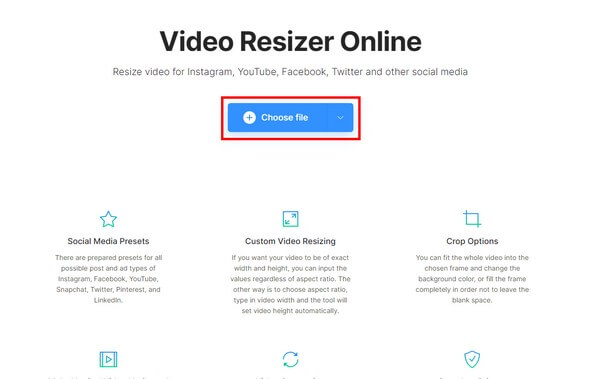
Step 2 Choose from preset options like 1080p, 720p, or 480p. Some tools let you enter custom dimensions if you need a specific size. For example, CloudConvert lets you click the wrench icon and select a resolution from the dropdown.
Step 3 Click convert, wait for processing (usually 1–3 minutes for a 5-minute clip), then download the result.
Privacy Warning: Never upload sensitive footage to online converters. I made this mistake once with a client project that had confidential information. If your video contains private content, business material, or anything personal, use offline software.
Part 3: Pro Desktop Method – FoneLab Video Converter Ultimate
When I need consistent quality and control, FoneLab Video Converter Ultimate is my go-to tool. It's a professional desktop application that does far more than just resolution changes.
Video Converter Ultimate is the best video and audio converting software which can convert MPG/MPEG to MP4 with fast speed and high output image/sound quality.
- Convert any video/audio like MPG, MP4, MOV, AVI, FLV, MP3, etc.
- Support 1080p/720p HD and 4K UHD video converting.
- Powerful editing features like Trim, Crop, Rotate, Effects, Enhance, 3D and more.
Why I Choose FoneLab Video Converter Ultimate:
- Offline processing – your files stay on your computer
- Video enhancer with AI-powered upscaling
- Supports 4K, 1080p, 720p, and custom resolutions
- Batch conversion for multiple files
- Additional editing: crop, trim, rotate, add subtitles, remove watermarks
Step 1 Download and install from the links above. Installation takes about a minute. Launch the program when complete.
Step 2 Click Add Files in the top-left corner. Navigate to your video file and select it. The video will appear in the interface with editing options below.
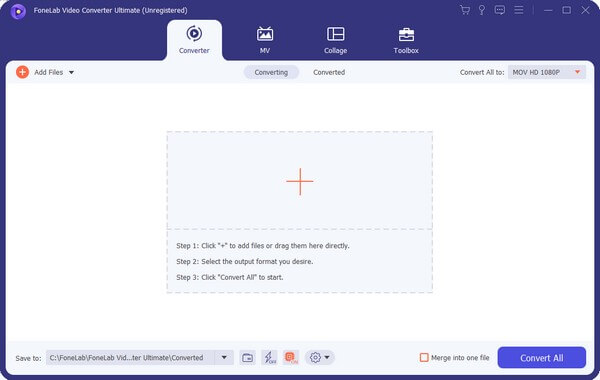
Step 3 Click the Format bar in the top-right. Select your target output format and resolution – options include 1080p HD, 720p HD, and 4K UHD presets. For upscaling, use the Toolbox section to access the Video Enhancer. You can boost resolution while also reducing noise and adjusting sharpness.
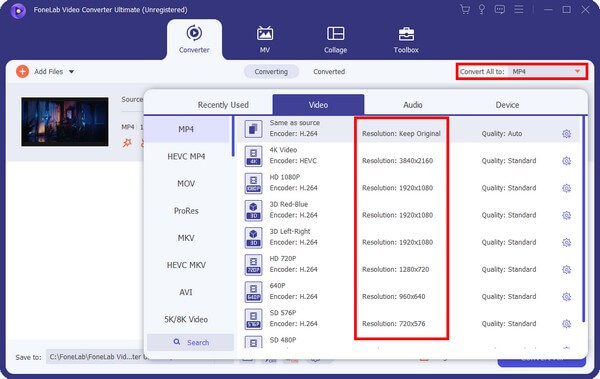
Step 4 Click Convert All to process your video. The output will save to your chosen folder. For batch jobs, you can queue multiple videos and let it run overnight.
Video Converter Ultimate is the best video and audio converting software which can convert MPG/MPEG to MP4 with fast speed and high output image/sound quality.
- Convert any video/audio like MPG, MP4, MOV, AVI, FLV, MP3, etc.
- Support 1080p/720p HD and 4K UHD video converting.
- Powerful editing features like Trim, Crop, Rotate, Effects, Enhance, 3D and more.
Part 4: Free Desktop Option – HandBrake
For a free, powerful alternative, HandBrake is the industry standard. It's open-source, regularly updated, and trusted by millions. In my testing, I found HandBrake achieves quality-to-size ratios comparable to paid tools.
Why HandBrake Works:
- Completely free and open-source
- Hardware acceleration (NVENC, QSV, QuickSync) – 3-5x faster for 4K
- Device-specific presets (Apple TV 4K, Roku, Chromecast, Android)
- Batch processing with queue system
Step 1 Go to handbrake.fr and download the version for your system. Install normally.
Step 2 Click File or drag your video directly into the HandBrake window. The video will load with a preview.
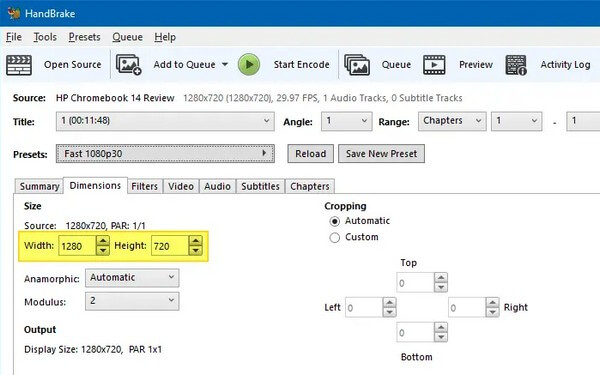
Step 3 Go to the Dimensions tab. Here you can adjust width and height manually or use the preset options. To maintain aspect ratio, ensure the "Keep Aspect Ratio" box is checked. You can also crop unwanted areas.
Step 4 Select a preset like Fast 1080p30 or Production Standard from the preset panel. Click the green Start Encode button at the top. The video will process – a 5-minute clip takes 15-45 seconds with hardware acceleration.
Part 5: Developer Method – FFmpeg Command Line
For batch processing, automation, or maximum control, FFmpeg is unmatched. It's a command-line tool that powers most other video converters behind the scenes. I use this when I need to process dozens of files or integrate video conversion into automated workflows.
Essential FFmpeg Commands I Use Regularly:
Basic Resolution Change (to 1080p):
ffmpeg -i input.mp4 -vf scale=1920:1080 output.mp4
Maintain Aspect Ratio Automatically (scale width to 1280):
ffmpeg -i input.mp4 -vf scale=1280:-1 output.mp4
Upscaling with Better Quality (Lanczos algorithm):
ffmpeg -i input.mp4 -vf scale=3840:2160:flags=lanczos output.mp4
The Lanczos algorithm provides the best quality for upscaling, though it's slower than other methods.
Upscale to 4K with Quality Settings:
ffmpeg -i input.mp4 -vf scale=3840:2160 -c:v libx264 -crf 18 -c:a copy output.mp4
Step-by-Step Workflow:
Step 1 Install FFmpeg: Windows – download from ffmpeg.org and add to PATH; Mac – brew install ffmpeg (if you have Homebrew); Linux – sudo apt install ffmpeg.
Step 2 Open Terminal/Command Prompt and navigate to the folder containing your video using cd path/to/folder.
Step 3 Enter your chosen FFmpeg command and press Enter. The video will process – speed depends on your hardware and file size.
Step 4 The new video will appear in the same folder with your specified filename.
Video Converter Ultimate is the best video and audio converting software which can convert MPG/MPEG to MP4 with fast speed and high output image/sound quality.
- Convert any video/audio like MPG, MP4, MOV, AVI, FLV, MP3, etc.
- Support 1080p/720p HD and 4K UHD video converting.
- Powerful editing features like Trim, Crop, Rotate, Effects, Enhance, 3D and more.
Part 6: Changing Resolution on Mobile
Mobile video resolution is usually handled at the export stage, not after recording. Here's what works based on my testing.
Native Settings:
iPhone (iOS): Go to Settings > Camera > Record Video. Choose between 720p HD at 30fps (smallest files), 1080p HD, or 4K for highest quality.
Android: Open your camera app, go to Settings (gear icon). Look for Video resolution or Video quality. Options vary by device but typically include 720p, 1080p, and 4K.
Mobile Editing Apps:
- CapCut (free, iOS & Android): Import your video, tap Export, and choose resolution before saving. Options include 720p, 1080p, and 4K.
- InShot (free with watermark, paid for pro): Similar workflow – import, edit, then select resolution in export settings.
Part 7: Troubleshooting Common Issues
Why Does My Video Look Stretched or Distorted?
The Fix: Your aspect ratio changed. If you went from 16:9 to 4:3 without cropping, your video will stretch.
Solutions:
- Letterboxing: Add black bars to maintain the original ratio. HandBrake does this automatically if "Keep Aspect Ratio" is checked.
- Cropping: Crop the video to the new aspect ratio, losing some edges but preserving shape.
- Don't manually adjust both dimensions without understanding the original ratio.
Why Did My File Size Double After Changing Resolution?
The Fix: Resolution and bitrate are connected. When you increase resolution without adjusting bitrate, the encoder often increases bitrate to maintain quality, ballooning file size.
Solutions:
- Lower the bitrate in your encoder settings
- Use a more efficient codec like H.265 (HEVC) instead of H.264
- HandBrake lets you set Quality (RF) – lower numbers = better quality = larger files
Higher resolutions typically require higher bitrates to maintain quality. Always adjust bitrate settings alongside pixel dimensions.
Video Converter Ultimate is the best video and audio converting software which can convert MPG/MPEG to MP4 with fast speed and high output image/sound quality.
- Convert any video/audio like MPG, MP4, MOV, AVI, FLV, MP3, etc.
- Support 1080p/720p HD and 4K UHD video converting.
- Powerful editing features like Trim, Crop, Rotate, Effects, Enhance, 3D and more.
Frequently Asked Questions
What's the best resolution for YouTube?
1080p (1920×1080) is the most common and widely supported. YouTube also handles 4K (3840×2160) for higher quality videos. For vertical content like Shorts, use 1080×1920.
What is the best resolution for my monitor?
The best resolution is typically your monitor's native resolution, which provides the sharpest image. You can check this in your display settings.
Can I upscale a 480p video to 1080p?
Yes, but with limits. FFmpeg can upscale using the Lanczos algorithm, and tools like FoneLab Video Converter Ultimate include AI enhancement features that can improve quality during upscaling. However, upscaling cannot create detail that wasn't in the original.
Why does my video appear blurry after changing resolution?
Blurriness often occurs when using a resolution that does not match the video's native settings, or when using a poor scaling algorithm. For best results, use Lanczos scaling in FFmpeg or the video enhancer in FoneLab Video Converter Ultimate.
What's the difference between 4K and 1080p?
4K (3840×2160) has approximately 4× the pixels of 1080p (1920×1080). This means 4K can display much more detail, especially on larger screens. However, 4K files are significantly larger.
Final Thoughts
Changing video resolution doesn't have to be complicated. Based on my hands-on experience across dozens of tools and hundreds of conversions, here's my recommendation:
- For quick one-off conversions: Use online tools like CloudConvert or Adobe Express
- For the best quality and control: FoneLab Video Converter Ultimate with its video enhancer features
- For free, professional-quality results: HandBrake with hardware acceleration
- For batch processing or automation: FFmpeg with Lanczos scaling
One final tip: If you're posting to social media, check platform requirements before converting. YouTube handles 4K and HDR, while TikTok and Reels need vertical 9:16 formats with specific resolutions.
Video Converter Ultimate is the best video and audio converting software which can convert MPG/MPEG to MP4 with fast speed and high output image/sound quality.
- Convert any video/audio like MPG, MP4, MOV, AVI, FLV, MP3, etc.
- Support 1080p/720p HD and 4K UHD video converting.
- Powerful editing features like Trim, Crop, Rotate, Effects, Enhance, 3D and more.