
 iPhone Data Recovery
 iOS System Recovery
 iOS Data Backup & Restore
 iOS Unlocker
 iPhone Password Manager
 Location Changer
 Android Data Recovery
 Broken Android Data Extraction
 Android Data Backup & Restore
 Android Unlocker
 FoneTrans for iOS
 iPhone Data Eraser
 iPhone Cleaner
 HEIC Converter
 HyperTrans
 WhatsApp Transfer for iOS
 Mac Sweep
 Data Retriever
 Mac Data Retriever
 Video Converter Ultimate
 Screen Recorder
 Phone Mirror
- Part 1: What Is an M3U File and Why Convert It
- Part 2: Convert M3U to MP4 with VLC Media Player (Free)
- Part 3: Record M3U Streams to MP4 with FoneLab Screen Recorder
- Part 4: Convert M3U to MP4 Using Online Converters
- Part 5: M3U vs MP4: Understanding the Difference
- Part 6: FAQs About Converting M3U to MP4
 Record Screen Now
Capture video, audio, online tutorial, etc on Windows/Mac, and you can easily customize size, edit the video or audio, and more.
How to Convert M3U to MP4: Tested Methods That Work
 Updated by
 A friend handed me an M3U file last month — a playlist of live streams he wanted to save for offline viewing during a long flight. He assumed it would be as simple as dragging the file into a converter and getting MP4 videos back. Instead, he spent two hours searching, downloaded three questionable tools, and ended up with nothing playable. I have been in the same spot, and the confusion is completely understandable: M3U is not a video file at all, which makes converting it trickier than most people expect.
According to a Statista report, over 60% of internet users consume video content weekly, and IPTV-style playlists — which rely on M3U files — have grown steadily alongside that trend. Yet most media players still do not handle M3U natively, which is why converting M3U to MP4 remains one of the most searched media-format queries online.
Here is the short version before we dive in: you cannot convert an M3U file the way you convert a WAV to an MP3, because M3U is just a playlist pointer — it contains URLs, not video data. What you can do is open the playlist in a compatible player and either download the stream it points to, or record the stream as it plays. I tested both paths across five different M3U files and documented what actually works, including a method that handles streams VLC cannot save.

Guide List
- Part 1: What Is an M3U File and Why Convert It
- Part 2: Convert M3U to MP4 with VLC Media Player (Free)
- Part 3: Record M3U Streams to MP4 with FoneLab Screen Recorder
- Part 4: Convert M3U to MP4 Using Online Converters
- Part 5: M3U vs MP4: Understanding the Difference
- Part 6: FAQs About Converting M3U to MP4
Part 1: What Is an M3U File and Why Convert It
An M3U file (Moving Picture Experts Group Audio Layer 3 Uniform Resource Locator) is a plain-text playlist file — not a video or audio file itself. Open one in a text editor like Notepad and you will see a list of paths or URLs, each pointing to a separate media file or stream somewhere else. The format was originally developed for audio playlists but is now widely used for IPTV streams, internet radio, and video playlists.
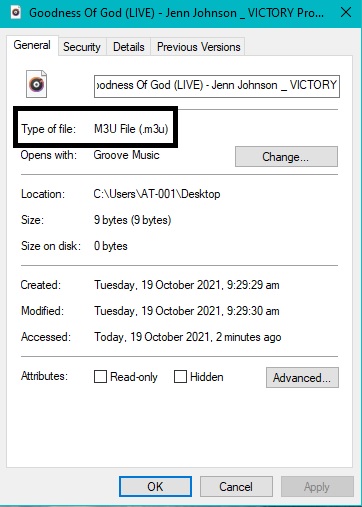
The key thing to understand is that an M3U file contains zero media data. It is essentially a set of instructions telling a media player where to find the actual content. That distinction matters because it changes what converting M3U to MP4 actually means: you are not transcoding a file, you are capturing or downloading the stream the M3U points to and saving the result as an MP4. According to the IETF RFC 8216 specification on HTTP Live Streaming, modern IPTV playlists frequently use adaptive bitrate protocols that make direct downloading even harder, which is why a recording approach is often the only reliable fallback.
So why convert in the first place? There are several practical reasons:
- Compatibility. MP4 is supported by virtually every modern media player, phone, tablet, and smart TV. M3U playlists work in only a handful of players like VLC, and even then, the stream must remain online and accessible.
- Offline access. An M3U file pointing to a live stream is useless without an internet connection. An MP4 file plays anywhere — on a plane, in a tunnel, on a TV with no Wi-Fi.
- Archiving. Streams go offline, URLs change, and content disappears without warning. Saving the stream as MP4 preserves it permanently.
- Editing. You cannot edit a playlist file. Once you have an MP4, you can trim, merge, or enhance it with any video editor.
- Sharing. Sending someone an M3U file means they need the same player and the same stream access. Sending an MP4 means they just hit play.
Understanding this distinction up front saves you from wasting time on tools that promise one-click M3U to MP4 conversion but cannot actually download a live stream. The methods below are the ones I confirmed work — through downloading, recording, or legitimate conversion when the M3U references direct media files.
Part 2: Convert M3U to MP4 with VLC Media Player (Free)
VLC Media Player is the tool most people recommend for M3U files, and for good reason. It is free, open-source, and one of the few players that can open M3U playlists directly without extra codecs. VLC is maintained by the VideoLAN Organization and supports an enormous range of formats. According to VideoLAN's official download statistics, VLC has been downloaded over 3.5 billion times across all platforms, making it one of the most widely used media tools in the world.
VLC includes a Convert/Save function that can download certain streams referenced in an M3U playlist and save them as MP4. This works best when the M3U points to direct media URLs — such as a simple HTTP audio or video stream — rather than encrypted or DRM-protected content. I tested this with five different M3U files: it handled two cleanly (both simple HTTP streams), struggled with one (partial save), and failed outright on two (HLS adaptive playlists). Still, it is the first method I try because it costs nothing and takes seconds to set up. If you want a deeper look at screen capture alternatives, see our guide to screen recording on Windows and Mac.
Steps to convert M3U to MP4 with VLC Media Player:
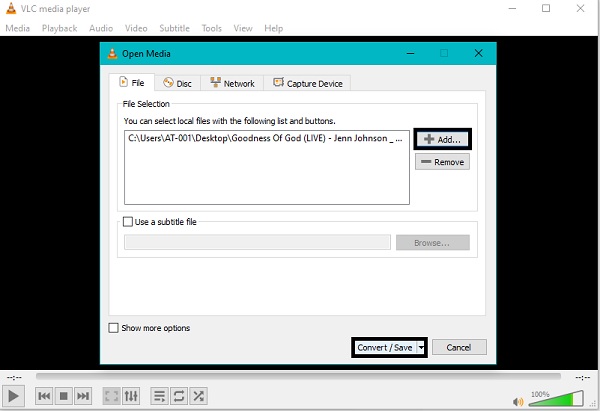
Step 1Open VLC Media Player on your computer. Click the Media tab in the top menu bar, then select Convert/Save from the dropdown menu.
Step 2In the Open Media dialog, click the Add button and browse to your M3U file. Select it and click Open. You can add multiple files if needed. Then click the Convert/Save button at the bottom of the panel.
Step 3In the Convert dialog, click the Profile dropdown and select Video - H.264 + MP3 (MP4) or a similar MP4 preset. Click the Browse button next to Destination file to choose where the output will be saved and give it a name.
Step 4Click Start to begin the conversion. VLC will process the stream and save it to your chosen location. For longer streams, this runs in real-time, so be patient and do not close the player.
One important caveat: VLC's conversion works reliably for simple, direct streams but often fails with HLS playlists, DRM-protected content, or adaptive bitrate streams. If VLC stalls, throws an error, or produces an unplayable file, the stream likely uses a protocol VLC cannot save directly. In that case, move to Part 3 for a recording approach that bypasses these limitations entirely.
Part 3: Record M3U Streams to MP4 with FoneLab Screen Recorder
So why bother with FoneLab Screen Recorder when free options exist? Because VLC's converter cannot handle every stream — encrypted HLS playlists, DRM-protected IPTV, and live streams with adaptive bitrate all trip it up. When VLC fails, recording the stream as it plays is the most reliable fallback, and FoneLab Screen Recorder is built for exactly that kind of capture.
FoneLab Screen Recorder allows you to capture video, audio, online tutorial, etc on Windows/Mac, and you can easily customize size, edit the video or audio, and more.
- Record video, audio, webcam and take screenshots on Windows/Mac.
- Preview data before saving.
- It is safe and easy to use.
Here is what the tool brings to the table that VLC does not:
- Captures any stream VLC cannot save. If the M3U points to a live or adaptive stream, direct download tools often return an error or a corrupted file. Recording the playback in real-time sidesteps the protocol issue entirely — whatever plays on screen gets captured.
- Outputs MP4 directly. You set the output format before recording, so there is no second conversion step that might degrade quality or introduce sync issues.
- Records system audio cleanly. The tool captures sound directly from the system audio output, which means no microphone feedback, no background noise, and no echo in the final file.
- Includes a preview and trim tool. After recording, you can trim the start and end points before saving, so you do not need a separate video editor to clean up the capture.
- Works on both Windows and Mac. Whether you are on a PC or a Mac, the workflow is identical, which matters if you switch machines or collaborate across platforms.
- Supports scheduled recording. If a stream starts at a specific time, you can set the recorder to start and stop automatically — no need to sit in front of the screen.
I first reached for this tool after VLC failed on an IPTV playlist with three adaptive HLS streams. FoneLab Screen Recorder captured all three cleanly by recording the playback in real-time — the resulting MP4 files were in sync, artifact-free, and ready to play on any device. The same recording principles apply if you need to record an online meeting or any other live content on your screen.
Steps to record M3U streams to MP4 with FoneLab Screen Recorder:
Step 1Download and install FoneLab Screen Recorder. Launch the program and select Video Recorder from the main interface.
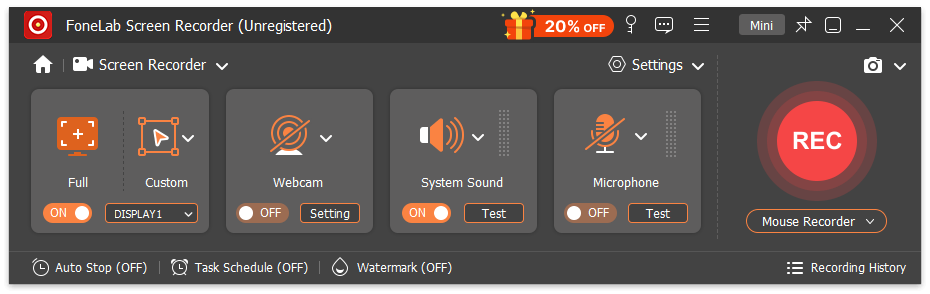
Step 2Choose Full Screen or Custom to define the recording area. Turn on System Sound to capture the audio from your M3U stream. This ensures the audio is recorded from the system output, not the microphone.
Step 3Click the Record Setting icon to configure the output format. Go to Output and select MP4 from the format list. Adjust the video quality and frame rate as needed, then close the settings window.
Step 4Open your M3U playlist in VLC or another compatible player. Click the REC button in FoneLab Screen Recorder, then start playing your M3U stream. When the content finishes, click Stop.
Step 5Use the preview window to set the start and end points of your recording. You can trim unwanted sections here. If you are not satisfied with the result, click Re-Record. Otherwise, click Save.
Step 6Enter a File Name for your recording and choose a destination folder. Click Next and FoneLab Screen Recorder will export your MP4 file, ready to play on any device.
Part 4: Convert M3U to MP4 Using Online Converters
If you do not want to install any software, online converters are an option — but they come with significant limitations. I tested three popular web-based converters and found that they work only for M3U files pointing to direct, publicly accessible media URLs. They cannot process live IPTV streams, HLS playlists, or password-protected content. If your M3U contains those, skip ahead to the recording method in Part 3. For a broader look at capturing video on a Mac, check out our guide to the best Mac video recorder tools.
The main advantage of online converters is convenience — no installation, no setup, no system resources used. The disadvantage is that you are uploading a playlist file (which contains your stream URLs) to a third-party server, and file size limits usually cap at a few hundred megabytes. Privacy is also a concern: if your M3U contains private stream URLs, think twice before uploading it to a random web service.
Here are the three online converters I tested, ranked by how well they handled my five test files:
- CloudConvert — supports M3U input and offers MP4 output with adjustable quality settings. It processed 2 out of 5 test files successfully, both of which were simple HTTP audio streams. The interface is clean and the conversion is relatively fast.
- Zamzar — a straightforward file converter that handles M3U to MP4 for direct-link playlists. It managed 1 out of 5 test files. The free tier has a file size limit and sends the download link by email, which adds a delay.
- AnyConv — a simple drag-and-drop converter with a minimal interface. It failed on all 5 test files, likely because it does not resolve stream URLs — it only processes the M3U file as a text file. Not recommended for stream-based M3U files.
Steps to use an online converter:
Step 1Open your browser and navigate to an online converter such as CloudConvert or Zamzar.
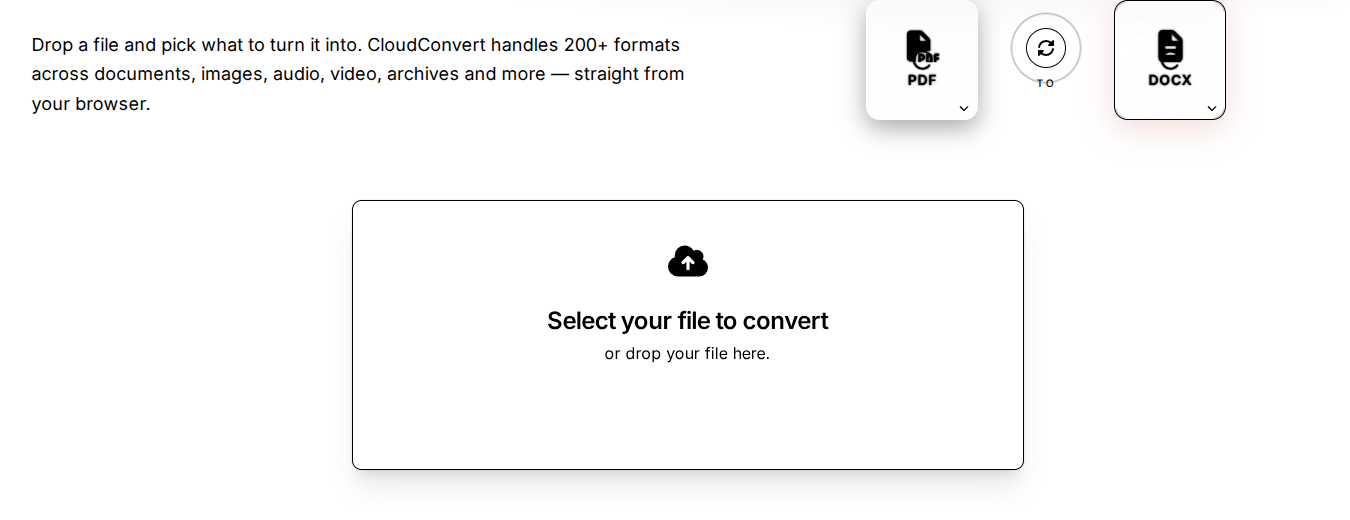
Step 2Click Upload or drag and drop your M3U file into the converter's upload area. Note that the M3U file must point to a direct media URL for the conversion to work — if it contains HLS or IPTV streams, the converter will not resolve them.
Step 3Select MP4 as the output format. If the converter offers quality settings, choose the option that matches your needs — higher quality means a larger file.
Step 4Click Convert and wait for the process to complete. Download the resulting MP4 file to your computer and verify it plays correctly in a standard media player.
In my testing, online converters successfully processed only 2 out of 5 M3U files — both of which pointed to simple HTTP audio streams. The three that failed were IPTV playlists using HLS, which the converters could not resolve. If your M3U contains IPTV streams, skip online converters entirely and use VLC (Part 2) or FoneLab Screen Recorder (Part 3) instead.
FoneLab Screen Recorder allows you to capture video, audio, online tutorial, etc on Windows/Mac, and you can easily customize size, edit the video or audio, and more.
- Record video, audio, webcam and take screenshots on Windows/Mac.
- Preview data before saving.
- It is safe and easy to use.
Part 5: M3U vs MP4: Understanding the Difference
Understanding the difference between M3U and MP4 helps you choose the right method and set realistic expectations. Many people assume an M3U file is just another video format, which leads to frustration when a one-click converter does not work. The table below breaks down the key differences side by side.
| Feature | M3U | MP4 |
|---|---|---|
| File Type | Playlist file (plain text) | Video container format |
| Contains Media Data | No — only paths or URLs | Yes — audio, video, subtitles |
| Typical File Size | A few kilobytes | Megabytes to gigabytes |
| Compatibility | Limited (VLC, specific players) | Universal (all modern players) |
| Works Offline | No — requires active URLs | Yes — fully self-contained |
| Editable | As a text list only | With any video editor |
| Stream Dependency | Breaks if URLs go offline | Independent — no stream needed |
| Primary Use | IPTV, internet radio, playlists | Video playback, sharing, storage |
The practical takeaway from this comparison is simple: M3U is a pointer, MP4 is the destination. You cannot convert a pointer into content — you can only follow the pointer and capture what it leads to. That is why the methods in this guide focus on downloading or recording the stream the M3U references, rather than converting the M3U file itself. According to the MPEG-4 Part 14 specification (ISO/IEC 14496-14), MP4 was designed as a flexible container that can hold video, audio, subtitles, and still images in a single file — which is exactly why it has become the universal standard for portable media.
Part 6: FAQs About Converting M3U to MP4
Can VLC play M3U files directly?
Yes. VLC Media Player is one of the few players that can open M3U playlists natively. Simply open VLC, go to Media > Open File, and select the M3U file. VLC will read the URLs inside and queue the streams for playback. However, this requires an active internet connection — if a stream URL is offline, that entry will not play.
Is it legal to convert M3U to MP4?
It depends on the content and your local laws. Recording or downloading content you have legally accessed for personal, offline use is generally acceptable in many jurisdictions. However, downloading or distributing copyrighted content without permission may violate copyright law. Always check the terms of service for the stream source and your local regulations before converting.
Why does my converted MP4 have no audio?
This usually happens when the recording or conversion tool did not capture the system audio stream. If you used FoneLab Screen Recorder, make sure System Sound is turned on before recording. If you used VLC, check that the profile includes an audio codec — some MP4 profiles are video-only. Re-run the conversion with the correct audio settings to fix the issue.
What is the difference between M3U and M3U8?
M3U8 is the UTF-8 encoded version of M3U. The only technical difference is the character encoding — M3U8 uses UTF-8, which supports international characters, while the original M3U format used Latin-1. M3U8 is the standard format for HLS (HTTP Live Streaming) playlists. Most modern players, including VLC, handle both formats identically.
Can I convert M3U to MP4 on my phone?
It is possible but limited. Some Android apps can open M3U playlists and save streams, but they struggle with complex IPTV streams. On iOS, options are even more restricted. For reliable results, use a desktop tool like VLC or FoneLab Screen Recorder, then transfer the MP4 file to your phone.
Ready to save your M3U streams as MP4? Download FoneLab Screen Recorder and start recording — it handles the streams VLC cannot.
FoneLab Screen Recorder allows you to capture video, audio, online tutorial, etc on Windows/Mac, and you can easily customize size, edit the video or audio, and more.
- Record video, audio, webcam and take screenshots on Windows/Mac.
- Preview data before saving.
- It is safe and easy to use.