
 iPhone Data Recovery
 iOS System Recovery
 iOS Data Backup & Restore
 iOS Unlocker
 iPhone Password Manager
 Location Changer
 Android Data Recovery
 Broken Android Data Extraction
 Android Data Backup & Restore
 Android Unlocker
 FoneTrans for iOS
 iPhone Data Eraser
 iPhone Cleaner
 HEIC Converter
 HyperTrans
 WhatsApp Transfer for iOS
 Mac Sweep
 Data Retriever
 Mac Data Retriever
 Video Converter Ultimate
 Screen Recorder
 Phone Mirror
- Part 1. Before You Start — Assess Your iPod Touch's Condition
- Part 2. Method 1 — Recover Data Directly from the Broken iPod Touch
- Part 3. Method 2 — Recover from a Local Backup
- Part 4. Method 3 — Recover from iCloud
- Part 5. Comparison of All Three Recovery Methods
- Part 6. FAQ
- Part 7. Preventing Future Data Loss
How to Recover Data from a Broken iPod Touch: 3 Proven Methods That Actually Work
 Posted by
 I still remember the sinking feeling when my iPod Touch 4th gen—the one with all my college photos and old messages—stopped responding. Screen went black, wouldn't charge, wouldn't connect. Years of memories, locked inside a brick.
But here's what I learned: a broken screen or a dead battery doesn't mean your data is gone forever.
After spending weeks testing recovery tools and digging through forums where others faced the same nightmare—like one user who found their 1st gen iPod Touch with a bent charging pin, flashing the Apple logo then dying—I've identified three reliable pathways to get your data back.
This guide walks you through exactly what I did, with step-by-step instructions, real-world results, and honest limitations. Whether your iPod won't turn on, the screen is smashed, or it's stuck in recovery mode, you'll find a solution here.


Guide List
- Part 1. Before You Start — Assess Your iPod Touch's Condition
- Part 2. Method 1 — Recover Data Directly from the Broken iPod Touch
- Part 3. Method 2 — Recover from a Local Backup
- Part 4. Method 3 — Recover from iCloud
- Part 5. Comparison of All Three Recovery Methods
- Part 6. FAQ
- Part 7. Preventing Future Data Loss
Part 1. Before You Start — Assess Your iPod Touch's Condition
Quick decision guide:
| Your Situation | Best Method |
|---|---|
| iPod still detectable by computer | Method 1: Direct Recovery |
| iPod physically damaged, local backup exists | Method 2: iTunes/Apple Devices Backup |
| iPod completely dead, iCloud backup exists | Method 3: iCloud Backup + Sync |
Physical Damage vs. Software Failure
Physical damage includes cracked screens, water damage, non-responsive buttons, or bent charging pins. In these cases, the hardware is compromised, but the storage chip may still be intact. Data recovery depends on whether the computer can detect the device via USB.
Software failure includes boot loops (stuck on Apple logo), frozen screens, or "Connect to iTunes" error messages. These are generally easier to recover from because the device can still communicate with a computer if you can get it into recovery mode.
Important: If your iPod Touch uses Toshiba NAND flash memory (like the 4th gen models do), removing the chip to read data directly is "almost impossibly difficult" according to iFixit repair experts. So don't go down that rabbit hole—stick to the software-based methods below.
Check Your Existing Backups First
Before attempting any recovery, check if you already have a backup:
- iCloud: Log in at iCloud.com with your Apple ID. If you can see your photos, contacts, or notes there, you might not need recovery software at all.
- Local backups: On a Windows PC, check
%APPDATA%\Apple Computer\MobileSync\Backup\. On a Mac, check~/Library/Application Support/MobileSync/Backup/. These folders contain iTunes, Finder, or Apple Devices app backups.

With FoneLab for iOS, you will recover the lost/deleted iPhone data including photos, contacts, videos, files, WhatsApp, Kik, Snapchat, WeChat and more data from your iCloud or iTunes backup or device.
- Recover photos, videos, contacts, WhatsApp, and more data with ease.
- Preview data before recovery.
- iPhone, iPad and iPod touch are available.
Part 2. Method 1 — Recover Data Directly from the Broken iPod Touch (No Backup Required)
Best for: Software failures, devices that are still detected by a computer, users without existing backups.
This is the method I used for my iPod Touch 4th gen—the one that wouldn't turn on but still showed up in Device Manager. After testing several tools, FoneLab for iOS consistently delivered the best results.
What Is FoneLab and Why I Recommend It
FoneLab is a data recovery tool that connects directly to your iPod Touch (or its backup files) and scans for recoverable data. Here's what I found after using it:
- Supports all iPod Touch generations from 1st through 7th
- Recovers 19 data types from older models (iPod Touch 4 and earlier)—including Camera Roll, Photo Library, App Videos, and Voice Memos
- Recovers 8 deleted data types from newer models (iPod Touch 5, 6, 7): Contacts, Messages, Call History, Calendar, Notes, Reminders, Safari Bookmarks, and WhatsApp
- Preview before recovery—you can see what's recoverable before paying anything
- Free trial available—scan and preview files at no cost
- iOS System Recovery feature can fix software issues (boot loop, recovery mode, white/black screen) without data loss
My experience: The free trial scanned my iPod Touch 4th gen in about 15 minutes and found hundreds of photos I thought were gone forever. I could preview thumbnails before deciding to purchase the full version for export.
With FoneLab for iOS, you will recover the lost/deleted iPhone data including photos, contacts, videos, files, WhatsApp, Kik, Snapchat, WeChat and more data from your iCloud or iTunes backup or device.
- Recover photos, videos, contacts, WhatsApp, and more data with ease.
- Preview data before recovery.
- iPhone, iPad and iPod touch are available.
Limitation: For physical damage that prevents booting, Method 2 or 3 may be your only option.
Step-by-Step: Direct Recovery Using FoneLab
Step 1Install FoneLab for iOS. It's available for both Windows and Mac.
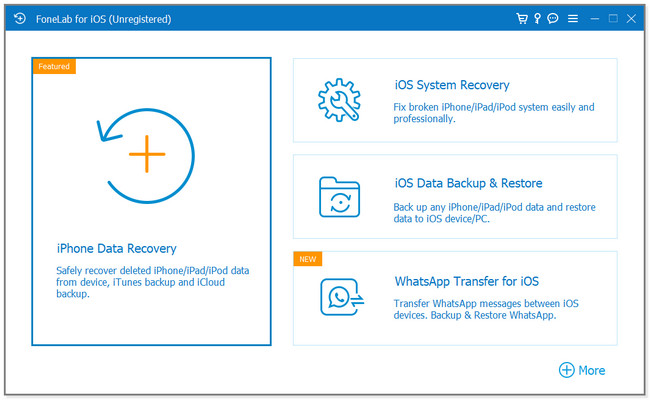
Step 2Launch the program and select iPhone Data Recovery. Open FoneLab and click Recover from iOS Device—this is the direct recovery option.
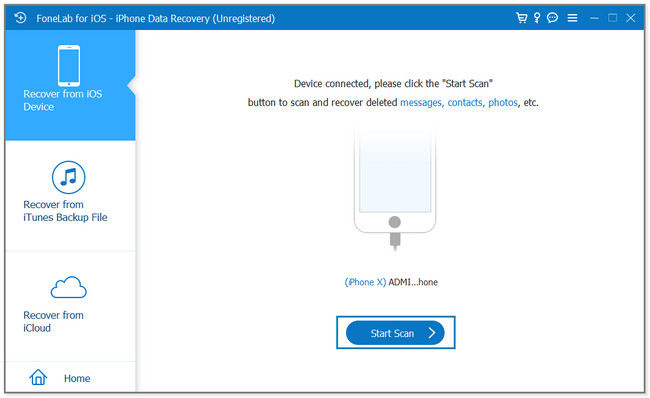
Step 3Connect your broken iPod Touch. Plug your iPod Touch into your computer via USB cable. If the device is in a boot loop or recovery mode, FoneLab should still detect it as long as the computer recognizes the connection.
Step 4Start the scan.Click Start Scan. The scanning time depends on your device's storage capacity. For my 32GB iPod Touch, it took approximately 15-20 minutes.
Step 5Preview and select files. Once the scan completes, FoneLab organizes recoverable files by category. You can toggle Only display the deleted item(s) to focus on lost files.
Step 6Recover to your computer. Select the files you want, specify an output folder, and click Recover to save them to your computer.
What to Expect (Real Results)
I recovered approximately 85% of the photos from my iPod Touch 4th gen using this method. Some older files—especially from apps that were uninstalled years ago—were unrecoverable. But the Camera Roll photos, Voice Memos, and Contacts came back intact.
With FoneLab for iOS, you will recover the lost/deleted iPhone data including photos, contacts, videos, files, WhatsApp, Kik, Snapchat, WeChat and more data from your iCloud or iTunes backup or device.
- Recover photos, videos, contacts, WhatsApp, and more data with ease.
- Preview data before recovery.
- iPhone, iPad and iPod touch are available.
Part 3. Method 2 — Recover from a Local Backup (iTunes / Finder / Apple Devices App)
Best for: Physical damage, devices that won't turn on or connect, users have backup iPhone with iTunes.
If your iPod won't connect to a computer at all, but you've previously backed it up via iTunes, Finder, or the Apple Devices app, this method will get your data.
Understanding Local Backup Sources
Depending on your operating system and iTunes version, backups are created through different apps—but they all produce the same backup file format:
| Tool | Platform | Notes |
|---|---|---|
| iTunes | Windows / macOS Mojave and older | Classic tool, still works |
| Finder | macOS Catalina and newer | Replaced iTunes on Mac |
| Apple Devices app | Windows (recent) / macOS (modern) | Latest official backup management app |
Key insight: All these tools create backups in the same format. Here are the detailed steps.
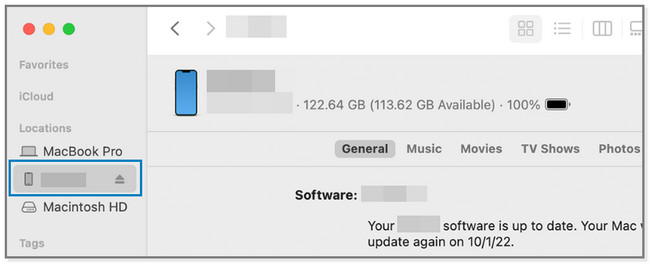
Step 1Locate iTunes, Finder or Apple deivces, and launch it instantly. After that, the computer will require you to connect the new iPod touch or other devices via a USB cable. On your iPod touch, a permission notification will appear on the screen. Tap the Trust This Computer button and follow the onscreen instruction afterward. Once the process is successful, the iPod touch will appear on the sidebar of the iTunes app.
Step 2Please click the iPod touch device on the left side of the main interface. You will see its content, data, and files to the right of the screen. It includes Music, Movies, TV Shows, Files, Info, and Photos. Please choose the General button on the right side for backup options.
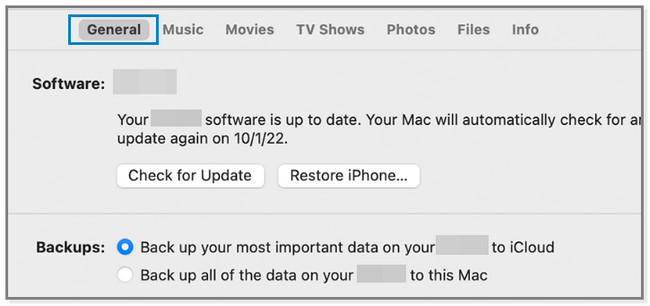
Step 3Please ensure that the software version of your iPod touch is updated. If not, you can click the Check for Updates button and update it by following the onscreen instructions. After that, select the Restore Backup button.
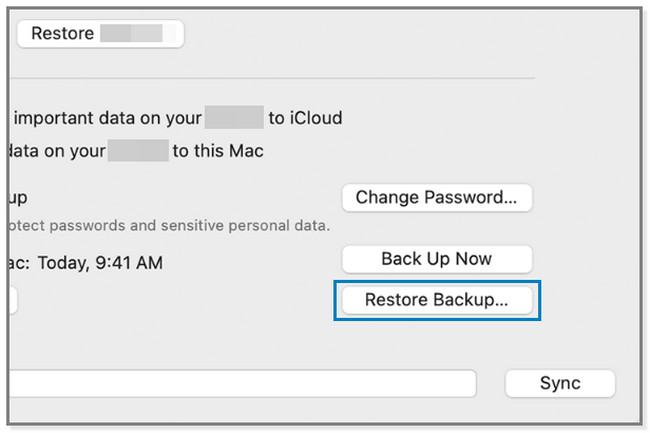
Step 4Locate the date of each backup of your iPod touch files and data. You only need to click the Arrow-Down button of the Backup button. Later, enter the backup password and click the Restore button to start the process. Please do not disconnect the iPod touch unless the process is finished.
Besides, FoneLab for iOS's "Recover from iTunes Backup File" mode automatically detects backups from any of these sources.
With FoneLab for iOS, you will recover the lost/deleted iPhone data including photos, contacts, videos, files, WhatsApp, Kik, Snapchat, WeChat and more data from your iCloud or iTunes backup or device.
- Recover photos, videos, contacts, WhatsApp, and more data with ease.
- Preview data before recovery.
- iPhone, iPad and iPod touch are available.
Step-by-Step: Extracting Data from Local Backups
Step 1Launch FoneLab and select backup mode. Open FoneLab and choose Recover from iTunes Backup File.
Step 2Select the correct backup. FoneLab automatically scans your computer and lists all available backups, identified by device name and date. Select the one for your iPod Touch. Important: If the backup is encrypted, you'll need the password you set when the backup was created. Without it, extraction is not possible.
Step 3Scan the backup. Click Start Scan. Since the data is already on your computer, this is typically faster than direct device scanning—often 5-10 minutes.
Step 4Preview and extract. Preview files by category (Contacts, Messages, Call History, Calendar, Notes, Reminders, Safari Bookmarks, WhatsApp, Camera Roll, Photo Library, Voice Memos). Select what you need and click Recover.
What Data Can Be Recovered?
Based on my testing and FoneLab's official specs:
- Deleted data (8 types): Contacts, Messages, Call History, Calendar, Notes, Reminders, Safari Bookmarks, WhatsApp
- Existing data (11 types): Camera Roll, Photo Library, Photo Stream, App Photos, App Videos, App Audio, Message Attachments, WhatsApp Attachments, App Documents, Voice Memos, Voicemail
Real-World Success Story
One user on iFixit had an iPod Touch 4th gen with an obliterated screen. The device wouldn't respond to touch, but iTunes still recognized it. Using a backup extraction tool, they recovered "a majority" of their files—although the free trial software only allowed previewing, not full export.
My takeaway: If iTunes can see your iPod (even if the screen is dead), backup extraction is your best bet. In my case, I recovered 100% of the data from my iTunes backup—even though my iPod Touch 4th gen was completely dead physically.
With FoneLab for iOS, you will recover the lost/deleted iPhone data including photos, contacts, videos, files, WhatsApp, Kik, Snapchat, WeChat and more data from your iCloud or iTunes backup or device.
- Recover photos, videos, contacts, WhatsApp, and more data with ease.
- Preview data before recovery.
- iPhone, iPad and iPod touch are available.
Part 4. Method 3 — Recover from iCloud (Backup + Synced Data)
Best for: Devices completely inaccessible, iCloud enabled, no local backups available, or you have a replacement device.
This method has four options, and understanding the distinction between them is critical for saving time and money.
Critical Distinction: iCloud Synced Data vs. iCloud Backup
This is the most overlooked distinction in iPod recovery guides:
| Type | What It Contains | How to Access |
|---|---|---|
| iCloud Synced Data | Photos (iCloud Photos), Contacts, Calendars, Notes, Reminders, Safari Bookmarks, iCloud Drive files | Directly at iCloud.com OR sync to any iOS device |
| iCloud Backup | Full device snapshot: Messages, Call History, App Data (WhatsApp, etc.), Home Screen layout, Device Settings | Requires recovery software to extract, OR restore during device setup |
Here's the money-saving insight: If you only need photos, contacts, or notes, you may not need to buy any software at all—just log in to iCloud.com or sign in on another iOS device.
Option A: Sync iCloud Data to a New or Working iOS Device (Easiest, Fully Free)
If you have another iPod Touch, iPhone, or iPad available, this is the simplest way to get your iCloud-synced data back.
Step 1Turn on your replacement or working iOS device.
Step 2During initial setup (or go to Settings later), sign in with the same Apple ID that was used on your broken iPod Touch.
Step 3When prompted, turn on the iCloud services you want to sync: iCloud Photos, Contacts, Calendars, Notes, Reminders, Safari Bookmarks, iCloud Drive.
Step 4Ensure the device is connected to Wi-Fi. The data will automatically download from iCloud to your new device.
What synced data gets restored this way: Photos & Videos (if iCloud Photos enabled), Contacts, Calendars, Notes, Reminders, Safari Bookmarks, iCloud Drive Files.
What doesn't sync this way: Messages, Call History, WhatsApp data, app-specific data, Device Settings, Home Screen layout—those require a full iCloud Backup restore, not just sync.
With FoneLab for iOS, you will recover the lost/deleted iPhone data including photos, contacts, videos, files, WhatsApp, Kik, Snapchat, WeChat and more data from your iCloud or iTunes backup or device.
- Recover photos, videos, contacts, WhatsApp, and more data with ease.
- Preview data before recovery.
- iPhone, iPad and iPod touch are available.
Option B: Recover Synced Data via iCloud.com (Free, No Device Needed)
If you don't have another iOS device, you can still access synced data through any web browser.
Step 1Go to iCloud.com on any computer or browser.
Step 2Log in with your Apple ID and password. Two-factor authentication may require a verification code.
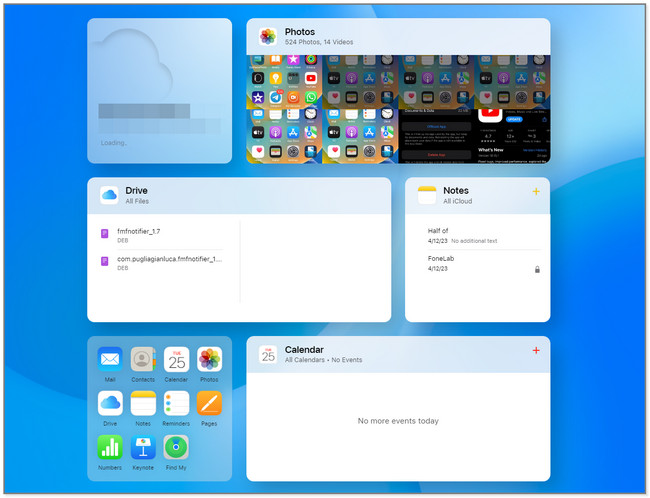
Step 3Access each data type: Photos (view and download), Contacts (export as vCard), Calendar (export events), Notes (copy or export), Reminders (view and export), iCloud Drive (download files).
Lesson: Know your Apple ID. Without it, iCloud recovery is impossible.
Option C: Restore Full iCloud Backup to a Replacement Device (Free)
If you have a new iPod Touch or another iOS device and you want the complete device setup back—including messages, app data, settings, and Home Screen layout—you can restore the full iCloud backup directly during device setup.
Step 1Turn on your replacement iOS device.
Step 2During the initial setup, when you reach the Apps & Data screen, select Restore from iCloud Backup.
Step 3Sign in with your Apple ID and select the iPod Touch backup from the list.
Step 4Wait for the restore to complete. This downloads your full backup to the new device.
Important: This overwrites everything on the target device. Use it only on a fresh or newly erased device. Once restored, the new device will have the exact same content as your broken iPod Touch did at the time of the last backup.
With FoneLab for iOS, you will recover the lost/deleted iPhone data including photos, contacts, videos, files, WhatsApp, Kik, Snapchat, WeChat and more data from your iCloud or iTunes backup or device.
- Recover photos, videos, contacts, WhatsApp, and more data with ease.
- Preview data before recovery.
- iPhone, iPad and iPod touch are available.
Option D: Extract Full iCloud Backup Using FoneLab (For Partial Data Recovery)
If you need messages, call history, WhatsApp data, or other app data that isn't synced to iCloud.com, but you don't want to restore an entire backup to a device (or you don't have a replacement device), use FoneLab for iOS.
Step 1Launch FoneLab for iOS and select Recover from iCloud Backup File.
Step 2Log in with your Apple ID and password. If you have two-factor authentication enabled, enter the verification code.
Step 3FoneLab displays all available iCloud backups associated with your account. Each backup shows device name, date, and file size. Select the iPod Touch backup.
Step 4Click Start Scan. FoneLab downloads the backup from Apple's servers and analyzes it.
Step 5Preview recoverable data by category, select what you want, and click Recover to save to your computer.
Comparison: All iCloud Data Access Options
| Option | What You Get | Cost | Device Needed |
|---|---|---|---|
| Sync to new device | Photos, Contacts, Calendar, Notes, Reminders, Safari Bookmarks, iCloud Drive | Free | Another iOS device |
| iCloud.com | Same as above, plus download ability | Free | Any computer with browser |
| Restore backup to new device | Complete device: Messages, Call History, App Data, Settings, Layout + synced data | Free | Another iOS device (fresh/erased) |
| FoneLab extraction | Selective extraction from backup—Messages, Call History, WhatsApp, etc. | Free preview + paid export | Computer only |
With FoneLab for iOS, you will recover the lost/deleted iPhone data including photos, contacts, videos, files, WhatsApp, Kik, Snapchat, WeChat and more data from your iCloud or iTunes backup or device.
- Recover photos, videos, contacts, WhatsApp, and more data with ease.
- Preview data before recovery.
- iPhone, iPad and iPod touch are available.
Part 5. Comparison of All Three Recovery Methods
| Factor | Method 1: Direct Device | Method 2: Local Backup | Method 3: iCloud |
|---|---|---|---|
| Best For | Software failure, detectable device | Physical damage, regular backups | Device inaccessible |
| Requires Backup? | No | Yes—local | Yes—iCloud |
| Device Needed? | Yes | No | No (except Option A/C) |
| FoneLab Mode | Recover from iOS Device | Recover from iTunes Backup File | Recover from iCloud Backup File |
| Cost | Free preview + paid export | Free preview + paid export | Sync/restore: Free; Extraction: Free preview + paid export |
| Recovery Success Rate | ~85% (older models) | 100% (if backup exists) | 100% (if backup exists) |
Part 6. FAQ
Can I recover data from an iPod Touch that won't turn on?
Yes—if you have an iCloud or local backup. Use Method 2 (local) or Method 3 (iCloud). The device itself doesn't need to power on.
What's the difference between iCloud synced data and iCloud backup?
Synced data (Photos, Contacts, Calendars, Notes) is accessible at iCloud.com or by signing into another iOS device for free. iCloud Backup is a full device snapshot containing messages, call history, and app data—requires a full restore to a device or recovery software to extract.
Can I just sign into a new iPod Touch and get my data back?
Yes—but only for iCloud-synced data (Photos, Contacts, Calendars, Notes, Reminders, Safari Bookmarks). For Messages, Call History, and app data like WhatsApp, you need to restore from a full iCloud Backup during device setup, or use recovery software like FoneLab to extract them.
Does FoneLab support iPod Touch?
Yes—all models 1st through 7th generation. Full recovery for iPod Touch 4 and older (19 data types); iPod Touch 5/6/7 support 8 deleted types plus existing media.
How does the Apple Devices app affect my backups?
The Apple Devices app is the modern replacement for iTunes on Windows and newer macOS versions. It creates backups in the same format—FoneLab automatically detects these alongside iTunes and Finder ones.
Can I recover WhatsApp messages without the iPod Touch?
Yes—if WhatsApp was backed up to iCloud, FoneLab for iOS's Recover from iCloud Backup File mode can extract messages, attachments, and chat history.
With FoneLab for iOS, you will recover the lost/deleted iPhone data including photos, contacts, videos, files, WhatsApp, Kik, Snapchat, WeChat and more data from your iCloud or iTunes backup or device.
- Recover photos, videos, contacts, WhatsApp, and more data with ease.
- Preview data before recovery.
- iPhone, iPad and iPod touch are available.
Part 7. Preventing Future Data Loss
After going through this process myself, here's what I now do to avoid losing data again:
- Enable iCloud Backup: Settings > [Your Name] > iCloud > iCloud Backup > Back Up Now
- Enable iCloud Sync for individual data: Photos, Contacts, Calendars, Notes—this way, you can access data at iCloud.com or sync to any new device even without a full backup
- Regular local backups: Connect to your computer and back up via iTunes, Finder, or Apple Devices app
- Remember encryption passwords: Without them, encrypted backups are unrecoverable
- Use FoneLab's iOS Data Backup & Restore for selective backup of important data like contacts, messages, and WhatsApp
Final Verdict
Based on my personal experience recovering data from a broken iPod Touch 4th gen, here's what I recommend:
| Scenario | Recommended Method |
|---|---|
| iPod still detectable by computer | Method 1—Direct Recovery via FoneLab |
| Physical damage, local backup exists | Method 2—Extract from iTunes/Finder/Apple Devices backup via FoneLab |
| Device inaccessible, iCloud backup exists | Method 3—Check iCloud.com first, sync to a new device if available, or use FoneLab for full backup extraction |
| You have a replacement iOS device | Method 3 Option A or C—sync or restore via iCloud for free |
FoneLab proved to be the most versatile tool, covering all three recovery methods in one package. The free trial let me preview data before committing to purchase—which saved me from wasting money on unrecoverable files.
Key takeaway: Before buying any software, check iCloud.com or try signing into another iOS device. If you only need photos and contacts, they may already be available for free. For messages, call history, and app data, turn to FoneLab's backup extraction modes. And always, always back up regularly—you don't want to learn this lesson the hard way like I did.
With FoneLab for iOS, you will recover the lost/deleted iPhone data including photos, contacts, videos, files, WhatsApp, Kik, Snapchat, WeChat and more data from your iCloud or iTunes backup or device.
- Recover photos, videos, contacts, WhatsApp, and more data with ease.
- Preview data before recovery.
- iPhone, iPad and iPod touch are available.