
 iPhone Data Recovery
 iOS System Recovery
 iOS Data Backup & Restore
 iOS Unlocker
 iPhone Password Manager
 Location Changer
 Android Data Recovery
 Broken Android Data Extraction
 Android Data Backup & Restore
 Android Unlocker
 FoneTrans for iOS
 iPhone Data Eraser
 iPhone Cleaner
 HEIC Converter
 HyperTrans
 WhatsApp Transfer for iOS
 Mac Sweep
 Data Retriever
 Mac Data Retriever
 Video Converter Ultimate
 Screen Recorder
 Phone Mirror
- Part 1: Why FLV Files Need Converting in the First Place
- Part 2: Check the Source Before You Convert
- Part 3: Convert FLV to MP4 Online for Free
- Part 4: Convert FLV to MP4 with FoneLab Video Converter Ultimate
- Part 5: FLV Conversion on Mac and Linux
- Part 6: Online vs. Desktop Converter: Which One Should You Use?
- Part 7: FAQs About Converting FLV Files
- Convert AVCHD to MP4
- Convert MP4 to WAV
- Convert MP4 to WebM
- Convert MPG to MP4
- Convert SWF to MP4
- Convert MP4 to OGG
- Convert VOB to MP4
- Convert M3U8 to MP4
- Convert MP4 to MPEG
- Embed Subtitles into MP4
- MP4 Splitters
- Remove Audio from MP4
- Convert 3GP Videos to MP4
- Edit MP4 Files
- Convert AVI to MP4
- Convert MOD to MP4
- Convert MP4 to MKV
- Convert WMA to MP4
- Convert MP4 to WMV
Convert FLV to MP4: The Practical Ways That Work
 Posted by Lisa Ou / September 09, 2026 16:00
FLV was built for Flash streaming, and Flash is gone. So if you've got a folder of FLV files that won't play on your phone, your TV, or the video editor you use, the fix is the same: convert them to MP4. I've converted hundreds of these files over the years, and the workflow below is what actually gets the job done without wasting your afternoon.
Here's the short version before we dive in: you can convert FLV online for free, use a desktop tool for better control, or go the pro route if you edit video. Pick based on how many files you have and how picky you are about quality.

Guide List
- Part 1: Why FLV Files Need Converting in the First Place
- Part 2: Check the Source Before You Convert
- Part 3: Convert FLV to MP4 Online for Free
- Part 4: Convert FLV to MP4 with FoneLab Video Converter Ultimate
- Part 5: FLV Conversion on Mac and Linux
- Part 6: Online vs. Desktop Converter: Which One Should You Use?
- Part 7: FAQs About Converting FLV Files
Part 1: Why FLV Files Need Converting in the First Place
FLV (Flash Video) is a container format Adobe pushed for web streaming back when Flash Player was everywhere. It holds video and audio together with small metadata headers, and it did its job well for online video in the late 2000s. The problem is that Flash Player was officially retired at the end of 2020, and most modern browsers, phones, and editors simply don't touch FLV anymore.
The practical result: double-click an FLV and nothing happens, or you get an error. Convert it to MP4 and it plays on just about everything. MP4 is smaller for the same quality in most cases, too, which matters if you're moving files around or storing them long-term.
One thing I noticed while converting old downloads: not every FLV is the same inside. Some use H.264 video with AAC audio — the same codecs MP4 uses — so the conversion is basically a repackaging job with no quality loss. Others use older codecs like Sorenson Spark, and those need a real re-encode. That's why Part 2 matters.
For a full step-by-step on every method, this FLV to MP4 guide covers the same ground in more detail.
Part 2: Check the Source Before You Convert
Before you run anything, take ten seconds to see what's actually inside the FLV. Open it in a media player that still supports the format — VLC handles it well. If it plays, great, the file itself is healthy and conversion is straightforward. If it won't play or shows heavy artifacts, the file may be damaged, and no converter will fix that cleanly.
You can also check the codec info. In VLC, open Tools > Codec Information, or use MediaInfo on either OS.
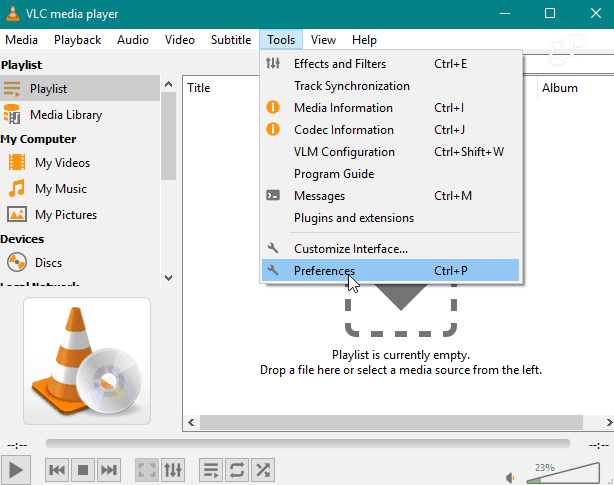
You're looking for the video codec (H.264 is ideal) and audio codec (AAC or MP3). If the file is H.264/AAC, you're getting a fast remux with no quality loss. If it's Sorenson Spark or another older codec, expect a slower re-encode.
One more check: the file size. A 10-minute FLV that's only a few megabytes is probably corrupted or truncated. Converting a broken file just gives you a broken MP4. In that case, you might need to recover the file first rather than convert it.
If the FLV turns out to be damaged rather than just outdated, FLV video editing tools can sometimes rescue the usable parts.
Part 3: Convert FLV to MP4 Online for Free
If you have one or two files and don't want to install anything, an online converter gets the job done. I've tested several, and Zamzar is a solid free option that handles FLV well. The main limits are upload size caps and the fact that your file goes through their servers — fine for casual use, not ideal for sensitive content.
Step 1Go to zamzar.com in your browser and click Add Files to select your FLV file.
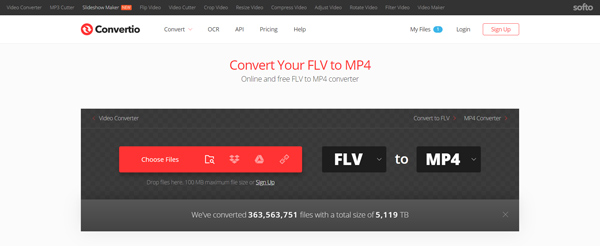
Step 2Once the file uploads, choose MP4 from the format list under Convert To.
Step 3Click Convert Now and wait for the progress bar to finish, then download the converted file.
Other free online options like CloudConvert and Convertio work the same way and are worth trying if Zamzar rejects the file for size. The tradeoff is the same across all of them: you wait on upload and download times, and the file leaves your computer.
If WMV is your target instead of MP4, converting FLV to WMV follows the same steps with the same tools.
Part 4: Convert FLV to MP4 with FoneLab Video Converter Ultimate
For more than a couple of files — or when you want to control the output quality and edit while converting — a desktop converter is the way to go. I use FoneLab Video Converter Ultimate for most of my conversion work. It handles FLV to MP4 (and dozens of other formats) locally, so nothing is uploaded, and it keeps the file quality where I set it.
What sets it apart for me: you can trim, crop, rotate, or merge the video before converting, and it does batch conversion, so a folder of FLVs becomes a folder of MP4s in one pass. I converted a batch of 20 lecture recordings from FLV to MP4 and it took under two minutes, with the output files playing perfectly on every device I tested.

Video Converter Ultimate is the best video and audio converting software which can convert MPG/MPEG to MP4 with fast speed and high output image/sound quality.
- Convert any video/audio like MPG, MP4, MOV, AVI, FLV, MP3, etc.
- Support 1080p/720p HD and 4K UHD video converting.
- Powerful editing features like Trim, Crop, Rotate, Effects, Enhance, 3D and more.
- Convert any video/audio formats.
- Support 1080p/720p HD and 4K UHD.
- Powerful editing: Trim, Crop, Rotate, Effects, Enhance, 3D.
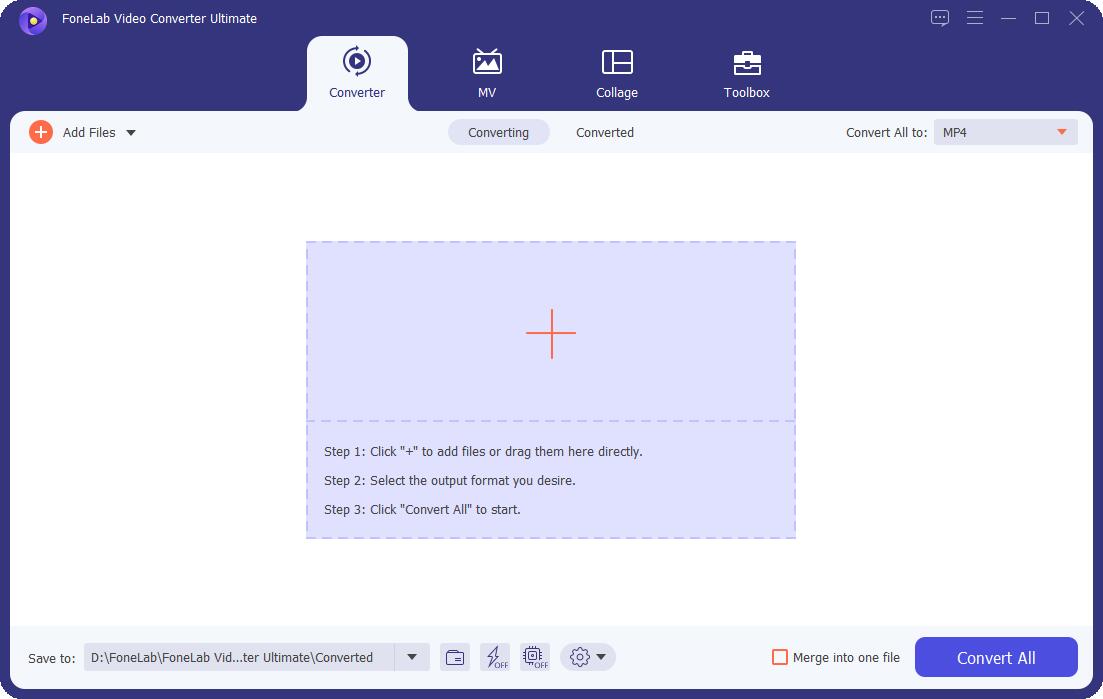
Step 1Download and install FoneLab Video Converter Ultimate, then launch it. You'll land on the main converting window.
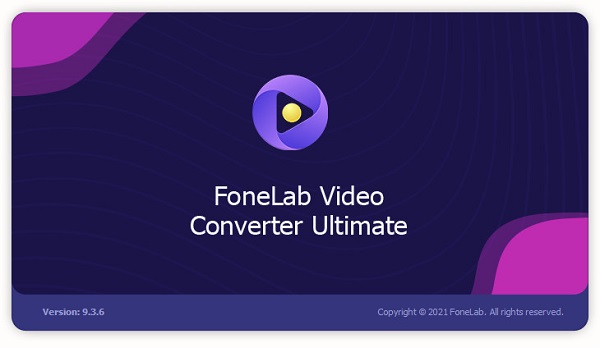
Step 2Drag your FLV files in, or click Add File to browse for them. You can select several at once for batch conversion.
Step 3Open the output format panel on the right and choose MP4. You can also pick the resolution if you want to downscale or keep the source size.
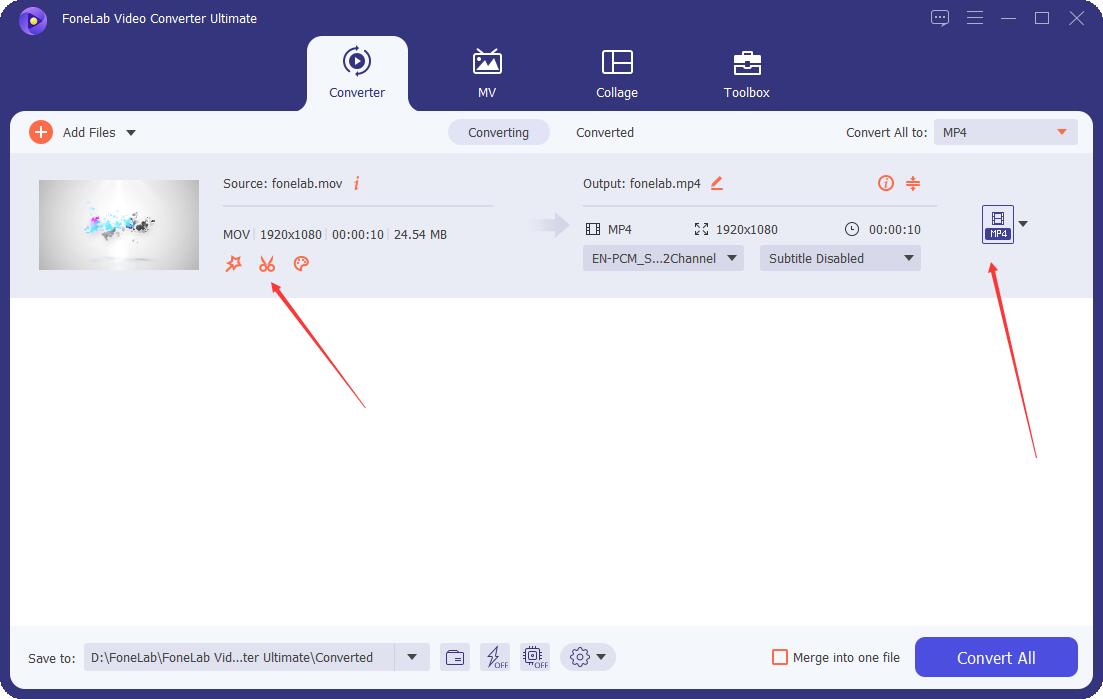
Step 4If you need to trim or edit first, use the editing tools below the file list, then click Convert All to start.
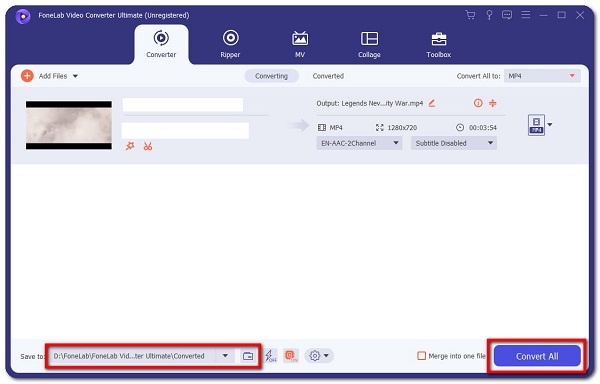
That's the whole flow. For everyday FLV to MP4 work, this is my default — it's fast, the output quality is consistent, and I don't have to think about upload limits.
One habit that saves me real trouble: name the output files before you start, or at least know where the converter puts them. When you batch-convert twenty files with similar names, it's easy to lose track of which is which afterward. I also keep the source FLVs for a week or two after converting, just in case I need to re-export a different version or a higher resolution. It's a small step that has bailed me out more than once.
If you're converting for a specific device, check that device's supported formats first. Most modern phones, tablets, and smart TVs accept MP4 with H.264 video and AAC audio out of the box, which is exactly what this guide produces. If you're aiming at an older device, a quick check of its manual will save you a re-convert.
Part 5: FLV Conversion on Mac and Linux
FLV is equally awkward on Mac and Linux — no native player support, and most editing tools ignore it. The good news is the conversion methods above cover both. FoneLab Video Converter Ultimate has a Mac version with the same workflow, and the online tools work in any browser regardless of OS.
If you're comfortable with the command line, FFmpeg is the classic power-user route on all three platforms. A simple remux for H.264/AAC FLV looks like this:
ffmpeg -i input.flv -c copy output.mp4
If the codecs are older, drop the -c copy and let FFmpeg re-encode: ffmpeg -i input.flv -c:v libx264 -c:a aac output.mp4. FFmpeg is free and fast, but there's a learning curve, and the GUI tools in this guide are friendlier for most people.
Convert FLV to MP4 with VLC Media Player
VLC is a free, open-source player that can also convert files. It works on Windows, Mac, and Linux, which makes it a solid cross-platform option.
- Open VLC and go to Media > Convert / Save.
- Click Add and select your FLV file, then click Convert / Save.
- Under Profile, choose Video - H.264 + MP3 (MP4).
- Click Browse to pick an output folder and file name, then click Start.
VLC handles most FLV files without issues, though it lacks the batch conversion and editing tools you get in a dedicated converter like FoneLab Video Converter Ultimate.
id="part6" class="bor-btm">Part 6: Online vs. Desktop Converter: Which One Should You Use?| Online converter | Desktop converter | |
|---|---|---|
| Best for | One or two quick files, no installs | Batches, editing, quality control |
| Installation | None, runs in browser | Requires a download and install |
| Privacy | File is uploaded to a third-party server | Conversion happens locally on your machine |
| Quality control | Limited presets | Full control over resolution and format |
| Batch conversion | Usually limited by size caps | Convert many files in one go |
My rule of thumb: for a quick single file, an online tool is fine. If you're converting several files, want to edit them, or care about the exact output quality, go with a desktop converter like FoneLab Video Converter Ultimate.
Part 7: FAQs About Converting FLV Files
Does converting FLV to MP4 lose quality?
If the FLV uses H.264/AAC codecs, a remux to MP4 keeps the quality identical. With older codecs there's a re-encode, but set a decent bitrate and the difference is barely noticeable.
Can I play FLV files on a Mac?
Not natively — macOS doesn't have a built-in FLV player. Install VLC, or convert the file to MP4 so it opens in QuickTime and other apps.
Why is my FLV file bigger than the MP4?
FLV containers and older codecs are less efficient than MP4's H.264/AAC. For the same video, the MP4 is usually several times smaller, which is one reason converting saves storage.
Conclusion
FLV doesn't need to be a headache. For a quick job, an online converter works. For batches, editing, or consistent quality, FoneLab Video Converter Ultimate is what I reach for. Check the source file first, pick the method that fits, and you'll have playable MP4s in minutes.
Video Converter Ultimate is the best video and audio converting software which can convert MPG/MPEG to MP4 with fast speed and high output image/sound quality.
- Convert any video/audio like MPG, MP4, MOV, AVI, FLV, MP3, etc.
- Support 1080p/720p HD and 4K UHD video converting.
- Powerful editing features like Trim, Crop, Rotate, Effects, Enhance, 3D and more.
- Convert any video/audio formats.
- Support 1080p/720p HD and 4K UHD.
- Powerful editing: Trim, Crop, Rotate, Effects, Enhance, 3D.