
 iPhone Data Recovery
 iOS System Recovery
 iOS Data Backup & Restore
 iOS Unlocker
 iPhone Password Manager
 Location Changer
 Android Data Recovery
 Broken Android Data Extraction
 Android Data Backup & Restore
 Android Unlocker
 FoneTrans for iOS
 iPhone Data Eraser
 iPhone Cleaner
 HEIC Converter
 HyperTrans
 WhatsApp Transfer for iOS
 Mac Sweep
 Data Retriever
 Mac Data Retriever
 Video Converter Ultimate
 Screen Recorder
 Phone Mirror
How to Send an Anonymous Text
 Updated by
 A few years ago, I wanted to send a “secret santa” riddle to a coworker without giving my identity away. Nothing dramatic — just a funny hint about the gift. The problem was that every messaging app I owned would reveal my real number the moment the message landed. That is when I started digging into anonymous text websites, and I quickly learned the difference between a harmless prank and a genuine privacy risk.
Anonymous texting is more common than most people think. Industry estimates suggest Americans received roughly 86 billion spam text messages in 2021 alone, which is one reason carriers and regulators keep tightening the rules around disguised sender IDs. That scale is exactly why you need to know what you are getting into before you hit send.
In this guide, I will walk you through what anonymous texting actually means, the legal boundaries you need to respect, the five websites I tested for sending anonymous texts, and what to do when the messages you actually care about — the ones on your own iPhone — go missing.
Before we get to the list, one warning I cannot repeat enough: read the terms of use on whichever site you choose. Most anonymous texting services explicitly prohibit illegal activity, and in the United States, the Truth in Caller ID Act makes it illegal to spoof caller ID with the intent to defraud. Send a playful message to a friend and you are almost certainly fine. Send threats, harassment, or scam messages, and the site’s logs — including your IP address — can and will be handed over when asked.

Part 1: What Does Sending an Anonymous Text Really Mean?
An anonymous text is simply an SMS that reaches the recipient without exposing your real phone number. Behind the scenes, it works one of two ways. The first is sender ID spoofing: the website lets you type any sender name or number to display, and the message rides the site’s own gateway to the recipient. The second is a temporary or virtual number: the service assigns you a disposable number that forwards texts, and you discard it when you are done.
Neither method is truly untraceable. Every message carries metadata — timestamps, the gateway’s IP address, and the account that placed the request. In practice, “anonymous” usually means “not linked to your personal number,” not “invisible to law enforcement.” That distinction matters more than any other detail in this article.
There are legitimate reasons to send an anonymous message: a secret santa exchange, reporting a problem without risking retaliation, or getting in touch in a sensitive personal situation. There are also clearly illegal ones: harassment, fraud, impersonation, and spam. The dividing line is intent, and the services below are built on the assumption that you are on the right side of it.
One more thing to keep in mind: sending anonymous texts has nothing to do with protecting the messages already stored on your phone. If you delete a text you actually need — a confirmation code, a photo from a friend, a conversation with a loved one — none of these websites can get it back. That is a different problem, and I will show you the fix in Part 4.
Part 2: How to Send an Anonymous Text in 4 Steps
Every anonymous texting website works a little differently, but after testing them back to back, I found the flow is almost always the same. Here is the general process I recommend, which applies to most of the services in this article:
Step 1Choose a reputable service. Look for HTTPS, a published privacy policy, and real user reviews before you enter anything. Skip any site that asks for more personal information than necessary — a genuinely anonymous service should never need your real name or a credit card just to send one text.
Step 2Read the terms of use before you type. Check the character limit, the supported countries, and the list of prohibited uses. Most free services cap messages at 140 to 160 characters, and many only support specific regions, often the United States and Canada.
Step 3Enter the recipient’s number with the country code, compose your message, and set the sender display if the site allows it. Double-check the number before sending — an anonymous message sent to the wrong person is awkward at best and harmful at worst.
Step 4Send the message and confirm delivery. If the site offers a delivery report, use it. Remember that MMS — photos, audio, and video — is only supported on a few services, so if your message includes media, pick a site like SEA SMS that handles MMS rather than a plain-text-only gateway.
That is the whole process. The sites below differ mainly in limits, coverage, and extra features, which brings me to the comparison.
Part 3: Top 5 Anonymous Text Websites Compared
I tested the five most-mentioned anonymous texting websites, focusing on message limits, supported regions, MMS support, and how easy they are to use. Here is how they compare at a glance:
| Website | Message Limit | Supported Regions | MMS | Standout Feature |
|---|---|---|---|---|
| SEND ANONYMOUS SMS | Not stated | International (pick country) | No | Spoofed sender number, anonymous email |
| Text for Free | 140 characters | USA only | No | Clear step-by-step instructions |
| SEA SMS | 160 characters | International (country code) | Yes | Bulk SMS available (paid) |
| TEXTEM | 155 characters | US carriers only | No | Messages can also go to email |
| TxtDrop | Not stated | USA & Canada | No | Email address for replies |
Below are the details for each site, including the pros and cons I noticed during testing.
1. SEND ANONYMOUS SMS
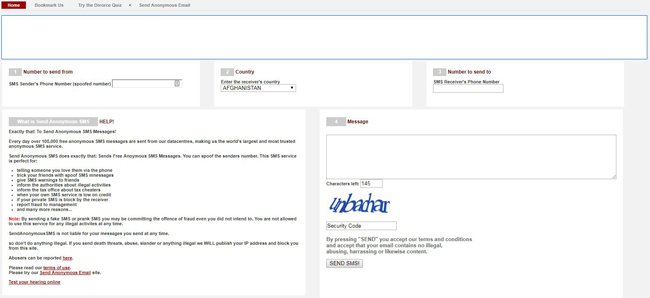
SEND ANONYMOUS SMS is about as simple as it gets. The page explains what you can and cannot do on the left, and the form you need to fill in — numbered 1 through 4 — sits on the right. You can finish everything on a single page, including entering a spoofed sender number and choosing the recipient’s country.
Pros:
- You can enter a spoofed number and choose the recipient’s country.
- You are allowed to report abusers directly on the website.
- It also offers an anonymous email feature.
Cons:
- Page navigation between sections is clunky.
2. Text for Free
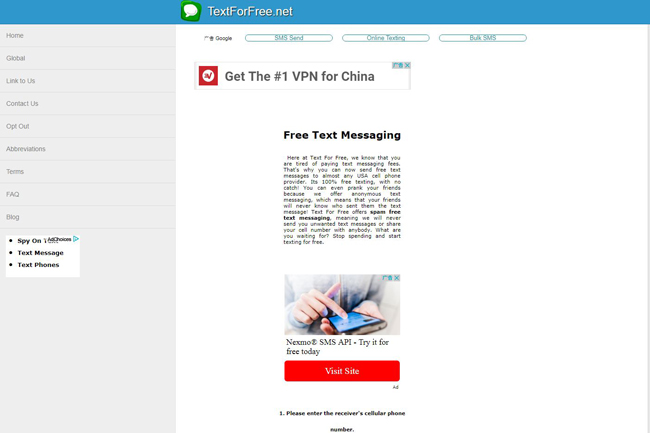
As the name suggests, Text for Free lets you send anonymous texts without charge. Its first page shows exactly how to send a message step by step, and there are tips below the input pane. It is a decent choice for pranking a friend, sending a message to someone who blocked your number, or reporting an issue without revealing who you are.
Pros:
- It shows clear step-by-step instructions on the first page.
- There are helpful tips below the text pane.
Cons:
- It supports USA cell phone providers only.
- Messages are limited to 140 characters.
3. SEA SMS
SEA SMS stands out visually with a blue sea image at the top of the page. Scroll down and you will find three fields: the recipient’s number, the SMS or MMS content, and your own mobile number. It does not ask for anything else, and it supports sending pictures, audio, video, and documents when you choose MMS.

Pros:
- It supports both SMS and MMS.
- MMS is convenient — you can drop in pictures, audio, video, or document files, or browse from your device.
- The recipient’s number is prefixed with a country code, which makes international sending easier.
Cons:
- Text is limited to 160 characters.
4. TEXTEM
If you want unlimited free anonymous texts to friends, family, or anyone else, TEXTEM is worth a look. You can send messages without your own number to any of the major US cellular services by choosing the mobile carrier from a drop-down list, and both sending and receiving through the site are free.
Pros:
- You can also send messages to an email address.
- You can block the site from sending you unwanted messages.
Cons:
- Messages are limited to 155 characters.
- It is limited to US carriers.
5. TxtDrop
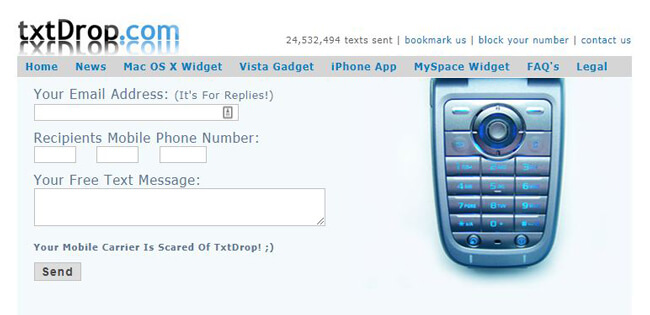
TxtDrop runs a clean, user-friendly page that lets you send and receive messages without identities. All you need to do is enter the content and the recipient’s number — no further information is required. It is the fastest option I tested if you just want a message out the door.
Pros:
- You can enter your email address to receive replies.
Cons:
- It is available for USA and Canada numbers only.
Part 4: Recover Deleted Text Messages on iPhone with FoneLab for iOS
All five websites above share one limitation: they send messages outward, but none of them can recover a message you have already lost. I found this out the hard way. While testing these services, I accidentally deleted a thread of texts I needed for a work project — confirmation numbers, dates, the whole conversation — and none of the anonymous texting sites could help me get it back.
If you are in the same situation, stop using your iPhone right away so new data does not overwrite the deleted messages. Then use a desktop recovery tool that scans the device directly. In my testing, FoneLab for iOS was the most reliable option for getting deleted texts back — it reads the iPhone itself, or an iCloud or iTunes backup, and lets you preview the messages before you restore a single one. If you lost your texts and never made a backup, this is the route I recommend over restoring from iCloud, because it does not depend on a backup existing in the first place.
What sold me on FoneLab for iOS is that it does not require you to have backed up beforehand. When I ran it on an old iPhone that had never touched iCloud, it still found the deleted message threads in the device’s storage and showed them in a preview pane before I committed to recovery. That is the difference between guessing and knowing exactly what you will get back. And if you are wondering whether this also works for other data types — yes, it covers photos, contacts, WhatsApp, WeChat, and more, not just SMS.

With FoneLab for iOS, you will recover the lost/deleted iPhone data including photos, contacts, videos, files, WhatsApp, Kik, Snapchat, WeChat and more data from your iCloud or iTunes backup or device.
- Recover photos, videos, contacts, WhatsApp, and more data with ease.
- Preview data before recovery.
- iPhone, iPad and iPod touch are available.
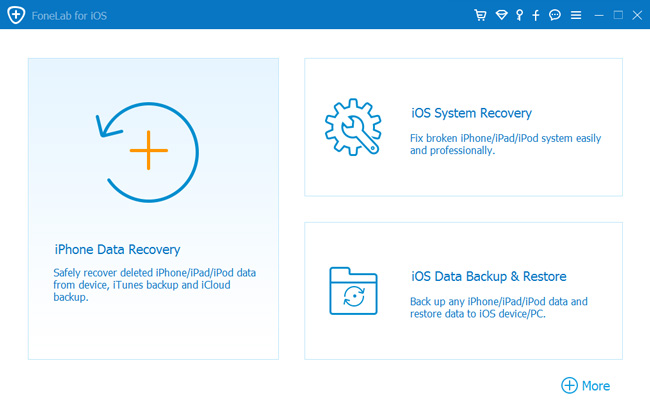
Step 1Download and install FoneLab for iOS on your Windows PC or Mac, then launch the program. From the main interface, choose iPhone Data Recovery.
Step 2Connect your iPhone to the computer with a USB cable and tap Trust on the phone when prompted. Then pick a recovery mode: Recover from iOS Device scans the phone directly, while Recover from iTunes Backup File and Recover from iCloud Backup File work if you have a backup available. Click Start Scan.
Step 3When the scan finishes, the results are grouped by type — Messages & Contacts, Media, Memos & Others, and more. Click Messages to see your texts, then tick the checkboxes next to the conversations you want to bring back.
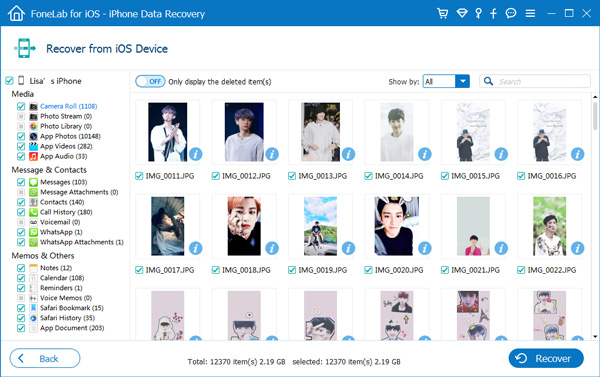
Step 4Click the Recover button in the bottom-right corner. The selected messages are saved to your computer, where you can read, print, or archive them.
With FoneLab for iOS, you will recover the lost/deleted iPhone data including photos, contacts, videos, files, WhatsApp, Kik, Snapchat, WeChat and more data from your iCloud or iTunes backup or device.
- Recover photos, videos, contacts, WhatsApp, and more data with ease.
- Preview data before recovery.
- iPhone, iPad and iPod touch are available.
So the next time you are tempted to send a mystery message, go ahead and have fun — but remember that the texts you actually care about live on your own iPhone. If they ever disappear, you now know exactly how to get them back. And if you skipped the backup habit, this 5-step rescue plan walks you through every recovery option in order.
Part 5: FAQs About Sending Anonymous Texts
1. Can the recipient find out who sent an anonymous text?
It depends on the service. Reputable anonymous texting sites log IP addresses and timestamps, and if a message breaks the law, providers cooperate with authorities when asked. For a prank between friends, most recipients will never know who sent it — but “anonymous” is not the same as “untraceable.” If the message is serious enough, metadata can be used to identify the sender.
2. Is sending an anonymous text illegal?
The act itself is not illegal, but how you use it can be. In the United States, the Truth in Caller ID Act prohibits spoofing caller ID with the intent to defraud, and harassment or threats are illegal no matter how they are sent. Read the site’s terms, keep it to honest pranks and legitimate reporting, and you are on safe ground.
3. Can I send anonymous texts on WhatsApp?
No. WhatsApp binds every message to a registered phone number, so true anonymity is not possible there. A virtual number hides your real number but still ties the account to you through registration details. For genuinely anonymous SMS, the web-based services in Part 3 are the better route.
4. What is the character limit for anonymous texts?
Most free anonymous texting sites cap messages at 140 to 160 characters, which mirrors the standard SMS limit. For longer messages or photos, look for a service with MMS support like SEA SMS, or split your text into multiple messages. Always check the site’s stated limit before composing, because most services silently truncate or reject messages that are too long.
With FoneLab for iOS, you will recover the lost/deleted iPhone data including photos, contacts, videos, files, WhatsApp, Kik, Snapchat, WeChat and more data from your iCloud or iTunes backup or device.
- Recover photos, videos, contacts, WhatsApp, and more data with ease.
- Preview data before recovery.
- iPhone, iPad and iPod touch are available.