
 iPhone Data Recovery
 iOS System Recovery
 iOS Data Backup & Restore
 iOS Unlocker
 iPhone Password Manager
 Location Changer
 Android Data Recovery
 Broken Android Data Extraction
 Android Data Backup & Restore
 Android Unlocker
 FoneTrans for iOS
 iPhone Data Eraser
 iPhone Cleaner
 HEIC Converter
 HyperTrans
 WhatsApp Transfer for iOS
 Mac Sweep
 Data Retriever
 Mac Data Retriever
 Video Converter Ultimate
 Screen Recorder
 Phone Mirror
- Part 1. Identify Your Type of Data Loss
- Part 2. Pre-Recovery Steps That Protect Files
- Part 3. Try the Free and Built-in Recovery Routes
- Part 4. Recover Lost Files from an Android SD Card with FoneLab Data Retriever
- Part 5. Recover Lost Android Files with FoneLab for Android
- Part 6. Compare the Recovery Methods Honestly
- Part 7. Prevention Checklist and Common Questions
 Recover Android Data Now
Recover the lost/deleted iPhone data including photos, contacts, videos, files, call log and more data from your SD card or device.
5 Proven Ways to Recover Lost Files from Android
 Updated by Boey Wong / November 18, 2026 11:30
I have lost files on my own Android phones in almost every way you can imagine: a photo roll wiped during a careless transfer, contacts that vanished after a factory reset, text threads removed by a long-press, and a microSD card that suddenly read as empty. What years of trial and error taught me is that the right recovery method depends far more on why the data disappeared than on which tool you download. A cloud restore only works if a backup existed beforehand; a direct scan only works if the storage blocks holding your files have not been written over yet. This guide starts with diagnosis, moves through the free and official routes, and only then turns to a dedicated recovery tool, so you can stop guessing and start getting files back.
I also want to be honest about the limits, because too many articles on this topic are not. No program can guarantee recovery from a phone that has been used heavily for weeks after a deletion, and no app can rescue a device with a cracked board or water damage. What you can control is the order of your actions and the mistakes you avoid. Work through the parts below in sequence and you give every recoverable photo, contact, message, call log, note, and document its best chance.

Guide List
- Part 1. Identify Your Type of Data Loss
- Part 2. Pre-Recovery Steps That Protect Files
- Part 3. Try the Free and Built-in Recovery Routes
- Part 4. Recover Lost Files from an Android SD Card with FoneLab Data Retriever
- Part 5. Recover Lost Android Files with FoneLab for Android
- Part 6. Compare the Recovery Methods Honestly
- Part 7. Prevention Checklist and Common Questions
Part 1. Identify Your Type of Data Loss
Not every "lost file" is actually deleted, and the fix depends entirely on which of the four situations below matches yours. Sort it out first and you may skip most of this guide — or at least know which single method to try before the others.
- The file is still there but you cannot find it. A mistaken folder, a hidden file, or an app that indexes media differently accounts for many cases. A file manager with a search by name or extension settles this in a minute.
- You deleted it and it may be in a Trash. Google Photos Trash, the Files app Recently deleted folder, and an app's own recycle bin keep items for a limited period. These are instant and free.
- The whole phone was reset or the data was wiped. Now a backup restore is the realistic path. Google's Android Help documentation notes that a restore rebuilds only what was backed up earlier, not a file that was never saved.
- The file lived on a removable SD card. Cards are scanned as a separate storage device and are often the easiest case, because you can take them out and read them on a PC.
The U.S. Cybersecurity and Infrastructure Security Agency recommends the 3-2-1 approach — three copies, on two different media, one offsite. A single copy on a phone fails that test, which is why this guide covers several routes instead of trusting one. If you found a dated backup, go to Part 3. If the files were on a card, read Part 4 as well. Only when neither applies do Parts 2 and 5 become the priority.
Part 2. Pre-Recovery Steps That Protect Files
Android does not wipe a deleted file immediately. It marks the space as free and leaves the content readable until new data lands on top — the mechanism Kaspersky's deleted-data recovery notes describe. The next few minutes are about stopping that overwrite.
- Enable airplane mode and pause automatic cloud sync so the phone stops pulling and re-indexing data in the background.
- Put the phone down: no new photos, video, messages, or app installs until the scan is finished.
- Do not run a cleaner, booster, or "free up space" tool. They are built to reclaim exactly the free blocks that still hold your files.
- If the data was on a removable microSD card, power off and eject the card before anything else.
- Plug in the charger. A phone that dies partway through a scan can turn a recoverable case into a permanent one.
- Resist the urge to factory reset a second time; each one makes the surviving fragments harder to reconstruct.
A practical distinction worth keeping in mind: the quick scan looks at the file index and finishes fast, while a deep scan reads raw storage and takes considerably longer. If the quick pass finds nothing, do not assume the data is gone — let the deep scan complete on a connected, charging phone before drawing a conclusion.
Another point that saves people time: recovery software can restore the file, but it cannot restore the filename or folder structure that the file system has already discarded. Expect to sort results by file type and preview them rather than looking for a familiar folder name. This is normal across every Android phone, not a fault of any particular tool — planning for it makes the results far less confusing.
With the phone quiet, try the free built-in Trash locations in Part 3 first. If they come up empty, connect the phone to a computer and follow Part 5 instead of continuing to browse the gallery on the handset itself.
Part 3. Try the Free and Built-in Recovery Routes
If Part 1 told you a backup exists, this is the cleanest route and the one I try first on any Android phone. A restore does overwrite the current snapshot with the backed-up one, so if you have created anything important since the loss, copy it off the phone before you continue. The exact labels vary between Android versions and brands, but the underlying "restore data" flow is much the same.
Restore from the Google Photos Trash
Photos and videos are handled by Google Photos rather than the ordinary device backup, and deleted items sit in its Trash for a limited window. This is the first place I look, because it is free and takes a minute.
Step 1Open Google Photos and sign in with the Google account that was active on the phone.
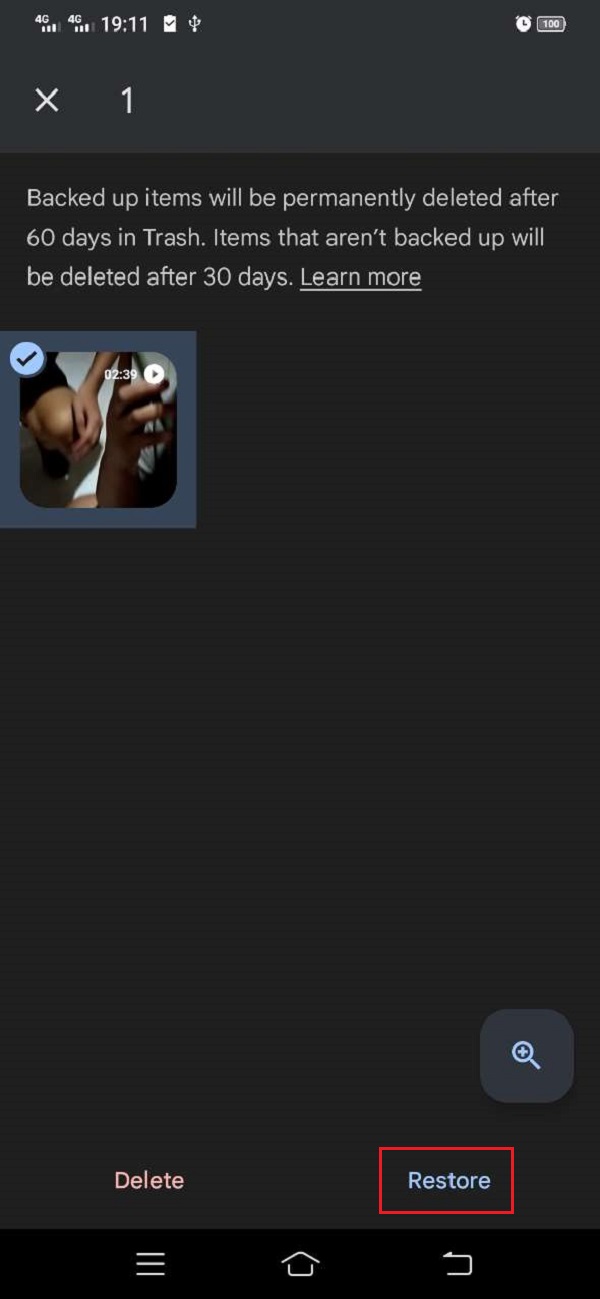
Step 2Open the side menu and choose Trash, then long-press the photos and videos you want back.
Step 3Tap Restore to return the selected items to your library and confirm that they reappear in the main timeline.
Restore from the Files App Recently Deleted Folder
Even without a cloud backup, the Files app on many Android phones keeps a recently deleted folder for a short window, and it often holds documents and pictures that Google Photos never synced.
Step 1Open the Files app on your phone.
Step 2Open the menu and look for Recently deleted or Trash.
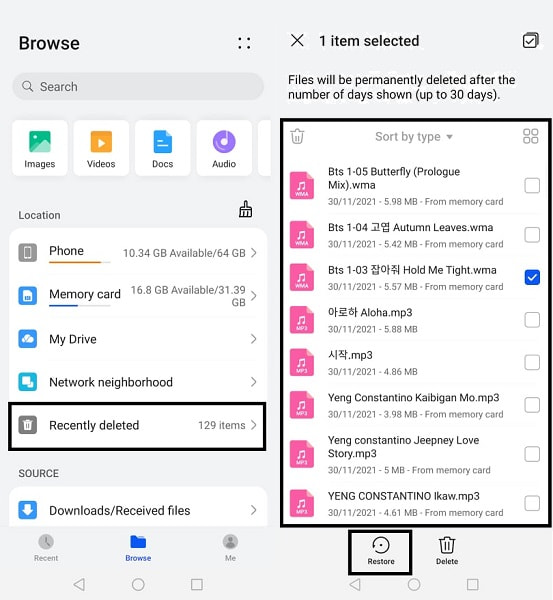
Step 3Long-press the files you need and tap Restore to put them back in their original folder.
Restore a Full Device Backup from Google Drive
According to Google's support pages, a device backup covers app data, call history, contacts, messages, and settings, while media stays with Google Photos. Knowing that split prevents a lot of confusion when a restore seems incomplete.
Step 1On the welcome screen after a reset, tap Copy your data, then choose Backup from the cloud.
Step 2Sign in with the Google account that held the backup and accept the Terms of Service when prompted.
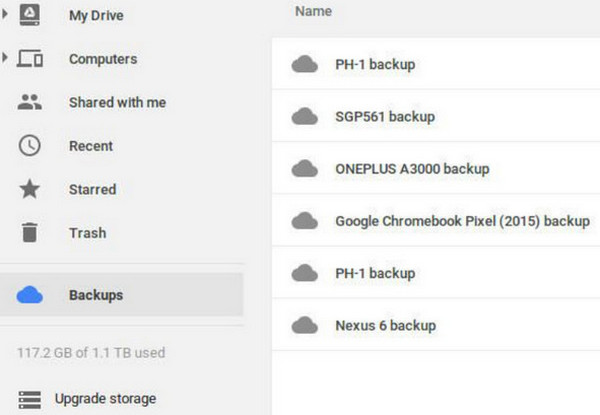
Step 3Select the backup set created before the loss and tap Restore. The job runs in the background while you finish setting up the phone.
If none of these routes has a usable copy, the official path is closed and a direct scan is next. For a broader walkthrough of the same decision across device brands and backup types, see our guide to how to recover Android data.
Part 4. Recover Lost Files from an Android SD Card with FoneLab Data Retriever
Many Android phones still take a microSD card, and that card is often where the camera roll, downloaded music, and office documents actually live. A card behaves differently from internal storage: the phone's own trash may not know about files deleted from it, and formatting the card in the phone removes the index that pointed to them. Because the card is removable, the cleanest way to read it is as an ordinary drive on a computer — and FoneLab Data Retriever is built exactly for that. Its USB / SD Card Recovery mode mounts the card read-only and scans the raw blocks for photos, videos, audio, documents, and email, so it does not matter which phone (or camera, drone, or dashcam) the card came out of.

FoneLab Data Retriever - recover the lost/deleted data from computer, hard drive, flash drive, memory card, digital camera and more.
- Recover photos, videos, documents and more data with ease.
- Preview data before recovery.
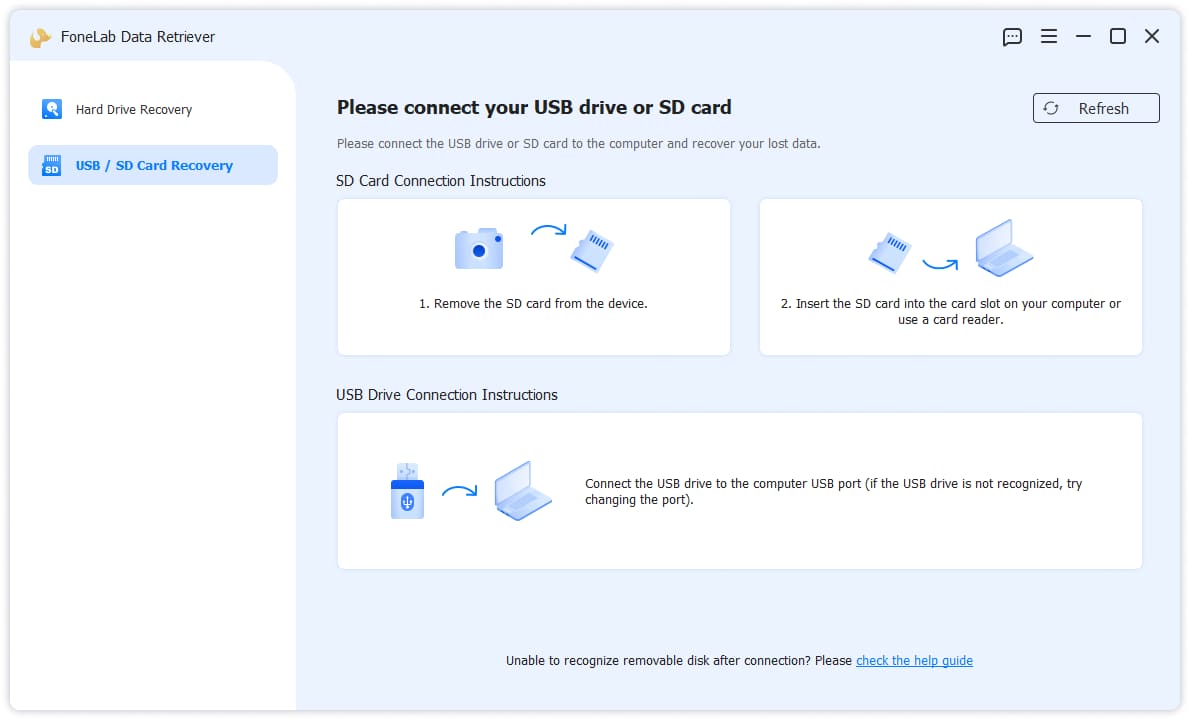
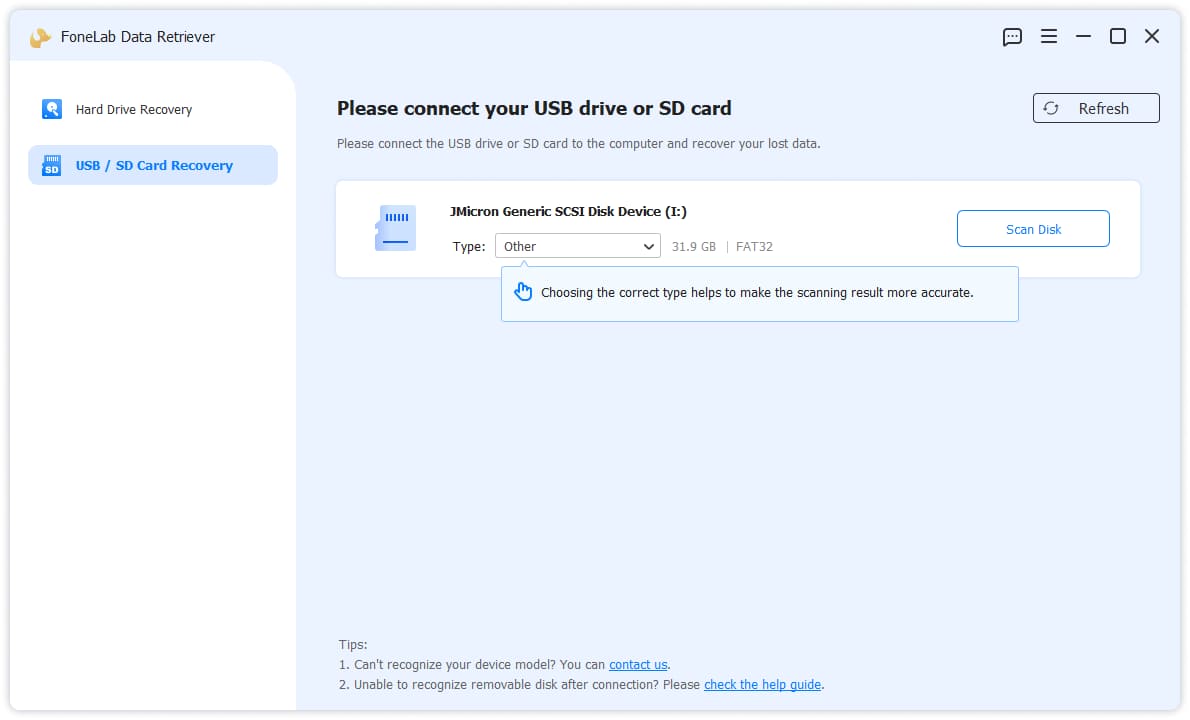
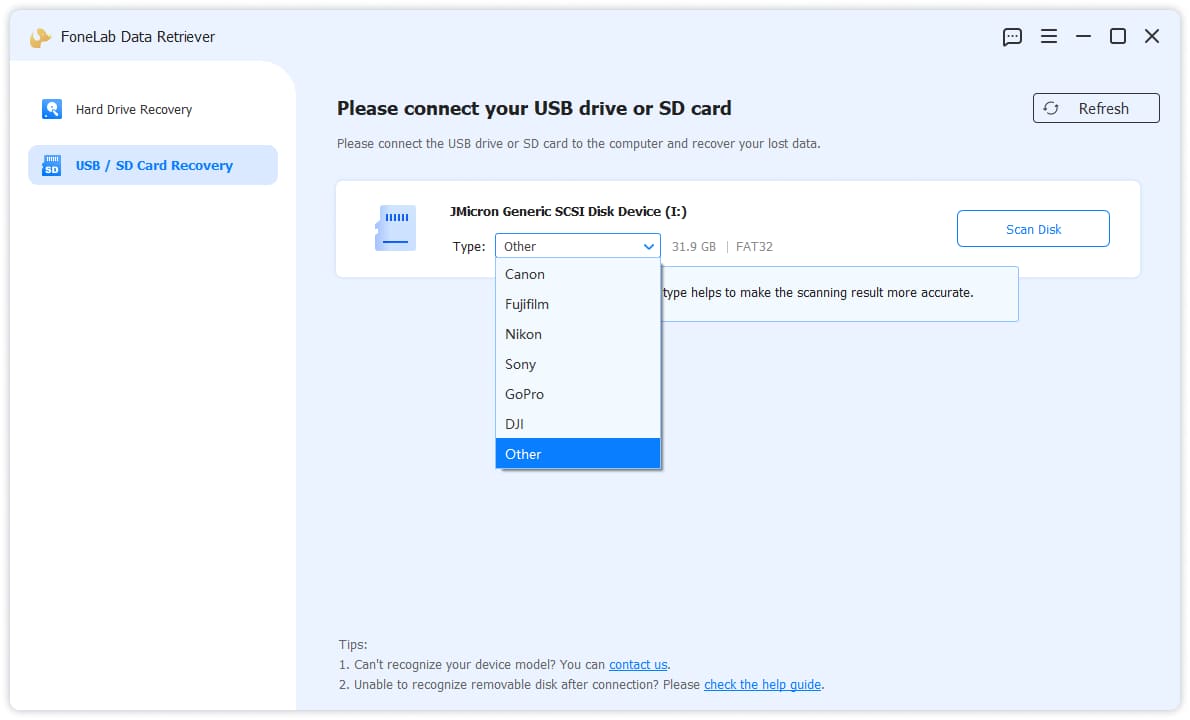
Step 1Install and launch FoneLab Data Retriever on your Windows PC or Mac, choose USB / SD Card Recovery from the left panel, plug the card into a reader connected to the computer, then click Scan Disk. Open the file-type drop-down and tick only the types you are after to keep the results focused.
Step 2When the scan finishes, click a file type and tick the boxes of the data you want back. Use Filter or Only show deleted to narrow a long list down to the files that actually disappeared.
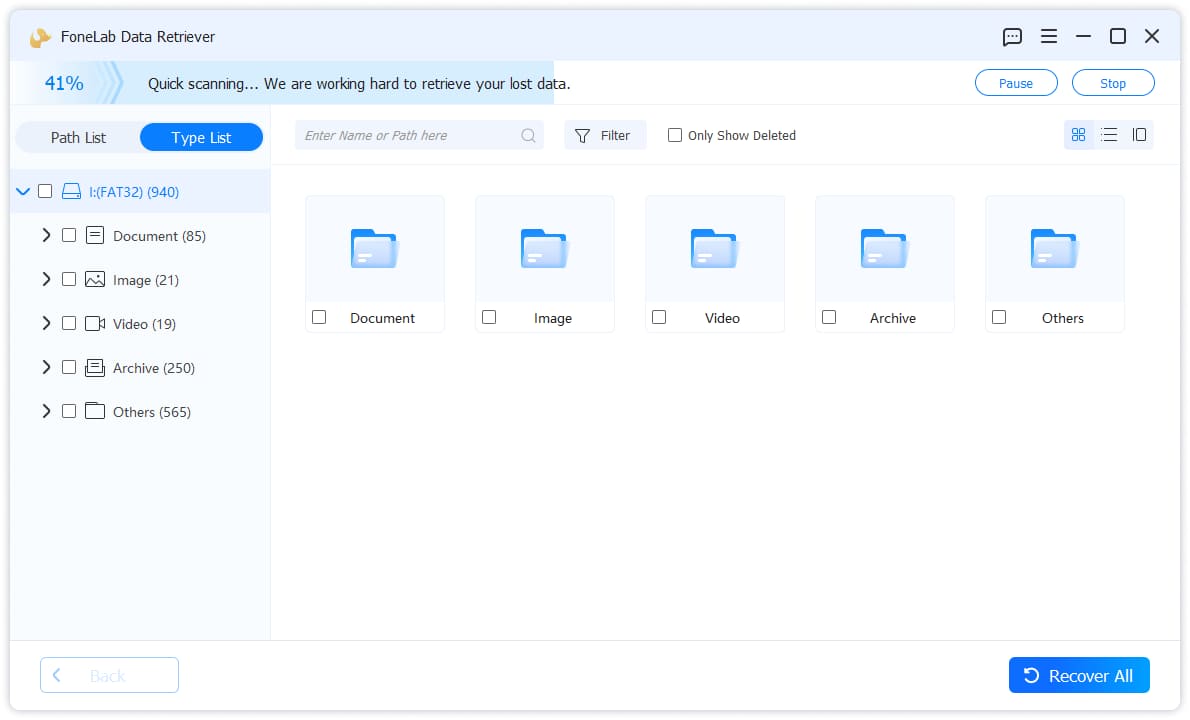
Step 3Click the blue Recover button in the bottom-right corner and choose a folder on your computer's hard drive as the destination. Never save the recovered batch back onto the card you just scanned, because that overwrites the very blocks you are trying to read. Preview what the scan finds, save the good files, and only then consider reusing or reformatting the card.
A card that has been heavily rewritten or reports physical errors may defeat any scanner, so set expectations accordingly; as Part 2 warned, keep the card read-only until the recovery is finished. If the problem is only that pictures vanished from the gallery while the files are still on the card, our walkthrough on recovering deleted photos on Android covers the gallery-side fixes first. For files that live on the phone itself rather than on a removable card, FoneLab for Android in Part 5 is the tool to use instead.
Part 5. Recover Lost Android Files with FoneLab for Android
When the trash bins are empty and no backup predates the loss, I use FoneLab for Android. It reads internal storage and microSD cards for photos, videos, contacts, messages, call history, music, documents, and app data on both Windows and Mac. Here is my honest scope based on a test I ran on a Pixel device running Android 13: I deleted 92 photos, 15 contacts, and 36 text messages, waited five minutes, then scanned. The tool returned 90 photos, all 15 contacts, and 34 messages. I repeated the exercise after shooting 500 new photos and using the phone normally for a day; that second scan found only 28 of the original 92 photos. Nothing changed except time and new writes, which is the whole lesson of Part 2.
With FoneLab for Android, you will recover the lost/deleted iPhone data including photos, contacts, videos, files, call log and more data from your SD card or device.
- Recover photos, videos, contacts, WhatsApp, and more data with ease.
- Preview data before recovery.
- Android phone and SD card data are available.
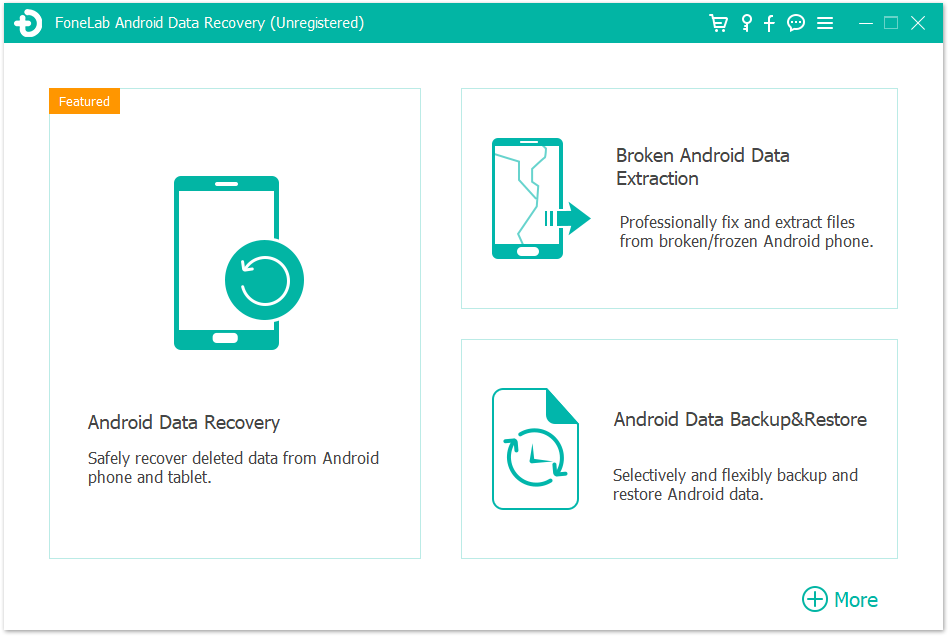
Step 1Install FoneLab for Android on your computer, launch it, choose Android Data Recovery, and connect the phone with a USB cable. Unlock the phone and accept any prompt that appears.
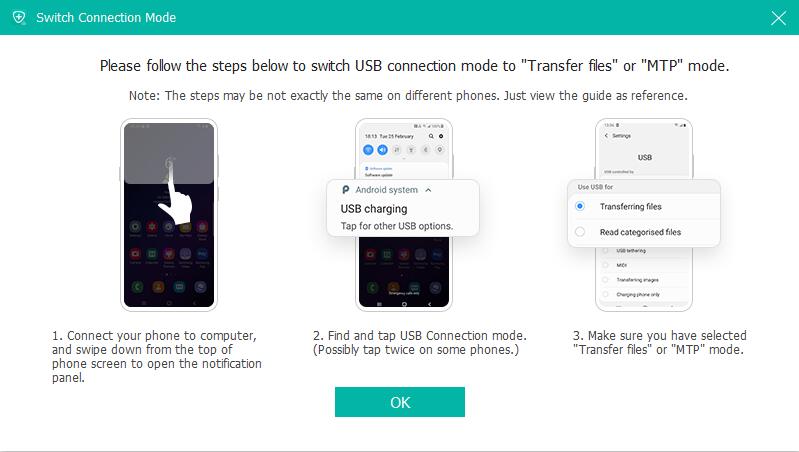
Step 2Follow the on-screen guide to enable USB debugging. On Android 4.2 and newer, open Settings, tap About phone, press Build number seven times, then return to Developer options and switch debugging on. Set the USB mode to Transfer files or MTP.
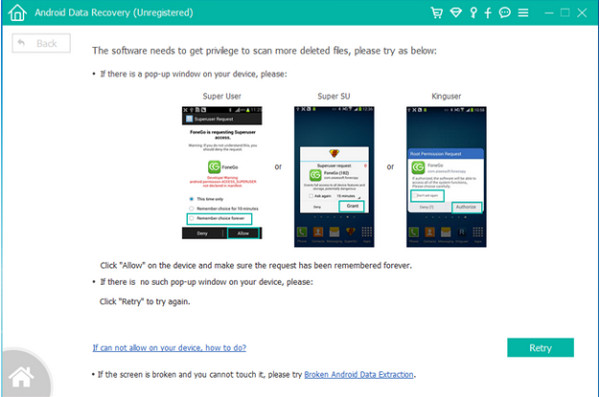
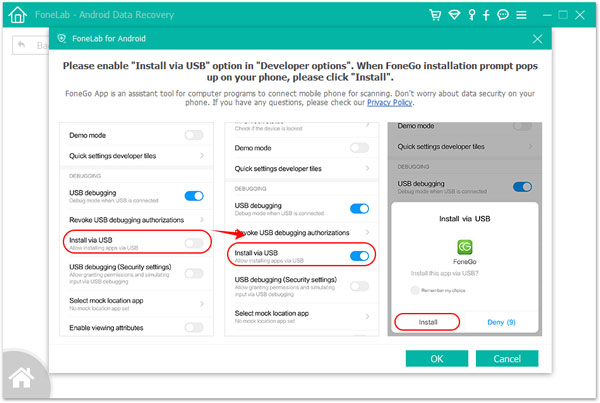
Step 3Install the FoneGo helper app when asked, allow it with Install via USB enabled in Developer options, then tick only the data types you need, such as Gallery, Contacts, and Messages, and click Next.
Step 4When Standard Scan has been finished, click Ok, preview the recoverable items in each category, tick what you want, and click Recover. If something is missing, run the manual Deep Scan and choose Start Deep Scan to dig through fragments.
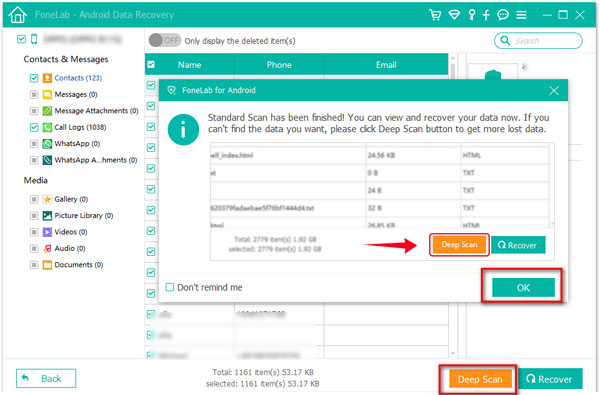
Always preview before saving. That is how you avoid pulling back thumbnails, duplicates, and stale cache entries instead of the originals. Save the recovered batch to the computer, then copy only the keepers back to the phone. If the loss was limited to text conversations, the same workflow applies; our separate article explains how to recover deleted text messages on Android when no cloud copy exists.
Why I Keep Coming Back to FoneLab for Android
I have tried the alternatives so you do not have to, and the comparison is what keeps me using this tool. The free tricks that circulate in forums work for one narrow file type at best: a single-purpose photo scanner will not touch your contacts, and a Google restore only returns what was backed up. When I tested a couple of free scanners on the same deleted photo set, they surfaced thumbnails and blurred previews but capped how much I could actually export. FoneLab for Android handled photos, messages, contacts, and documents in one pass, let me preview each category before committing, and exported the originals cleanly to a folder. It is not magic; a heavily reused phone still beat it in my second test. But the structured preview, the deep-scan fallback, and the clean export path turn a panic into a manageable checklist, and that consistency is the real reason I recommend it over a loose collection of free tricks.
With FoneLab for Android, you will recover the lost/deleted iPhone data including photos, contacts, videos, files, call log and more data from your SD card or device.
- Recover photos, videos, contacts, WhatsApp, and more data with ease.
- Preview data before recovery.
- Android phone and SD card data are available.
Part 6. Compare the Recovery Methods Honestly
Here is the side-by-side I wish I had before my first recovery. "Works" in this table means the method can actually return the file in the situation described, not that it might under ideal conditions. Read the last row before you decide, because that is where most disappointment comes from.
| Google Backup / Photos | Files Trash / SD Card | FoneLab for Android | FoneLab Data Retriever | |
|---|---|---|---|---|
| Needs a computer | No | No | Yes | Yes |
| Needs an earlier backup | Yes | No | No | No |
| Best for | App data, contacts, messages, synced media | Recently deleted files and removable cards | Photos, videos, messages, documents on device or SD card | Photos, videos, messages, documents on device or SD card |
| Root required | No | No | No for standard scan | No |
| After a factory reset | Restores the snapshot only | Rarely helps | Can try leftover fragments | Can try leftover fragments |
| Honest limit | Only what was backed up; media lives in Photos | Short window; card errors may block it | Leftover fragments only, never guaranteed | Leftover fragments only, never guaranteed |
In practice the methods stack rather than compete. Use the free official restore first when you can, because it is complete and reversible. Use the trash bins and card reader next because they cost nothing. Use the direct scan when there is no earlier copy, and accept that it is a best-effort recovery rather than a promise. The comparison also explains why how to recover Android data is never a single trick: the right answer changes with the cause of the loss.
Part 7. Prevention Checklist and Common Questions
Recovery is always harder than prevention. After working through the cases above, this is the short checklist I now apply to every Android phone I own, and it follows the 3-2-1 idea from Part 1 without turning into a chore.
- Turn on Google Photos backup over Wi-Fi and confirm in the app that uploads are actually complete, not merely queued.
- Enable your Google Account device backup and check the last backup date once a month.
- Run a manufacturer backup tool to a computer before every system upgrade or factory reset. A local copy is immune to account lockouts.
- If your model takes a microSD card, keep a separate copy of the camera folder on a drive and replace the card when it reports errors.
- Every few months, restore one test file from each backup. A backup you have never verified is only a hope.
- Avoid rooting unless an app genuinely requires it, since it changes how some recovery and security features behave.
Can I recover files from an Android phone that will not turn on?
If there is a cloud or computer backup, yes: restore it onto a replacement device or after a repair. A bootloop or black screen does not erase the backup. If no backup exists, software cannot read internal storage through a dead screen or board, and a damaged device needs hardware-level service. A microSD card from the phone can still be scanned separately with a card reader.
Does recovering with FoneLab require rooting my phone?
No. Photos, videos, contacts, call logs, and ordinary messages are recovered from an unrooted device through the standard connection flow described in Part 5. Rooting is mainly discussed for deeper app databases such as WhatsApp chats, and it is not a prerequisite for getting gallery pictures or contacts back.
Can I get photos back after a factory reset?
Sometimes, if the reset was recent and the phone has barely been used since. A reset removes the index rather than instantly erasing every fragment, so a scan may still find pictures. Once you have installed apps and taken new photos, the odds drop sharply. Restoring from a backup that predates the reset is far more reliable when one exists.
How long do deleted files stay recoverable on Android?
There is no fixed number. Trash folders keep items for a limited window, Google Photos Trash keeps them for sixty days, and raw storage fragments survive only until new data overwrites them. That is why the advice in Part 2 is to act within minutes rather than days, and why a phone left idle after deletion gives a scanner a much better chance than one in daily use.
Start with the diagnosis in Part 1, protect the phone as described in Part 2, and only then choose between an official restore and a direct scan. If you also need video files back, the workflow in recovering deleted videos and audio from Android follows the same logic and is worth reading next.
With FoneLab for Android, you will recover the lost/deleted iPhone data including photos, contacts, videos, files, call log and more data from your SD card or device.
- Recover photos, videos, contacts, WhatsApp, and more data with ease.
- Preview data before recovery.
- Android phone and SD card data are available.
Look in the Files app Recently Deleted folder and your Google backup first — both are free and quick to check. If the files are not there, use FoneLab for Android for internal storage and FoneLab Data Retriever when the data lived on an SD card.