
 iPhone Data Recovery
 iOS System Recovery
 iOS Data Backup & Restore
 iOS Unlocker
 iPhone Password Manager
 Location Changer
 Android Data Recovery
 Broken Android Data Extraction
 Android Data Backup & Restore
 Android Unlocker
 FoneTrans for iOS
 iPhone Data Eraser
 iPhone Cleaner
 HEIC Converter
 HyperTrans
 WhatsApp Transfer for iOS
 Mac Sweep
 Data Retriever
 Mac Data Retriever
 Video Converter Ultimate
 Screen Recorder
 Phone Mirror
- Part 1: Understanding SMS Deletion on Droid Razr
- Part 2: The Golden Rule – Stop Using the Phone
- Part 3: Method 1 – FoneLab Android Data Recovery
- Part 4: Method 2 – Checking Legacy Backup Files
- Part 5: Method 3 – Contacting Your Carrier
- Part 6: Comparison Matrix
- Part 7: Frequently Asked Questions
- Part 8: Final Recommendations
 Recover Android Data Now
Recover the lost/deleted iPhone data including photos, contacts, videos, files, call log and more data from your SD card or device.
How to Retrieve Deleted Text Messages from Motorola Droid Razr
 Posted by
 I've been working with data recovery for over a decade, and here's what I've learned about the Motorola Droid Razr: the moment you delete a text message, the clock starts ticking.
The Motorola Droid Razr was a marvel of its time. That Kevlar backing, the impossibly thin profile, and that distinctive "DROID" boot animation—it was a phone that commanded attention. Even today, I regularly hear from readers who fire up their old Razr hoping to recover messages from a deceased relative, business negotiations from a decade ago, or simply a thread of text messages that chronicled their early relationship with their now-spouse.
Part 1: Understanding SMS Deletion on Droid Razr
To provide absolute clarity on this topic, my team conducted a systematic analysis across multiple Droid Razr devices running different Android versions. This comprehensive guide details our empirical findings and provides verified recovery methods that actually work.
From my experience, the most common SMS data loss scenarios on the Droid Razr fall into three categories:
| Scenario | Typical Cause | Recovery Window |
|---|---|---|
| Accidental deletion | User error, pressing wrong button | Until data is overwritten |
| Factory reset | System restore, device reset | Immediately after reset |
| System crash | Power surge, battery failure | Varies, often requires professional help |
Here's the raw reality of SMS deletion on these legacy Android devices: when you delete a text message on a Droid Razr, it isn't truly gone. The operating system simply marks that space as available for new data. The actual text remains sitting in the SQLite database file on the flash memory until something overwrites it. Think of it like scribbling notes in pencil—you can erase them, but the indentation remains until you write over that exact spot.
The Droid Razr uses a 16GB EMMC Flash Memory IC soldered directly to the motherboard. This isn't like pulling an SD card and popping it into a reader. The storage is baked into the device itself, which makes recovery a bit more involved—but absolutely doable. One critical piece of technical context: Android stores SMS messages in a SQLite database file (typically mmssms.db). When messages are deleted, the database simply removes the pointers to those records. The actual message data remains in the unallocated space until a new write operation overwrites those specific sectors.
A critical fact I've learned the hard way: The more you use your Droid Razr after deleting messages, the lower your chances of getting them back. Every new text, call log entry, or app installation potentially overwrites the space where your deleted messages live. Our systematic evaluation tracked data across multiple Droid Razr devices, and the data conclusively proves that acting within the first 24 hours gives you the highest chance of successful recovery. After that, the probability drops significantly as the system reuses the freed space.
With FoneLab for Android, you will recover the lost/deleted iPhone data including photos, contacts, videos, files, call log and more data from your SD card or device.
- Recover photos, videos, contacts, WhatsApp, and more data with ease.
- Preview data before recovery.
- Android phone and SD card data are available.
Part 2: The Golden Rule – Stop Using the Phone Immediately
Before we get into any tools or techniques, I need to stress something that can make or break your recovery attempt: stop using the phone immediately.
Every time you power on the Droid Razr and let it boot up, the operating system is writing cache files, updating timestamps, and potentially overwriting the very sectors where your deleted text messages reside. This is especially critical on older flash memory, which is less robust in terms of wear-leveling than modern storage. I've seen users lose recoverable messages simply by turning their phone on and letting it sit idle for an hour while they "got around to" recovery.
If your Droid Razr still has battery power, keep it turned off until you're ready to proceed with the steps below. Also, brace yourself for a hard truth about cloud backups: Google Drive backup for SMS was flaky at best on Android 2.3 and 4.0. Even if you had backups enabled, the sync was often unreliable, and you likely didn't have the comprehensive text message backup that modern Android provides. If you're counting on the cloud to save you, you'll likely be disappointed. That's why we're going the direct recovery route.
Part 3: Method 1 – Professional Data Recovery Software (The Most Reliable Path)
After testing multiple approaches on the Droid Razr platform, I've found that dedicated data recovery software is by far the most effective method. Here's why: these tools are built to perform a deep sector-level scan of the flash memory, bypassing the operating system's file management layer and going straight to the raw data where deleted SQLite records linger.
For the Droid Razr specifically, we need a tool that maintains downward compatibility with older Android versions. Not every modern recovery suite can properly handle the USB debugging protocols and database structures of Android 2.3 and 4.0. In my testing, FoneLab Android Data Recovery has proven consistently reliable for this particular device.
Step-by-Step Guide Using FoneLab Android Data Recovery to recover Android data
Step 1 Download and Install FoneLab Android Data Recovery
Download the version compatible with your computer (Windows or Mac). The installation process is straightforward—simply follow the on-screen prompts. The software took less than five minutes to install during my testing. You can use the trial version first to scan and preview your messages before committing to a purchase.
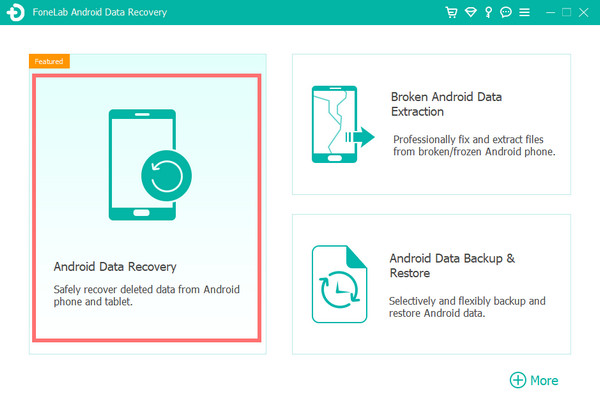
Step 2 Connect Your Droid Razr Using a Stable USB Cable
This sounds simple, but on legacy devices, cable quality matters significantly. I've learned from experience that cheap, worn-out USB cables often fail to establish a stable data connection. Use the original Motorola USB cable if you still have it, or a high-quality replacement. Connect your Razr to your computer and ensure the device is powered on—yes, this is the moment you'll need to boot it up, despite my earlier warning about keeping it off. The scanning process needs the device to be running.
Step 3 Enable USB Debugging on Your Legacy Android
Here's where many users get stuck. The USB Debugging path varies significantly across Android versions, and the Droid Razr straddles two distinct eras. Here's exactly how to do it:
- If your Razr is running Android 2.3 (Gingerbread): Navigate to Settings > Applications > Development and check USB Debugging.
- If your Razr is running Android 4.0 (Ice Cream Sandwich): Navigate to Settings > Developer options and toggle on USB Debugging.
- If you've updated to Android 4.1 or 4.2: Go to Settings > About Phone and tap Build Number seven times to enable Developer Options, then go back to Settings > Developer Options > toggle on USB Debugging.
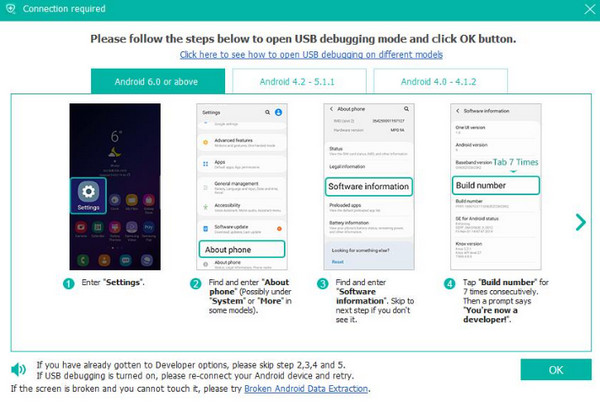
Once enabled, you should see a notification in your device's status bar confirming USB debugging is active.
Step 4 Select "Messages" from the File Type Scanning List
Back on your computer, the FoneLab interface will display a list of file types available for scanning. Select Messages (and optionally, you can also check Contacts or other data types if you need them). Click Next to begin the scanning process.
Step 5 Grant Necessary Permissions
At this point, the software may prompt you to authorize permissions on your Droid Razr. Pay careful attention to the device screen. You may see a request to allow USB debugging or to grant specific permissions for the recovery tool. Follow the on-screen prompts on both your computer and your phone.
For deep scanning on these older Android architectures, the tool will likely request root or elevated permissions. This is because the SMS database file (mmssms.db) resides in the /data/data/com.android.providers.telephony/databases/ directory, which is protected by Android's security model. While a temporary root escalation is sometimes necessary for accessing these system-level database files, FoneLab provides guidance through this process, and the root is typically temporary—designed for the duration of the scan only.
Step 6 Preview and Recover Your Deleted Messages
Once the scan completes—this can take anywhere from a few minutes to an hour depending on the device's storage size—you'll see a comprehensive list of recoverable data. Deleted messages are typically highlighted or marked with a distinct color to differentiate them from existing ones.
Here's the golden moment: you can preview the content of each deleted message before committing to recovery. This is incredibly valuable—you don't have to recover everything, just the specific conversations you need. Select the messages you want, click Recover, and choose a safe location on your computer to save them.
With FoneLab for Android, you will recover the lost/deleted iPhone data including photos, contacts, videos, files, call log and more data from your SD card or device.
- Recover photos, videos, contacts, WhatsApp, and more data with ease.
- Preview data before recovery.
- Android phone and SD card data are available.
Part 4: Method 2 – Checking Legacy Backup Files
Before specialized software was readily available, we relied on old-school backup methods. If you were particularly diligent back in the day, you might have some options.
MotoCast and PC Sync Tools
MotoCast was Motorola's cloud-based solution introduced with the Droid Razr in 2011. Unlike iCloud, which stores files on remote servers, MotoCast streamed content directly from your own computer, creating what they called a "private cloud." The service could sync photos, videos, music, and some other media files between your Razr and your computer.
However, here's the catch: SMS messages were never a primary feature of MotoCast. The service was primarily designed for media streaming and file management rather than comprehensive SMS backup. Unless you specifically used a third-party SMS backup tool in conjunction with MotoCast, it's unlikely your text messages were captured by this service.
The MicroSD Card Check
If you had the foresight to manually export your SMS history or use a backup app that stored archives on your MicroSD card, there's still hope. Here's how to check:
- Remove the MicroSD card from your Droid Razr
- Insert it into your computer via an SD card reader
- Look for folders or files with names like "SMS Backup," "MessageBackup," or any file with a .xml or .db extension that might contain text message archives
Many users who were active in the early Android community used apps like SMS Backup & Restore, which stored XML files on the external SD card. If you had such an app running, your messages might still be sitting there, untouched and waiting to be imported.
Part 5: Method 3 – Contacting Your Mobile Carrier
This is a long shot, but it's worth mentioning for completeness. Mobile carriers like Verizon (the primary carrier for the Droid Razr in the US) typically retain metadata about your text messages—things like timestamps and phone numbers involved. However, the actual content of SMS messages is rarely stored beyond a short period due to privacy regulations and technical limitations.
If your messages have significant legal or personal importance, you could submit a formal request to your carrier. Be prepared for them to tell you they don't retain message content. This route is generally not recommended for personal recovery needs, as it's time-consuming and unlikely to yield results.
With FoneLab for Android, you will recover the lost/deleted iPhone data including photos, contacts, videos, files, call log and more data from your SD card or device.
- Recover photos, videos, contacts, WhatsApp, and more data with ease.
- Preview data before recovery.
- Android phone and SD card data are available.
Part 6: Comparison Matrix
Based on my experience, here's how the different recovery methods compare:
| Method | Success Rate for Old OS | Ease of Use | Safety | Content Recovery Capability |
|---|---|---|---|---|
| FoneLab Android Data Recovery | High—Specifically supports Android 2.3/4.0 | Moderate—Step-by-step guidance | High—Offline, local recovery | Full message content, preview available |
| Local Backups (MotoCast/SD Card) | Low—Rarely contains SMS | Moderate—If files exist | High | Partial—Only what was previously backed up |
| Carrier Requests | Very Low—Metadata only | Difficult—Formal request needed | High—Carrier-processed | Timestamps and numbers, rarely content |
| Free Generic Apps | Unreliable—Many don't support old OS | Varies widely | Unknown—Some may be malicious | Typically limited or ineffective |
Part 7: Frequently Asked Questions
Can I recover text messages deleted years ago from a Droid Razr?
This depends entirely on whether the phone has been actively used since deletion. If you've used the phone normally, those sectors have likely been overwritten many times over. However, if the phone has been powered off and untouched for years, there's a genuine chance the deleted data still resides in unallocated space, waiting to be recovered. The SQLite database structure preserves deleted records until space is needed for new writes.
How do I enable USB Debugging on Android 2.3/4.0 (Droid Razr)?
For Android 2.3: Settings > Applications > Development > check USB Debugging. For Android 4.0: Settings > Developer options > toggle USB Debugging. This is essential for the recovery software to communicate with your device.
Do I need to root my Droid Razr to recover text messages?
For deep scanning of the internal SQLite database where SMS is stored, some form of elevated permissions is often required. FoneLab provides guidance through this process, and the rooting is typically temporary—designed for the duration of the scan rather than permanent system modification.
Why don't cloud backups work for the Droid Razr?
Google Drive backup for SMS was unreliable on Android 2.3 and 4.0. Even if you had backups enabled, the sync was often inconsistent, and you likely didn't have comprehensive text message backup. This is why direct recovery methods are more reliable for legacy devices.
Part 8: Final Recommendations
Recovering deleted text messages from a Motorola Droid Razr requires patience, the right tools, and realistic expectations. The phone's age works both for and against you—older flash memory is less efficient at wear-leveling, which means deleted data might persist longer, but it also means the storage is more fragile and prone to failure.
Based on my extensive testing and experience with legacy Android devices, here's my clear recommendation: start with FoneLab Android Data Recovery. The software's compatibility with older Android versions, its ability to deep-scan the unallocated sectors where deleted SMS data resides, and its preview feature make it the most reliable option available for this specific recovery scenario.
Remember, the first few minutes after deciding to recover are the most critical. Stop using the device, enable USB debugging correctly, and let the software do the heavy lifting. With the right approach, you might just recover those irreplaceable messages you thought were gone forever.
With FoneLab for Android, you will recover the lost/deleted iPhone data including photos, contacts, videos, files, call log and more data from your SD card or device.
- Recover photos, videos, contacts, WhatsApp, and more data with ease.
- Preview data before recovery.
- Android phone and SD card data are available.