
 iPhone Data Recovery
 iOS System Recovery
 iOS Data Backup & Restore
 iOS Unlocker
 iPhone Password Manager
 Location Changer
 Android Data Recovery
 Broken Android Data Extraction
 Android Data Backup & Restore
 Android Unlocker
 FoneTrans for iOS
 iPhone Data Eraser
 iPhone Cleaner
 HEIC Converter
 HyperTrans
 WhatsApp Transfer for iOS
 Mac Sweep
 Data Retriever
 Mac Data Retriever
 Video Converter Ultimate
 Screen Recorder
 Phone Mirror
How to Download MP3 to iPhone: 5 Proven Methods
 Updated by
 Let's be honest—moving music onto an iPhone used to mean one thing: iTunes. And for many of us, that was a headache. Syncing often erased existing libraries, and the whole process felt unnecessarily restrictive. The good news? iTunes isn't your only option anymore. In fact, depending on your setup, it might not even be your best option. Here are five proven methods that actually work, based on years of trial and error—including the official Apple ways you might not know about.

Guide List
Method 1: Using Cloud Services (Easiest & Wireless)
If you want the simplest, cable-free way to get MP3s onto your iPhone, cloud storage is hard to beat. I've been using this method for years, and it's perfect when you just need a few tracks quickly.
Why iCloud Drive/Dropbox is Recommended
Both iCloud Drive and Dropbox let you upload files from your computer and access them on your iPhone without plugging anything in. iCloud Drive is the most seamless option if you're already in the Apple ecosystem, while Dropbox offers solid cross-platform support. Google Drive works equally well and gives you generous free storage. The main downside? Free iCloud storage is only 5GB, which fills up fast if you're backing up photos too.
Quick Walkthrough (Using Google Drive as an example):
Step 1On your computer, upload your MP3 files to Google Drive (or Dropbox/iCloud Drive). Simply drag and drop them into the Drive folder or web interface.
Step 2On your iPhone, open the Google Drive app and navigate to the MP3 files you uploaded.
Step 3Tap the file to play it directly, or download it to your device for offline access. To download, tap the three-dot menu next to the file and select Make available offline or Download.
Expert Tip: How to Play These Files Offline Without Using Up Too Much Storage
Here's a trick I've learned: if you're just listening casually, stream the files directly from the cloud app instead of downloading them. This saves storage space. When you do need offline playback—like on a flight—download only the files you'll actually listen to, not entire albums. Apps like Documents by Readdle also let you play downloaded MP3s without importing them into Apple Music, which keeps your Music library clean and organized.

With FoneTrans for iOS, you will enjoy freedom to transfer your data from iPhone to computer. You can not only transfer iPhone text messages to computer, but also photos, videos and contacts can be moved to PC easily.
- Transfer photos, videos, contacts, WhatsApp, and more data with ease.
- Preview data before transferring.
- iPhone, iPad and iPod touch are available.
Method 2: Transferring MP3 from PC/Mac to iPhone Using Apple's Official Tools
If you want to use Apple's built-in methods, you have a few options depending on your computer. Here's the complete picture—including what's replaced iTunes and where iTunes still lives.
Using Finder (macOS Catalina or later)
If you're on a Mac running macOS Catalina or newer, Finder has replaced iTunes for device management. This is Apple's official route, and it's actually pretty straightforward.
Step 1Connect your iPhone to your Mac using a USB cable. Unlock your iPhone and tap Trust This Computer if prompted.
Step 2Open Finder. In the sidebar, locate and select your iPhone under Locations.
Step 3In the main window, click the Music tab.
Step 4Check the box that says Sync music onto [your iPhone]. You can then choose to sync your entire music library or selected playlists, artists, or albums.
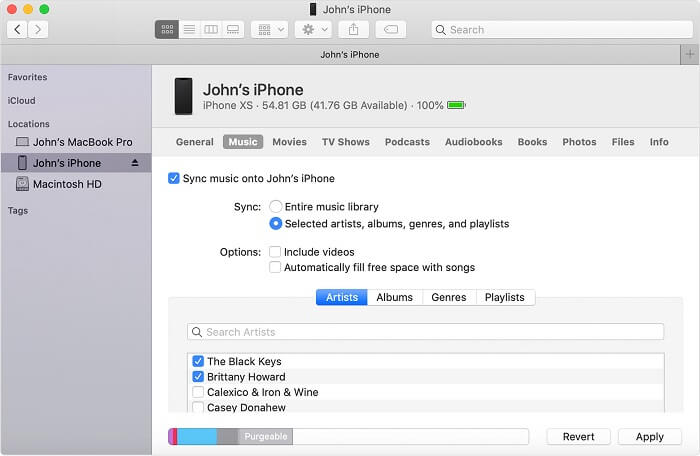
Step 5Click Apply to start the sync. Your MP3s will transfer to your iPhone's Music app.
Important note about Apple Music subscribers: If you subscribe to Apple Music and have Sync Library turned on in Settings > Music, you won't be able to use this manual sync method—your music automatically transfers across devices via the cloud instead.
A word of caution about how syncing actually works: When you sync music via Finder, iTunes, or the Apple Devices app, you're not adding songs to your phone—you're mirroring a selected set of content from your computer to your iPhone. Whatever is checked on your computer is what stays on your phone; anything previously on your phone that isn't checked in this sync will be removed. This is a critical distinction that many users don't realize until it's too late.
With FoneTrans for iOS, you will enjoy freedom to transfer your data from iPhone to computer. You can not only transfer iPhone text messages to computer, but also photos, videos and contacts can be moved to PC easily.
- Transfer photos, videos, contacts, WhatsApp, and more data with ease.
- Preview data before transferring.
- iPhone, iPad and iPod touch are available.
Using iTunes (macOS Mojave or earlier, and Windows)
For older Macs (macOS Mojave 10.14 or earlier) and Windows PCs, iTunes is still the primary tool. Apple officially split iTunes into separate apps for Windows 10 and 11—Music, TV, and Devices—but iTunes remains available for older systems.
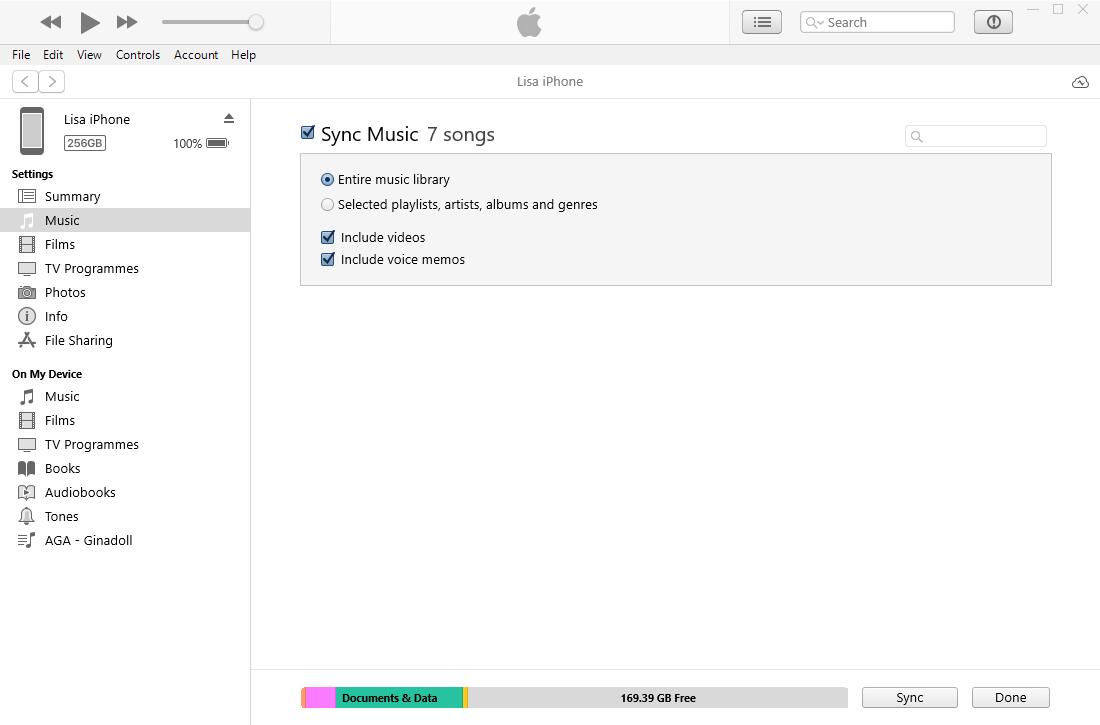
Step 1Connect your iPhone to your computer and open iTunes.
Step 2Click the device icon that appears near the top-left of the iTunes window.
Step 3Select Music from the sidebar.
Step 4Check Sync Music and choose whether to sync your entire library or selected playlists, artists, or albums.
Step 5Click Apply or Sync to begin the transfer.
Using the Apple Devices App (Windows 10/11)
If you're on Windows 10 or 11, Apple has replaced iTunes for device management with the Apple Devices app, available from the Microsoft Store. This is now Apple's recommended way for Windows users to sync music and manage their iPhones.
Here's the catch: You also need the Apple Music app installed—the Devices app syncs music from the Apple Music library on your PC. To get started:
Step 1Download both the Apple Music app and the Apple Devices app from the Microsoft Store.
Step 2Open Apple Music and add your MP3s to your library. You can do this by clicking File > Add File to Library or dragging MP3s directly into the Music window.
Step 3Connect your iPhone to your PC via USB and tap Trust on your phone if prompted.
Step 4Open the Apple Devices app and select your iPhone from the sidebar.
Step 5Click Music in the sidebar menu.
Step 6Check Sync music onto [your iPhone] and choose either Entire music library or Selected artists, albums, genres, and playlists.
Step 7Click Apply to sync.
One important thing I learned the hard way: If you install the new Apple Devices app, iTunes will no longer manage your iPhone—music and video content won't appear in iTunes anymore, and you can't use iTunes to sync manually. Also, if you use third-party music management tools like MediaMonkey, the new Devices app can break compatibility because it replaces the backend services those tools rely on.
With FoneTrans for iOS, you will enjoy freedom to transfer your data from iPhone to computer. You can not only transfer iPhone text messages to computer, but also photos, videos and contacts can be moved to PC easily.
- Transfer photos, videos, contacts, WhatsApp, and more data with ease.
- Preview data before transferring.
- iPhone, iPad and iPod touch are available.
Understanding Sync Options in Apple's Official Tools
Important clarification: Finder, iTunes, and the Apple Devices app all give you the ability to sync only selected content—you don't have to copy your entire computer library to your iPhone.
| Sync Option | What It Does | When to Use |
|---|---|---|
| Entire music library | Copies every song from your computer's Apple Music/iTunes library to your iPhone | You have a manageable library size and want all your music on the go |
| Selected playlists, artists, albums, and genres | You manually check/uncheck specific items—only the checked content transfers | You have a large library but only want specific playlists or artists on your phone |
In the selected mode, you'll see a full list of:
- Artists — check specific bands or singers
- Albums — pick entire albums
- Playlists — sync specific playlists you've created
- Genres — sync all songs from certain music styles
This is where the mirroring trap gets tricky: Let's say you check three playlists and sync. Those three playlists land on your iPhone—great. But what if you previously had a fourth playlist on your phone from an older sync, or you downloaded some songs directly via Apple Music? Those will be removed during this sync because they aren't checked in your current selection. Syncing isn't add this, leave everything else alone. It's make my iPhone match exactly what's checked on my computer.
To avoid surprises, I recommend thinking of Apple's official sync tools as curated replacement rather than incremental addition.
Method 3: Using Third-Party Software (The Flexible Way)
Third-party tools offer a much more flexible approach. They let you transfer MP3s directly without overwriting your existing music—something Apple's official tools don't allow. I've found these tools especially useful when I just want to add a few songs without disrupting my entire library.
A key advantage: You don't need to add your MP3s to iTunes or Apple Music first—most third-party tools let you transfer from any folder on your computer.
Spotlight: FoneTrans for iOS
Among the third-party options, FoneTrans for iOS stands out as a dedicated all-in-one solution. Unlike iTunes or Finder, which force you into full-library syncs, FoneTrans for iOS lets you selectively transfer MP3s and other files without overwriting anything on your iPhone.
What makes FoneTrans for iOS different:
FoneTrans positions itself as a true iTunes alternative—not just for music, but for managing photos, contacts, messages, voice memos, and more. The key selling point is control: you pick exactly which files to move, and nothing gets deleted or replaced unless you explicitly tell it to.
According to the developer's documentation, FoneTrans works by leveraging Apple's device drivers (so iTunes needs to be installed on your computer, but you never need to open it during transfers). This is a common setup for third-party iOS tools—they use the underlying framework while bypassing iTunes's restrictive sync logic.
With FoneTrans for iOS, you will enjoy freedom to transfer your data from iPhone to computer. You can not only transfer iPhone text messages to computer, but also photos, videos and contacts can be moved to PC easily.
- Transfer photos, videos, contacts, WhatsApp, and more data with ease.
- Preview data before transferring.
- iPhone, iPad and iPod touch are available.
Supported file types for music transfers:
FoneTrans supports importing and exporting a wide range of media including MP3, M4A, AAC, WAV, AIFF, and more. It also handles playlists, ringtones (custom creation from any song), music videos, audiobooks, and podcasts.
How to transfer MP3 to iPhone using FoneTrans for iOS:
Step 1Download and install FoneTrans for iOS on your computer (available for both Windows and macOS). Connect your iPhone via USB cable and tap Trust This Computer if prompted.
Step 2Launch FoneTrans. Your device should appear in the main interface. Click on Music in the left sidebar—the software will scan and load all existing music files on your iPhone.
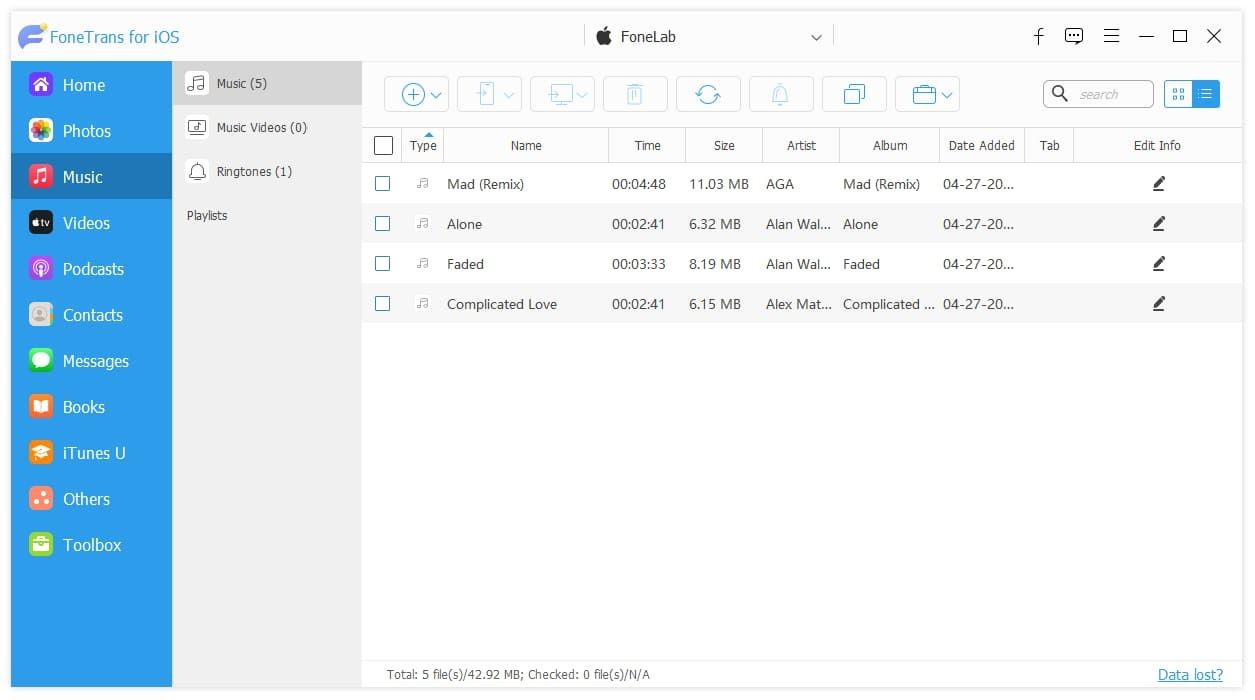
Step 3At the top of the interface, click the Add button. Navigate to the MP3 files on your computer, select them, and click Open. The software will then transfer the files directly to your iPhone's Music app.
A few real-world notes from my own experience: The transfer speed is decent—a typical album of 12 songs (around 100MB total) takes about 30–60 seconds. You can also drag and drop files directly into the interface, which feels much more natural than the iTunes sync process. And the best part? Your existing music library stays completely untouched.
With FoneTrans for iOS, you will enjoy freedom to transfer your data from iPhone to computer. You can not only transfer iPhone text messages to computer, but also photos, videos and contacts can be moved to PC easily.
- Transfer photos, videos, contacts, WhatsApp, and more data with ease.
- Preview data before transferring.
- iPhone, iPad and iPod touch are available.
Extra features that come in handy:
Beyond basic transfers, FoneTrans offers a few bonus tools that I've found genuinely useful:
- Ringtone Maker: You can pick any MP3 from your iPhone or computer, trim it to the section you want (max 29 seconds), add fade-in/fade-out effects, and export it directly as an iPhone ringtone. No format conversion headaches, no GarageBand workarounds.
- ID3 Tag Editor: If your MP3s have missing album art, wrong artist names, or messy genres, you can edit all of that directly in the software—much easier than doing it on the phone.
- HEIC to JPG/PNG Converter: Not music-related, but if you're managing photos alongside your audio files, this saves a step.
- Device-to-Device Transfer: If you're upgrading to a new iPhone, FoneTrans can move your entire music library (and more) directly from the old phone to the new one without using iCloud or a computer as an intermediary.
One important caveat: The software requires iTunes to be installed on your computer (because it uses Apple's drivers), but you never have to open iTunes itself. On newer Windows machines, this might mean you need the Apple Devices app or legacy iTunes drivers present—something to check before committing to the tool.
Method 4: Direct Download to iPhone (Using Safari)
You can download MP3 files directly from websites to your iPhone—no computer needed. This is great for grabbing a track you find online while on the go.
Step 1Open Safari and navigate to the website hosting the MP3 file. Tap the download link.
Step 2A download progress indicator appears. Once finished, tap the downloads button (down arrow icon) next to the Safari address bar.
Step 3Tap the downloaded file to play it, or tap the share icon to save it to the Files app or open it in a third-party music player.
How to Manage Downloaded Files in the Files App
By default, Safari saves files to iCloud Drive > Downloads, but you can change this in Settings > Safari > Downloads. To find your files, open the Files app, tap Browse, and select Downloads under either iCloud Drive or On My iPhone.
Warning: Copyright and Regional Considerations
Only download MP3s from legal sources. Sites like Free Music Archive, Jamendo, and Bandcamp offer legitimate free downloads under Creative Commons licenses. In some regions, downloading copyrighted music without permission violates local laws, so always check before you download.
With FoneTrans for iOS, you will enjoy freedom to transfer your data from iPhone to computer. You can not only transfer iPhone text messages to computer, but also photos, videos and contacts can be moved to PC easily.
- Transfer photos, videos, contacts, WhatsApp, and more data with ease.
- Preview data before transferring.
- iPhone, iPad and iPod touch are available.
Method 5: Streaming Services vs. Local Files
The debate between streaming and local files comes down to convenience versus control. Here's how they compare:
| Feature | Apple Music | Spotify | Local MP3 Files |
|---|---|---|---|
| Audio Quality | Lossless (ALAC) up to 24-bit/192kHz | Lossy (Ogg Vorbis) max 320 kbps | Variable (depends on file) |
| Internet Needed? | For streaming (can download for offline) | For streaming (can download for offline) | No |
| Library Control | Limited (streaming catalog) | Limited (streaming catalog) | Full control |
| Storage Impact | Minimal (streaming) | Minimal (streaming) | Uses device storage |
| Sync Across Devices | Automatic with Sync Library | Automatic | Manual |
For audiophiles, Apple Music's lossless support is a game-changer, though you'll need wired headphones or an external DAC to fully appreciate it. But if you value permanent ownership and unlimited playback without subscriptions, local MP3 files are the way to go.
With FoneTrans for iOS, you will enjoy freedom to transfer your data from iPhone to computer. You can not only transfer iPhone text messages to computer, but also photos, videos and contacts can be moved to PC easily.
- Transfer photos, videos, contacts, WhatsApp, and more data with ease.
- Preview data before transferring.
- iPhone, iPad and iPod touch are available.
Troubleshooting Common Issues
Why isn't my MP3 showing up in the Music App?
If you transferred via Apple's official tools and your song isn't there, check these common culprits:
- Apple Music Sync Library: If you have Sync Library turned on in Settings > Music, you cannot manually sync music via Finder, iTunes, or Apple Devices. You'll need to turn this off to use manual sync.
- File compatibility: Make sure your MP3 isn't corrupted or in an unsupported format (though MP3 is generally fine).
- Not added to library: For Apple's tools, the file must first be added to your computer's Apple Music or iTunes library.
How to fix Syncing Error in Apple Devices/iTunes
If you see syncing errors, Apple Support advises that issues often stem from third-party security software or media files stored in multiple locations. You can try:
- Converting to a lower bit rate: In the Apple Devices app or iTunes, go to General settings and select Convert higher bit rate songs to a lower bit rate to save storage and improve compatibility.
- Disabling security software temporarily: Some antivirus programs can interfere with sync.
- Checking for iTunes/Apple Music updates: Ensure you're running the latest version.
File Format Compatibility (MP3 vs. M4A/AAC)
iPhones support MP3, AAC, ALAC, WAV, and FLAC formats natively. MP3 works perfectly fine, but if you're using lossless files, consider ALAC (Apple Lossless) for full compatibility without quality loss. M4A (AAC) files also play without issue.
Legal and Safety Disclaimer
Download music only from legal sources. Unauthorized downloading of copyrighted material is illegal in many jurisdictions and violates the terms of service for most platforms. For legal free music, check out sites like Free Music Archive, Jamendo, and Bandcamp, which offer Creative Commons-licensed tracks.
With FoneTrans for iOS, you will enjoy freedom to transfer your data from iPhone to computer. You can not only transfer iPhone text messages to computer, but also photos, videos and contacts can be moved to PC easily.
- Transfer photos, videos, contacts, WhatsApp, and more data with ease.
- Preview data before transferring.
- iPhone, iPad and iPod touch are available.
Frequently Asked Questions (FAQ)
Can I transfer MP3 to iPhone via Bluetooth?
No. Apple restricts Bluetooth file transfers between iPhones and other devices for security reasons. AirDrop works for Apple-to-Apple transfers, but Bluetooth isn't a viable option for MP3 transfers.
Does transferring MP3 delete my existing Apple Music library?
It depends on the method. Using Finder, iTunes, or Apple Devices with Sync Music enabled will erase music not in your computer's library—this is true even in selected sync mode. Third-party tools, cloud services, and direct downloads add files without deleting anything.
What's the difference between iTunes and the Apple Devices app?
Apple split iTunes into separate apps for Windows 10/11: Apple Music (for playing music), Apple TV (for video), and Apple Devices (for syncing and managing iPhones). On Mac, Finder replaced iTunes for device management. iTunes still exists for older Windows versions and macOS Mojave or earlier.
Can I use iTunes after installing the Apple Devices app?
Yes and no. After installing the new apps, iTunes on Windows will no longer manage your iPhone or sync music—those functions move to the Devices app. iTunes remains only for podcasts and audiobooks.
Can I sync just a few songs using Finder/iTunes/Apple Devices, not my whole library?
Yes—all three tools offer a Selected playlists, artists, albums, and genres option that lets you choose exactly which content to sync. However, remember that even in selected mode, the sync process replaces your phone's music content with whatever is checked on your computer. Any music on your phone that isn't checked in the current sync will be removed. For true add-only transfers, use cloud services or third-party tools.
Conclusion
Here's my recommendation based on your setup and comfort level:
- For Windows 10/11 users: The new Apple Devices app (with Apple Music installed) is Apple's official path forward. Remember: you can choose to sync specific playlists or artists, but any sync replaces your phone's music library with what's checked on your computer.
- For Mac users: Finder is your go-to for official syncing. Same rule applies: you can select specific content, but it's still a mirroring operation—not an add-only transfer.
- For beginners who just want a few songs: Use cloud services like Google Drive or iCloud Drive. It's wireless, simple, and doesn't risk losing your existing music.
- For bulk transfers without overwriting: Third-party tools like FoneTrans let you transfer large libraries selectively, with bonus features like ringtone creation and ID3 editing.
- For quick single downloads: Safari direct download is perfect—no computer, no cables, just grab and go.
One final piece of advice from personal experience: If you're an Apple Music subscriber who uses Sync Library (Settings > Music > Sync Library), manual syncing via Finder/Apple Devices/iTunes won't work at all. You'll need to rely on iCloud Music Library to keep your music across devices, or turn Sync Library off if you want to manage files manually.
The key takeaway? You have more choices than ever. Pick the method that fits your workflow, and enjoy your music on your terms.
With FoneTrans for iOS, you will enjoy freedom to transfer your data from iPhone to computer. You can not only transfer iPhone text messages to computer, but also photos, videos and contacts can be moved to PC easily.
- Transfer photos, videos, contacts, WhatsApp, and more data with ease.
- Preview data before transferring.
- iPhone, iPad and iPod touch are available.