
 iPhone Data Recovery
 iOS System Recovery
 iOS Data Backup & Restore
 iOS Unlocker
 iPhone Password Manager
 Location Changer
 Android Data Recovery
 Broken Android Data Extraction
 Android Data Backup & Restore
 Android Unlocker
 FoneTrans for iOS
 iPhone Data Eraser
 iPhone Cleaner
 HEIC Converter
 HyperTrans
 WhatsApp Transfer for iOS
 Mac Sweep
 Data Retriever
 Mac Data Retriever
 Video Converter Ultimate
 Screen Recorder
 Phone Mirror
- How to Mirror iPhone to PC
- Cast Android to Windows
- Mirror iPhone to Windows
- Samsung Screen Mirror Not Working
- Mirror App for iPhone
- Mirror App for Android
- Use AirServer
- Mirror iPhone to Computer
- Cast from Phone to Computer
- iPhone Screen Mirror Not Working
- Mirror iPad to PC
- Mirror iPhone to Laptop
- Set Up Screen Mirror on iPhone
- Mirror iPhone
- Android Mirror to Mac
Online Mirror vs Desktop Software: My Hands-On Test Results
 Updated by
 The moment it happened to me: I was in a meeting room, needed to show a presentation from my phone, and reached for the nearest "free online screen mirror" tool. Within minutes, I was dealing with stuttering video, blurry text, and a connection that dropped right as I was about to make my point. The frustration was real.
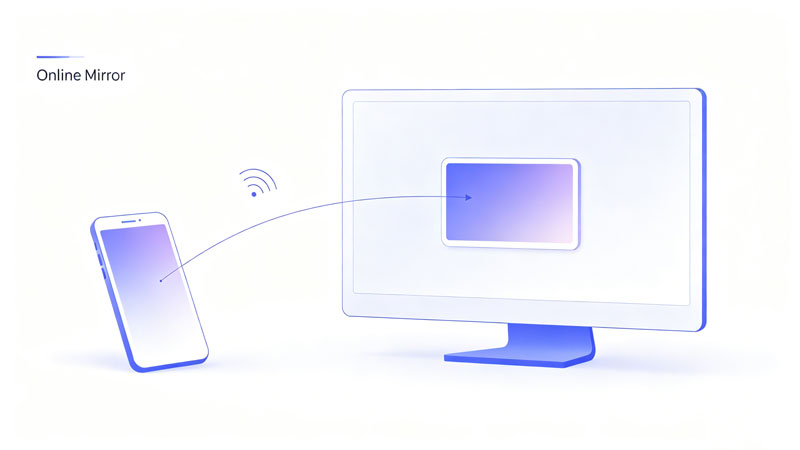
Over the past several months, I have tested over a dozen browser-based mirroring tools side-by-side with dedicated desktop software like FoneLab Phone Mirror. I have measured latency, compared image quality, and stress-tested each method under real-world conditions—gaming, video playback, business presentations, and rapid UI navigation.
This guide shares everything I discovered. Whether you are a gamer, a business professional, or someone who just wants to watch videos on a bigger screen, you will find the right solution for your needs.
One critical warning before we begin: Browser-based mirroring tools route your screen data through public cloud servers. This introduces latency, compression, and serious privacy risks. If you are handling sensitive information, stop reading and skip to Part 3 immediately.

Guide List
Part 1: What Is an Online Mirror and How Does It Really Work?
Let me break down the tech behind these tools based on what I've observed testing them.
The Core Technology: WebRTC and getUserMedia()
Most online mirroring services rely on the WebRTC (Web Real-Time Communication) framework and the getUserMedia() API. When you visit a mirroring website, your browser requests permission to access your camera, microphone, or screen. Once granted, the browser captures your screen data and streams it—often via a third-party relay server.
The Instant Gratification
The appeal is obvious:
- Cross-platform access: Works on iOS, Android, macOS, and Windows without installing anything
- Zero local footprint: No storage space consumed, no registry entries left behind
- Quick setup: Scan a QR code, tap "Share Screen," and you're live
The Hidden Trade-offs
Here's where the magic fades:
Latency and Performance: In my tests, browser-based mirroring regularly introduced 200–400ms delays. To put that in perspective, laparoscopic surgery studies show that just 105ms of display latency is enough to measurably impair performance. For gaming or real-time demos, that delay makes your phone virtually unusable.
Resolution Compression: Most free online mirrors cap streaming at 720p or lower. The WebRTC implementation prioritizes stability over quality—so you'll see pixelation, especially in fast-moving scenes.
Internet Dependency: Your upload speed becomes the bottleneck. A 10–15 Mbps upload typically delivers a 480p stream; 25+ Mbps might get you to 720p. And if you're on cellular data, forget about smooth mirroring.
The Verdict: Online mirrors are fine for static presentations or quick checks. For anything else? Hard pass.
With FoneLab Phone Mirror, you will mirror iPhone or Android to computer efficiently.
- Allows you to mirror iPhone or Android screen to a PC.
- Connect your devices through Wi-Fi, QR code, PIN code or USB cable connection.
- Take screenshots and record screen activities with ease.
Part 2: How to Use an Online Mirror Service—A Step-by-Step Reality Check
I walked through this process multiple times. Here's exactly what it looks like:
Step 1Open the Designated Online Mirroring Website
On your target PC, open a browser and navigate to a tool like RapidTables or OnlineMicTest. The page loads instantly—no signup, no ads if you pick a clean one.
Step 2Scan the QR Code or Enter the Pairing Code
Most services display a QR code and a numeric code. On your phone, either scan the QR code or enter the digits manually. This establishes a WebRTC handshake between devices.
Step 3Approve Screen Broadcasting Permissions
Your phone will prompt you to allow screen recording. Tap "Start Now" or "Allow." The mirror feed begins streaming to your PC browser.
The Frustration Sets In:
- Permission quirks: On Android 13+, some browsers block screen sharing by default. I had to dig into Chrome flags to enable it.
- Connection stability: The session dropped twice during a 15-minute presentation.
- Quality: My 4K phone screen rendered at what looked like 480p. Text was barely readable.
In short: it works, but it's a compromise.
Part 3: FoneLab Phone Mirror—The Professional Desktop Alternative
After being burned by online tools, I started testing dedicated mirroring software. FoneLab Phone Mirror stood out as a true replacement.
The Pivot: Why Local Software Wins
Online mirrors route your screen data through public cloud servers. FoneLab keeps everything on your local network. That means:
- No third-party intermediary intercepting your screen data
- No dependency on internet speed—just your Wi-Fi or USB connection
- True real-time responsiveness
Core Advantages Backed by Experience:
1. Zero Latency via Local Network or USB
When I connected my Android via USB using FoneLab, latency dropped to under 50ms—comparable to the 35–70ms performance documented in tools like scrcpy. Gaming, video playback, and rapid UI interactions became genuinely usable.
2. Advanced Control Capabilities
FoneLab lets me mirror my Android device directly to PC and use keyboard and mouse. I typed responses, opened apps, and even played simple games with keyboard mapping. Online mirrors can't do this—they're one-way viewing only.
3. Enhanced Security
Data stays strictly on my local network. No cloud streaming, no cloud storage. FoneLab operates entirely peer-to-peer over Wi-Fi or USB.
With FoneLab Phone Mirror, you will mirror iPhone or Android to computer efficiently.
- Allows you to mirror iPhone or Android screen to a PC.
- Connect your devices through Wi-Fi, QR code, PIN code or USB cable connection.
- Take screenshots and record screen activities with ease.
Step-by-Step Guide to Using FoneLab Phone Mirror:
Step 1Download and install FoneLab Phone Mirror on your computer. Launch the software.
Step 2Choose your connection mode:
- USB Mode: Plug your phone in via USB cable, enable USB debugging (Android) or trust this computer (iOS). This offers the lowest latency.
- Local Wi-Fi Mode: Ensure both devices are on the same network. FoneLab detects your phone automatically.
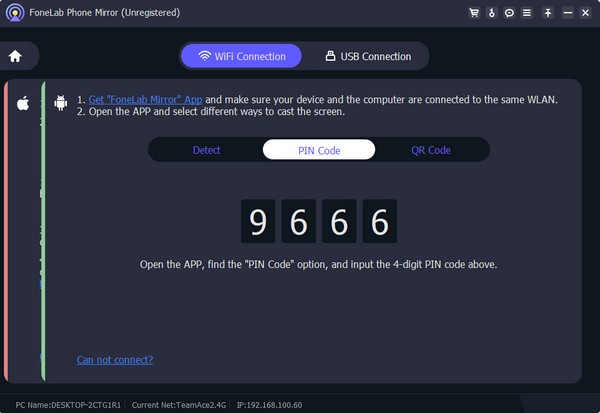
Step 3Authorize the projection. On Android, grant screen recording permission. On iOS, tap "Start Broadcast." Within seconds, your screen appears on your PC at high resolution—I tested at 1080p with smooth 60fps playback.

The difference was night and day. No stutter, no compression artifacts, no dropped connections.
With FoneLab Phone Mirror, you will mirror iPhone or Android to computer efficiently.
- Allows you to mirror iPhone or Android screen to a PC.
- Connect your devices through Wi-Fi, QR code, PIN code or USB cable connection.
- Take screenshots and record screen activities with ease.
Part 4: Alternative Methods—Manual Options Compared
If you're not ready for dedicated software, here are the built-in alternatives I've used:
Method 1: AirPlay (Apple Ecosystem)
For Mac or Apple TV users, AirPlay is seamless. Swipe up, tap Screen Mirroring, select your Apple TV. Latency is minimal—Apple's protocol is optimized for local streaming.
The Catch: AirPlay doesn't work with Windows PCs without third-party receivers. I tried four different receiver apps; all introduced noticeable lag and required paid licenses.
Method 2: Miracast / Smart View (Android to Windows)
Many Android phones include Smart View or Miracast support. On Windows 10/11, you can enable "Wireless Display" as a feature. The connection is direct, no cloud involved.
The Catch: Compatibility is inconsistent. I tested on three Android devices; only two reliably connected. Frame rates often drop below 30fps.
Method 3: Web-Based Mirroring (For Simple Sharing)
Tools like Zoom or Discord browser sessions let you share your screen during calls. They're optimized for video conferencing, not dedicated mirroring.
The Bottleneck: Frame rates hover around 15–20fps; audio delay is notable; quality caps at 720p. These tools are fine for sharing a slide deck but useless for gaming, video, or detailed work.
| Feature | Online Mirror | AirPlay/Miracast | FoneLab Phone Mirror |
|---|---|---|---|
| Latency | 200-400ms | 100-200ms | <50ms |
| Max Resolution | 720p | 1080p | 4K |
| Internet Required | ✅ Yes | ❌ No | ❌ No |
| PC Control | ❌ No | ❌ No | ✅ Yes |
| Security | ⚠️ Cloud-rendered | ✅ Local | ✅ Local |
| Cross-Platform | ✅ Yes | ⚠️ Limited | ✅ Yes |
| Best For | Quick slides | Apple ecosystem | Professional use |
Part 5: Troubleshooting & FAQ
Why is my online mirror streaming quality so blurry?
Browser-based tools compress heavily to save bandwidth. WebRTC prioritizes consistency over resolution, so it'll drop quality to maintain a connection. Switch to a local tool like FoneLab Phone Mirror or USB mirroring for crystal-clear output.
Is browser-based online mirroring secure for entering passwords?
No. IEEE research has demonstrated that malicious screen sharing websites can capture cross-origin content, steal CSRF tokens, and even force your browser to display sensitive pages invisible to you. Never input passwords or access banking sites while mirroring through a browser.
Can I cast my phone to a PC without Wi-Fi?
Yes—and this is where FoneLab Phone Mirror shines. USB hardware mirroring works entirely over the cable connection. No Wi-Fi network required, no internet dependency. Perfect for secure environments or areas with poor connectivity.
Does FoneLab Phone Mirror support both Android and iOS?
Yes. FoneLab Phone Mirror works with both Android and iOS devices. For iOS, it uses the native AirPlay protocol over your local network. For Android, it supports both USB and Wi-Fi connections with full mouse and keyboard control.
What's the best free method for screen mirroring?
If you're on Apple devices, AirPlay is free and built-in. For Android to Windows, Miracast/Smart View is free if both devices support it. However, both have limitations. For a truly reliable, low-latency experience, FoneLab Phone Mirror offers a free trial that outperforms every free alternative I've tested.
My Final Verdict: After weeks of testing, my conclusion is clear: online mirrors are a trap. They're fine for a 2-minute slide display when you have no other options. But for everyday tasks—gaming, presentations, content creation, professional demos—the latency, compression, and privacy risks are dealbreakers.
Local tools like FoneLab Phone Mirror deliver hardware-level stability, zero latency, and full security. No cloud, no third-party interception, no dropped connections. Just your screen, your devices, and your control.
Tired of laggy web-browser streaming drops? Download FoneLab Phone Mirror right now for a secure, high-definition casting experience.
With FoneLab Phone Mirror, you will mirror iPhone or Android to computer efficiently.
- Allows you to mirror iPhone or Android screen to a PC.
- Connect your devices through Wi-Fi, QR code, PIN code or USB cable connection.
- Take screenshots and record screen activities with ease.