
 iPhone Data Recovery
 iOS System Recovery
 iOS Data Backup & Restore
 iOS Unlocker
 iPhone Password Manager
 Location Changer
 Android Data Recovery
 Broken Android Data Extraction
 Android Data Backup & Restore
 Android Unlocker
 FoneTrans for iOS
 iPhone Data Eraser
 iPhone Cleaner
 HEIC Converter
 HyperTrans
 WhatsApp Transfer for iOS
 Mac Sweep
 Data Retriever
 Mac Data Retriever
 Video Converter Ultimate
 Screen Recorder
 Phone Mirror
[5 Fixes] "Could Not Activate iPhone or iPad" — Here's Why & How
 Updated by
Nothing is more frustrating than unboxing, resetting, or updating an iPhone or iPad only to be stopped cold by "could not activate iPhone" or "waiting for activation." You cannot get past the setup screen, and the phone feels like a brick. I have walked people through this enough times to know it is usually one of a handful of simple causes — and rarely something physically wrong with the device.
This guide covers five fixes in order of how likely they are to solve the problem, starting with the free checks that take a minute and moving to a dedicated system-repair tool if the device's own software is stuck. I am also honest about what none of these fixes can do — activation lock and carrier lock are different problems with different solutions.
Work through the parts in order. Most people are done after Part 2 or Part 3, and you only need the tool in Part 5 if the basic checks all pass.

Guide List
Part 1: Why Your iPhone or iPad Won't Activate
Activation is Apple checking, over the internet, that the device you are holding is allowed to be set up. If that handshake fails, you see the error. The usual culprits break down into four groups:
- Apple's own activation servers are down or busy — common right after a new iOS release.
- Your internet connection is weak, filtered, or blocking Apple's servers.
- The device software is stuck — a half-finished update or corrupted setup routine.
- A real lock: the device is still linked to a previous owner's Apple ID (activation lock) or your SIM/carrier is not recognized.
The first three are fixable at home. The fourth is not a software glitch — if you see an Activation Lock screen asking for the previous owner's Apple ID, the device was not properly erased before you got it, and only the original owner (or proof of purchase through Apple Support) clears it. None of the tools below bypass that, and I would be misleading you if I suggested otherwise.
One symptom worth naming: "waiting for activation" that spins for minutes on end, or an error that says the device could not be activated because the activation information could not be obtained. Those almost always point to the first two causes — servers or network — rather than broken hardware. People jump straight to assuming the phone is bricked, but in my experience a bad network or a busy server is behind the large majority of these.
Part 2: Check Apple's Activation Servers
Before touching anything on the phone, rule out Apple's end. When millions of people update at once, the activation servers get overwhelmed and perfectly good devices get the error.
Step 1On another device, open Apple's System Status page in a browser.
Step 2Look for Activation and Device Activation. If the dot is not green, the servers are the problem.
If the servers are down, there is nothing to fix on your side — wait an hour or two and try activating again. I have seen this resolve on its own within a morning more than once. If the servers are green, move on.
Right after a major iOS release, when everyone updates at once, this is the single most common cause. Check the timestamp on the problem too: if your activation trouble started right after updating, give it a few hours before trying anything more involved. There is no point wiping or repairing a device that is waiting on Apple's side.
Part 3: Restart and Check Your Network
A stuck activation screen and a flaky Wi-Fi are the next two most common causes. Start with a restart, then switch networks.
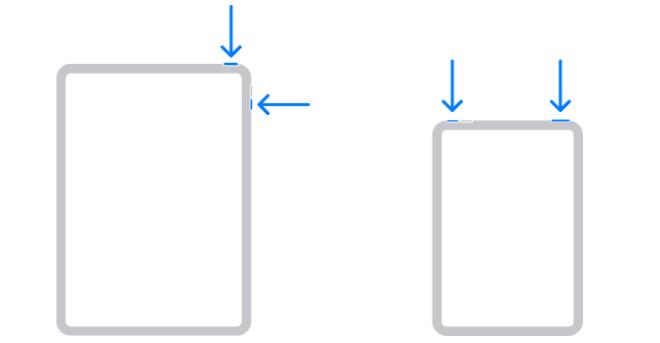
Step 1Force-restart the iPhone or iPad: press and quickly release volume up, volume down, then hold the side/top button until the Apple logo appears.
Step 2Try activating again. If it still fails, switch off Wi-Fi and use cellular data instead, or join a different, unrestricted Wi-Fi network.
Public Wi-Fi at hotels, schools, or offices often blocks the ports activation needs. Tethering to a phone's hotspot is the quickest way around that. If you activated over cellular, make sure a SIM is inserted and recognized.
Also double-check the date and time on the device. If the clock is wrong, Apple's security certificates are treated as expired and the activation handshake fails. On the setup screen this is hard to change directly, but the restart in Step 1 usually fixes the clock, and connecting to a network lets it sync automatically.
Part 4: Activate Through a Computer
If the phone itself cannot reach activation, doing it through a computer often works, because the computer's connection handles the handshake. On a Mac this happens in Finder; on a Windows PC use the Apple Devices app.
Step 1Connect the iPhone or iPad to the computer with a good USB cable and open Finder (Mac) or Apple Devices (Windows).
Step 2Select the device when it appears and follow the on-screen activation prompt.

This also updates the device to the latest iOS as part of the process, which clears a lot of stuck-setup problems. If the computer route also fails, the issue is likely the device's own system software — which is what Part 5 addresses.
A practical note: use the cable that came with the device, or a reputable MFi cable. A flaky cable is a surprisingly common reason the computer does not recognize the iPhone at all, which makes it look like an activation failure when it is really just a connection issue. If the device does not appear in Finder or Apple Devices, try a different port and a different cable before moving on.
Part 5: Fix It with FoneLab iOS System Recovery
When activation fails across servers, network, and computer, the setup routine itself is usually corrupted. FoneLab iOS System Recovery repairs the iOS system on your iPhone or iPad so the device can boot through setup normally — and, importantly, it does this without wiping your data in the standard mode.

FoneLab iOS System Recovery could fix your disabled, frozen, bricked, recovery/DFU mode iPhone/iPad back to normal without data loss.
- Fix abnormal iOS system to normal without data loss.
- Fix disabled iPhone, recovery mode, DFU mode and more.
- Work for iPhone, iPad and iPod touch.
The honest limits: this repairs the operating system, not a lock. If the screen is an Activation Lock asking for a previous owner's Apple ID, no repair tool can or should bypass that — that is a security feature. And the "advanced" repair mode, used when standard repair fails, will erase the device, so back up first if you can.
Step 1Install FoneLab iOS System Recovery on your computer, connect the device, and choose iOS System Recovery.
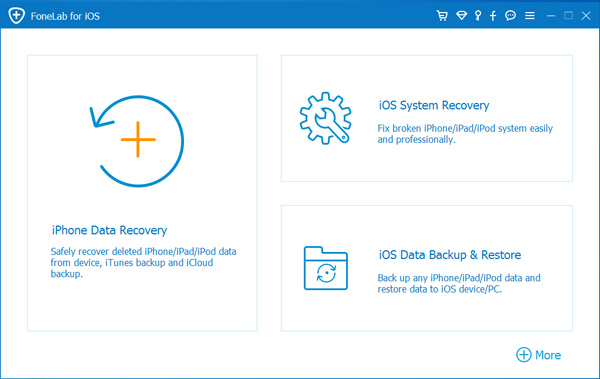
Step 2On the welcome screen, click Start to begin the repair.
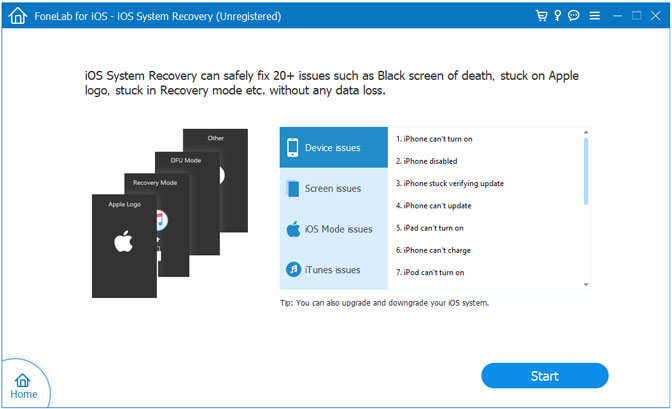
Step 3Choose Standard Mode (it keeps your data) or Advanced Mode, confirm the device information shown on screen, then click Repair. The program downloads the firmware needed to restore the system.
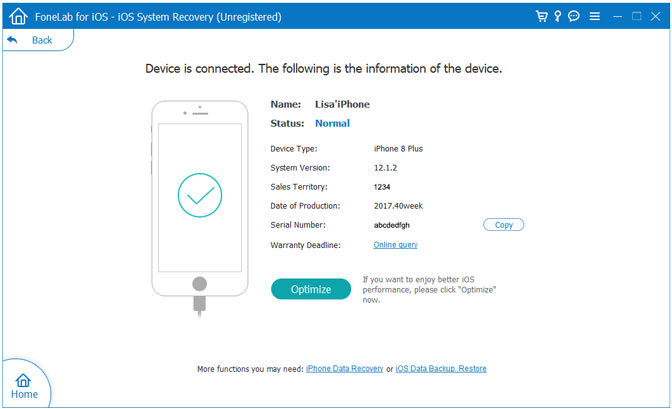
Step 4Wait for the repair to finish without disconnecting the device. It restarts, after which you can run activation again.
If your device is stuck on the Apple logo during this whole process, you may also want this walkthrough for an iPhone stuck on the Apple logo.
What to expect during the repair: the device screen may go dark and restart a few times, and the progress bar in the program moves as the firmware is installed. The single most important rule is leaving the cable plugged in the whole way — disconnecting mid-repair is the one thing that can actually turn a fixable device into a worse one. When it is done, unplugging and turning the device on drops you back at the setup screens, where activation should now go through.
If you get a specific error code like "activation could not be completed" or "no SIM" during setup, that points away from a system glitch and toward the account or carrier. No-service or SIM-not-valid messages mean your carrier account needs sorting before activation can finish, and Apple Support or your carrier can pull up the device's status. The goal of working through Parts 2 to 4 first is to rule out the simple, free causes before you spend time on a repair or a support call.
FoneLab iOS System Recovery could fix your disabled, frozen, bricked, recovery/DFU mode iPhone/iPad back to normal without data loss.
- Fix abnormal iOS system to normal without data loss.
- Fix disabled iPhone, recovery mode, DFU mode and more.
- Work for iPhone, iPad and iPod touch.
Part 6: Method Comparison
| Comparison | Check Servers | Restart / Network | Computer Activation | FoneLab System Recovery |
|---|---|---|---|---|
| Time needed | 1 minute | 5 minutes | 15 minutes | 20 minutes |
| Cost | Free | Free | Free | Free trial |
| Risks data | No | No | No | Standard mode no; advanced mode erases |
| Fixes a system glitch | No | Sometimes | Sometimes | Yes |
My recommendation: check the servers, then restart and switch networks (Parts 2 and 3); try a computer activation next (Part 4); use FoneLab iOS System Recovery when the device's own system is stuck (Part 5).
Part 7: FAQs
What is the difference between "could not activate" and Activation Lock?
"Could not activate" is a connection or software problem you can fix at home. Activation Lock is a security screen asking for the previous owner's Apple ID, which only that owner or Apple Support can clear. The fixes above apply to the first, not the second.
How long does "waiting for activation" normally take?
On a healthy connection it takes a minute or two. If it sits on "waiting for activation" for more than fifteen minutes, treat it as a real error and work through the restart, network, and computer steps rather than waiting it out.
Will activating through a computer erase my data?
No, activating through Finder or the Apple Devices app just completes the setup handshake and may update iOS. Only the advanced repair mode in a tool like FoneLab iOS System Recovery wipes the device, and it warns you before doing so.
Do I need a SIM card to activate an iPhone?
Many iPads can activate over Wi-Fi alone. An iPhone usually needs an active SIM or an unlocked status to complete activation, though some carriers let you activate over Wi-Fi after setup. If you see a SIM-related error, contact your carrier.
Stuck after the basic fixes? Try a standard repair with FoneLab iOS System Recovery to get past the activation screen without losing your data.
FoneLab iOS System Recovery could fix your disabled, frozen, bricked, recovery/DFU mode iPhone/iPad back to normal without data loss.
- Fix abnormal iOS system to normal without data loss.
- Fix disabled iPhone, recovery mode, DFU mode and more.
- Work for iPhone, iPad and iPod touch.