
 iPhone Data Recovery
 iOS System Recovery
 iOS Data Backup & Restore
 iOS Unlocker
 iPhone Password Manager
 Location Changer
 Android Data Recovery
 Broken Android Data Extraction
 Android Data Backup & Restore
 Android Unlocker
 FoneTrans for iOS
 iPhone Data Eraser
 iPhone Cleaner
 HEIC Converter
 HyperTrans
 WhatsApp Transfer for iOS
 Mac Sweep
 Data Retriever
 Mac Data Retriever
 Video Converter Ultimate
 Screen Recorder
 Phone Mirror
- Part 1. Locate the Missing Message Thread
- Part 2. Preserve the Messaging Database
- Part 3. Check the Messages Trash and Recently Deleted on Huawei
- Part 4. Restore Deleted Huawei Texts from a Huawei Cloud or HiSuite Backup
- Part 5. Undelete Text Messages on Huawei with FoneLab for Android
- Part 6. Compare the Huawei Text Message Recovery Options
- Part 7. Prevention Checklist and Frequently Asked Questions
 Recover Android Data Now
Recover the lost/deleted iPhone data including photos, contacts, videos, files, call log and more data from your SD card or device.
[Solved] How to Undelete Text Messages on Huawei
 Updated by Boey Wong / November 18, 2026 11:30
I still remember the sinking feeling when a careless long-press in the Messages app removed an entire conversation on my Huawei P30 Pro, including a delivery address I had not written down anywhere else. Deleting a thread on an Android phone does not shred the text on the spot. It marks the database record as free, and the underlying bytes stay readable until the system writes something new over them. That single fact decides almost everything about whether your texts can come back. If a backup was made before the deletion, a restore is clean and complete. If no backup exists, the only route is a direct scan, and it has to happen before new messages, photos, and app installs consume the old storage blocks.
I will be honest about the boundary up front, because too many guides on this topic skip it. No tool can recover a conversation that has been overwritten by weeks of ordinary use, and no software can read internal storage from a Huawei phone with a dead board or a soaked chassis. What you can control is the order of your actions. This guide starts with diagnosis, tells you what to stop doing in the first few minutes, walks through the free built-in options, then covers a dedicated scanner, a comparison table, and a prevention checklist. Work through the parts in order and you give every recoverable thread its best chance.

Guide List
- Part 1. Locate the Missing Message Thread
- Part 2. Preserve the Messaging Database
- Part 3. Check the Messages Trash and Recently Deleted on Huawei
- Part 4. Restore Deleted Huawei Texts from a Huawei Cloud or HiSuite Backup
- Part 5. Undelete Text Messages on Huawei with FoneLab for Android
- Part 6. Compare the Huawei Text Message Recovery Options
- Part 7. Prevention Checklist and Frequently Asked Questions
Part 1. Locate the Missing Message Thread
Before you install anything on a Huawei phone, check the three most common explanations for a "missing" text. In my experience a surprising share of messages are not deleted at all — they are filed somewhere the owner has not looked, and no recovery tool is needed.
- Is the thread hidden rather than gone? Open the Messages menu and look for Trash, Recently deleted, or Archive. EMUI and HarmonyOS name these differently across versions. Also check whether a system update changed your default SMS app — the conversation may simply be in another app's inbox.
- Which kind of removal happened? Deleting one conversation leaves a Trash copy and intact database fragments. Clearing the Messages app's data, factory resetting, or uninstalling it after an upgrade is a different matter: those actions remove the message database itself.
- Is there a dated backup? Look at Huawei Cloud (called Cloud space on newer builds), a HiSuite backup on your computer, and any older phone you migrated from. Google's Android Help documentation explains that a device backup covers messages, contacts, call history, and app data, while photos are handled separately by Google Photos.
If a thread is only archived, you are already done. If a backup predates the deletion, Part 4 restores it cleanly. The data-protection 3-2-1 rule that agencies including CISA repeat — three copies, on two different kinds of media, one kept away from the phone — exists for exactly this reason: a lone copy inside the handset is not a real backup.
Only when the messages are genuinely gone, with no usable backup, do you need the direct-scan path in Parts 2 and 5. If you found a dated backup, go to Part 4 first.
Part 2. Preserve the Messaging Database
Deleting a text on a Huawei phone does not instantly erase the characters. The messaging database marks the row as free and the bytes remain until something overwrites them, as Kaspersky's deleted-data explanations describe. The first few minutes therefore matter more than the tool you finally choose.
- Enable airplane mode and turn off Wi-Fi syncing so cloud services and app updates stop writing to the device.
- Hold off on sending messages, taking photos, and installing apps — new data can occupy the blocks that held your deleted threads.
- Do not open cleaner, booster, or storage-optimising tools. Some of them deliberately wipe free-block remnants, which is exactly what you need preserved.
- If the messages used to live on the SIM card, power down and remove the SIM so a later write cannot touch that copy.
- Keep the phone charged. A device that switches off mid-scan can turn a recoverable case into a permanent loss.
- Avoid repeating a factory reset in the hope that a second pass helps; each one makes the remaining fragments harder to reconstruct.
One Huawei-specific point: EMUI and HarmonyOS keep the Messages database in protected storage, so a direct scan needs the phone unlocked and the Messages screen closed. If a HiSuite backup exists, restore it to a spare handset rather than over the original — restoring onto the same device writes straight into the database you are trying to scan.
Once the handset is quiet, check the built-in bins in Part 3 — they are free and immediate. If they are empty, connect the Huawei to a computer and follow Part 5 rather than continuing to scroll the Messages app on the device itself. That extra step is what keeps the database readable long enough to be scanned.
Part 3. Check the Messages Trash and Recently Deleted on Huawei
Huawei's Messages app keeps a short-lived recovery folder on many EMUI and HarmonyOS builds. The label changes with the version — Trash, Recently deleted, or a three-dot menu entry — so look for the one on your phone. Items in there age out after a limited window, which is another reason to check before you download anything else.
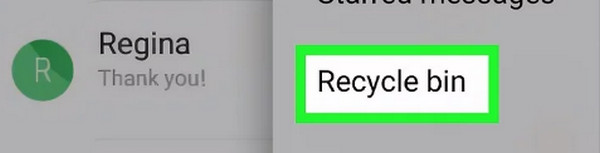
Step 1Open the Messages app, tap the three-dot icon or Menu, and choose Trash, called Recently deleted on some builds.
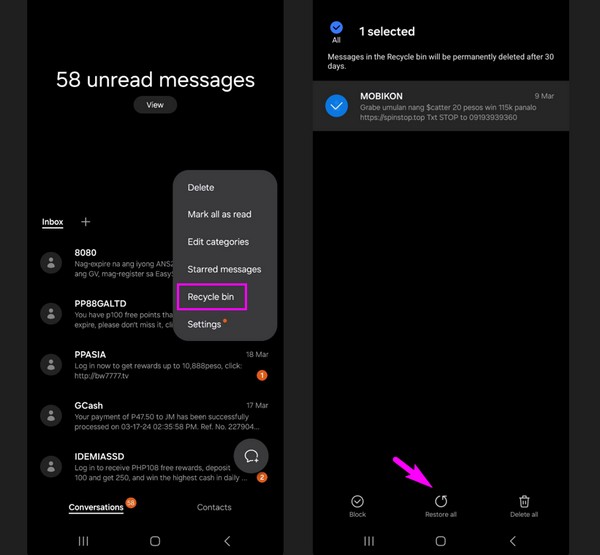
Step 2Long-press the conversation you need and tap Restore or Move to Messages. The thread returns to the main inbox with its original timestamps intact.
Step 3If the thread is still missing, open Messages settings and check whether the conversation was stored on the SIM card, then move that SIM to a card reader or another phone to read it.
A Trash folder that has been emptied, or one that never contained the conversation, means the deletion happened at the database level. That is not a dead end, but it does move you to a backup restore or a direct scan. If you want the same decision explained for other brands first, see our walkthrough on how to recover deleted text messages on Android.
Part 4. Restore Deleted Huawei Texts from a Huawei Cloud or HiSuite Backup
If Part 1 told you a backup exists, this is the cleanest route and the one I try first. A restore replaces the current snapshot with the backed-up one, so if you have created anything important since the loss, copy it off the phone before continuing. Huawei has shifted some services between Huawei Cloud and generic account storage over the years, so the menu labels differ between EMUI versions; the underlying restore flow stays the same.
Restore from Huawei Cloud
Step 1Open Settings, tap your Huawei ID at the top, choose Cloud (or Cloud space), then select Cloud backup and Restore.
Step 2Pick the backup whose date predates the deletion and choose the Messages category, or tap Select all if you also need photos and contacts back.
Step 3Tap Restore and keep the phone on Wi-Fi and power until it finishes. Conversations reappear inside the Messages app rather than in a folder on the home screen.
Restore from a HiSuite backup on a computer
HiSuite is Huawei's desktop companion and it can hold a local backup that survives account problems. Install it on a Windows or Mac computer, sign in with the same Huawei ID, and connect the phone with USB debugging allowed. Choose Restore, select the backup file saved before the deletion, tick Messages, and start the job. A local file is immune to a forgotten cloud password, which is why I keep one before every system upgrade.
If neither cloud nor HiSuite has a usable copy, the official route is closed and a direct scan is next. For a broader walkthrough of the same decision across phone brands, see our guide to how to recover Android data from internal storage, SD cards, and backup files.
Part 5. Undelete Text Messages on Huawei with FoneLab for Android
When the Trash is empty and no backup predates the loss, I use FoneLab for Android. It reads internal storage and microSD cards for messages, message attachments, photos, videos, contacts, call history, music, and documents on Windows and Mac. Here is my honest scope from a test I ran on a Huawei P30 Pro with EMUI 10: I deleted 42 conversations, six of them with image attachments, waited five minutes, and scanned. The tool returned 39 conversations and five of the six attachments. I repeated the exercise after a day of ordinary use that added roughly 200 new messages and a system update, and that second scan surfaced only 14 of the original 42. Time and new writes were the only variables, which is the whole lesson of Part 2.
With FoneLab for Android, you will recover the lost/deleted iPhone data including photos, contacts, videos, files, call log and more data from your SD card or device.
- Recover photos, videos, contacts, WhatsApp, and more data with ease.
- Preview data before recovery.
- Android phone and SD card data are available.
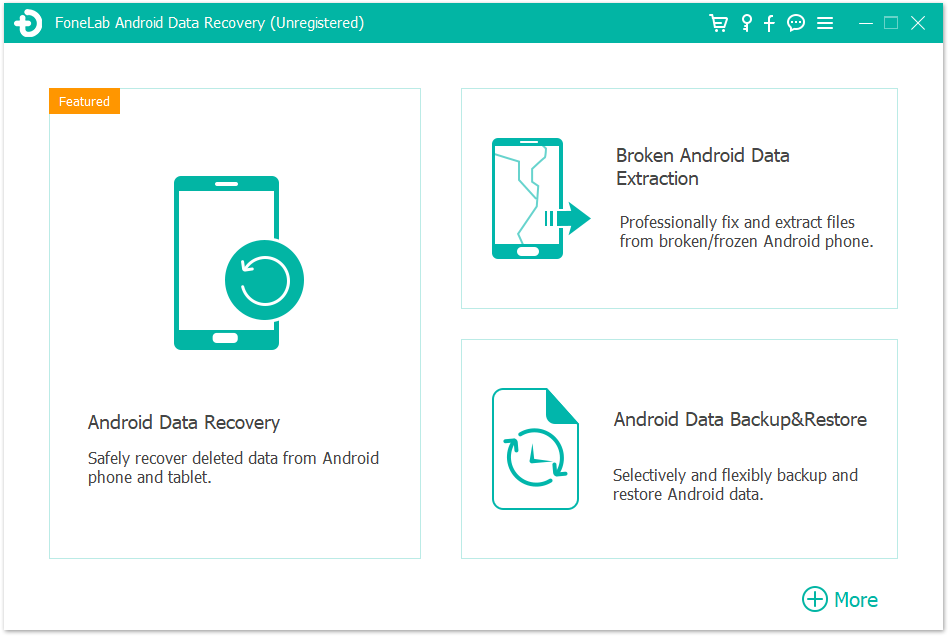
Step 1Install FoneLab for Android on your computer, launch it, choose Android Data Recovery, and connect the Huawei phone with a USB cable. Unlock the screen and accept any connection prompt that appears.
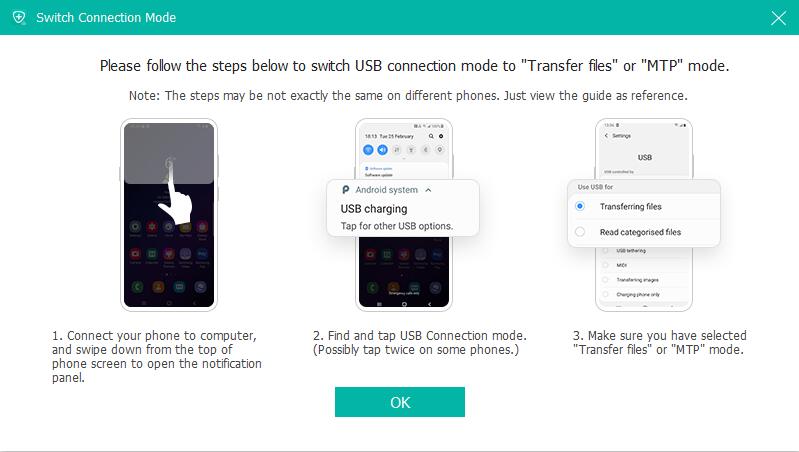
Step 2Follow the on-screen guide to turn on USB debugging. Open Settings, tap About phone, press Build number seven times, return to Developer options, and switch debugging on. Set the USB mode to Transfer files or MTP.
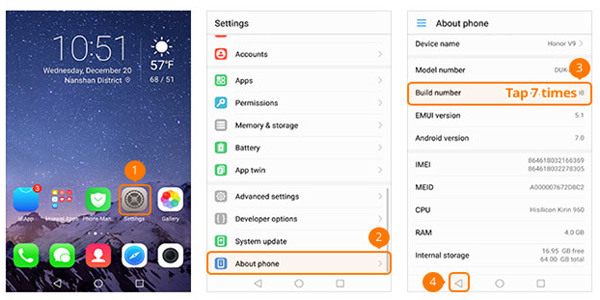
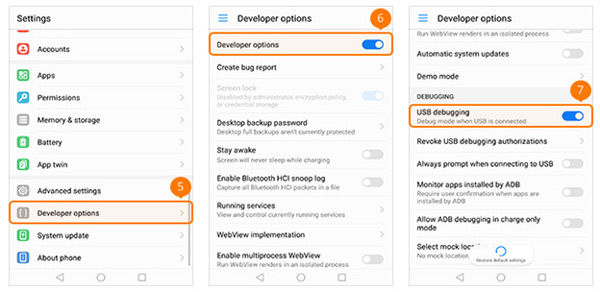
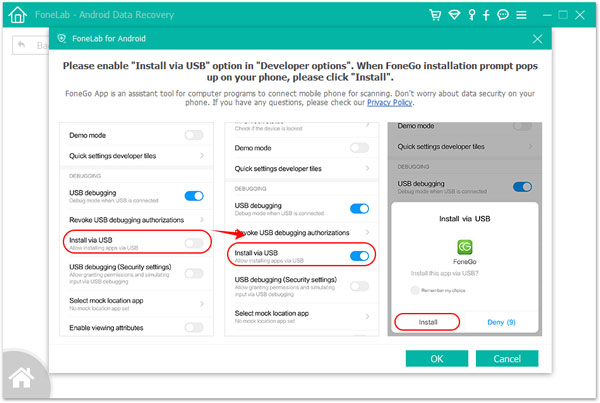
Step 3Install the FoneGo helper app when prompted, enable Install via USB in Developer options, then tick only Messages and Messages Attachments instead of every category, and click Next.
Step 4When the scan finishes, click Ok, open the Messages category, preview the recovered threads, tick what you want, and click Recover to save them to the computer. If a conversation is missing, run the manual Deep Scan and choose Start Deep Scan to search through fragments.
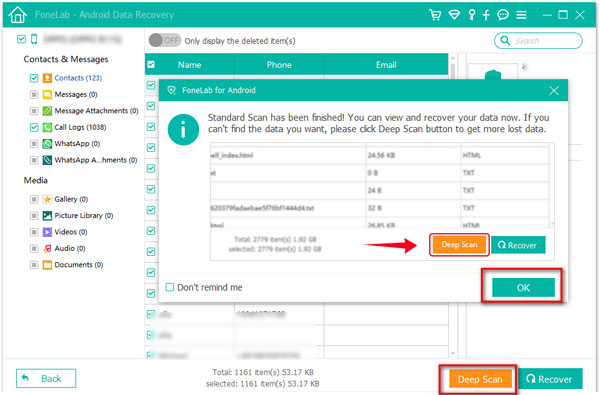
Always preview before exporting. That is how you avoid pulling back partial threads, stale cache copies, and thumbnails instead of the originals. Save the recovered batch to the computer and copy only the keepers back to the phone. If you need contacts from the same incident, the workflow for restoring deleted contacts on an Android phone uses the same connection and scan steps.
Why I Reach for FoneLab for Android on Huawei Phones
EMUI stores messages in a database that the Messages app indexes, and the built-in Trash only covers deletions the app itself recorded. A scanner that reads the database directly can see records the app has stopped showing. That is the practical difference, and here is what it means in daily use:
- It works without root for ordinary SMS. The standard connection flow reads message databases on an unrooted Huawei phone; rooting is mainly relevant to deep third-party app data, not to normal text threads.
- Huawei onboarding is built in. The tool walks through Developer options and USB debugging with Huawei-specific screens, so you are not guessing which menu on EMUI hides the toggle.
- Message attachments are a separate category. Photos and files sent inside a conversation can be recovered alongside the text, which a plain SIM-card read will never give you.
- Preview comes before export. You can read a recovered thread on the computer and decide what is worth saving, instead of restoring a whole blob and hoping for the best.
The honest weakness is the same one every tool shares: overwritten fragments. I have run scans on phones that were reused for a week and got nothing back, and I would rather say that plainly than promise a miracle. The value here is a structured preview, a deep-scan fallback, and a clean export path when the built-in options have nothing left. Used early, it turns a panic into a checklist; used late, it at least tells you the truth faster than guesswork would.
With FoneLab for Android, you will recover the lost/deleted iPhone data including photos, contacts, videos, files, call log and more data from your SD card or device.
- Recover photos, videos, contacts, WhatsApp, and more data with ease.
- Preview data before recovery.
- Android phone and SD card data are available.
Part 6. Compare the Huawei Text Message Recovery Options
Here is the side-by-side I wish I had before my first recovery. "Works" in this table means the method can actually return the conversation in the situation described, not that it might under ideal conditions. Read the last row before deciding, because that is where most disappointment starts.
| Huawei Cloud / HiSuite | Google Backup | FoneLab for Android | |
|---|---|---|---|
| Needs a computer | HiSuite yes, Cloud no | No | Yes |
| Needs an earlier backup | Yes | Yes | No |
| Best for | Messages, contacts and settings from a saved snapshot | Messages, contacts and app data in the Google snapshot | Texts, attachments and documents on the device |
| Root required | No | No | No for standard scan |
| After a factory reset | Restores the snapshot only | Restores the snapshot only | Can try leftover fragments |
| Honest limit | Only what was backed up | Only what was backed up | Leftover fragments only, never guaranteed |
In practice the methods stack rather than compete. Take the free official restore first when a dated copy exists, because it is complete and reversible. Use the direct scan when there is no earlier copy, and treat it as best-effort recovery rather than a promise. The table makes it clear that no single trick covers every case, since the right answer changes with the cause of the loss and the amount of time that has passed.
Part 7. Prevention Checklist and Frequently Asked Questions
Recovery is always harder than prevention. After working through the cases above, this is the short checklist I now apply to every Huawei phone I own, and it follows the 3-2-1 idea from Part 1 without turning into a chore.
- Turn on Huawei Cloud backup over Wi-Fi and open the backup settings once a month to confirm the last successful date, not just that the switch is on.
- Run a HiSuite backup to a computer before every system upgrade, factory reset, or app reinstall. A local copy does not depend on an account password.
- Enable Google backup for messages and contacts, and check which Google Account is active, since a restore only sees the account that was signed in when the backup ran.
- If your model takes a microSD card, keep a second copy of the camera folder on a drive and replace the card as soon as it reports errors.
- Every few months, restore one test conversation from each backup. A backup you have never verified is only a hope.
- Leave Messages as the default SMS app after updates, and avoid rooting unless an app genuinely requires it, because it changes how some recovery and security features behave.
Can I recover deleted text messages from a Huawei phone without a backup?
Only while the database fragments are still intact. A direct scan reads records the Messages app no longer shows, but if new conversations and app data have written over the storage, no tool can reconstruct them. This is why Parts 2 and 5 put so much weight on acting quickly and stopping new writes.
Where is the Trash in the Huawei Messages app?
It varies by EMUI and HarmonyOS version. Open Messages, tap the three-dot menu or Menu, and look for Trash, Recently deleted, or an Archive entry. Items stay for a limited window, so check it before trying anything more invasive on the phone.
Does recovering Huawei texts with FoneLab require root?
No. Ordinary text messages and their attachments are read from an unrooted phone through the standard connection flow in Part 5. Rooting is discussed mainly for deeper third-party app databases such as chat apps, not for SMS.
How long do deleted texts stay recoverable on a Huawei device?
There is no fixed number. The in-app Trash keeps items for its own limited window, while raw database fragments survive only until new writes reuse the space. A phone left idle after deletion gives a scanner a far better chance than one that stays in daily use.
Start with the diagnosis in Part 1, protect the phone as described in Part 2, and only then choose between an official restore and a direct scan. If the same incident also cost you chat conversations, the steps in recovering Huawei WhatsApp chat history follow the same backup-first logic and are worth reading next.
With FoneLab for Android, you will recover the lost/deleted iPhone data including photos, contacts, videos, files, call log and more data from your SD card or device.
- Recover photos, videos, contacts, WhatsApp, and more data with ease.
- Preview data before recovery.
- Android phone and SD card data are available.