
 iPhone Data Recovery
 iOS System Recovery
 iOS Data Backup & Restore
 iOS Unlocker
 iPhone Password Manager
 Location Changer
 Android Data Recovery
 Broken Android Data Extraction
 Android Data Backup & Restore
 Android Unlocker
 FoneTrans for iOS
 iPhone Data Eraser
 iPhone Cleaner
 HEIC Converter
 HyperTrans
 WhatsApp Transfer for iOS
 Mac Sweep
 Data Retriever
 Mac Data Retriever
 Video Converter Ultimate
 Screen Recorder
 Phone Mirror
 Recover PC Data Now
Recover the lost/deleted data from computer, hard drive, flash drive, memory card, digital camera and more.
SD Card Corrupted: Repair and Recovery Ways with a Guide
 Updated by
 Can’t access your data and need to learn how to fix corrupted SD card? We understand how alarming this can be, but the first critical step you must take is to stop using the SD card. That’s because any further action you take on the card risks permanently overwriting your lost photos, videos, or documents, making them impossible to recover.
Once you've safely set the card aside, it’s time to turn to the following sections. This article outlines the leading repair methods for an SD card experiencing corruption. Whether your priority is recovering the files or repairing the card itself, the solutions provided below will help. That said, continue browsing to gain a deeper understanding of how to fix your SD card.

Guide List
Part 1. First-Aid Hardware Troubleshooting
Before trying software fixes, try first-aid troubleshooting, as it might save you time and effort. First, replace the card reader you’re using, because the problem may lie in a faulty connector rather than the SD card itself. If it doesn’t work, try gently wiping the gold contacts on the SD card to remove any dirt or grime. You can use a cotton swab with a small amount of alcohol. Just ensure you dry them completely afterward with another clean cotton.
Part 2. Repair the Corrupted File System
Once you confirm the problem isn’t hardware-related, use the following methods to repair your SD card’s corrupted file system. The options below include detailed processes to help.
Option 1. Use CHKDSK Command (Windows)
CHKDSK is a built-in Windows command that can scan and automatically fix logical errors and bad sectors. It works by verifying the file system's integrity and fixing common issues such as corrupted directory entries or lost clusters, all without deleting your personal files. You can simply run it in Command Prompt, which is a built-in Windows utility, making it a fast and free solution. However, you must ensure that you type every letter correctly, as the command is case-sensitive.
Follow the procedure below to repair a corrupted SD card using the CHKDSK command on Windows:
Step 1First, insert your SD card and note its drive letter (e.g., E:, F:, etc.). Next, launch Command Prompt as administrator by right-clicking it and selecting Run as administrator.
Step 2Once the command-line interface is displayed, enter chkdsk X: /f, replacing letter X with your drive letter. The process will run automatically, so simply wait until it finishes and fixes the issue.
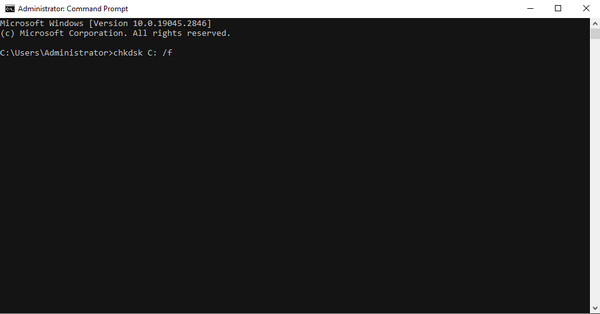
As you can see, this command requires that the card have an assigned drive letter. If your SD card isn't appearing, this method won't help, and we suggest skipping to data recovery instead.
Option 2. Use First Aid via Disk Utility (Mac)
For Mac users, Disk Utility's built-in First Aid feature is the equivalent of CHKDSK. It works by verifying the SD card's directory structure and repairing any inconsistencies it finds, such as invalid file permissions or corrupt volume headers. Like the last method, it requires no additional tools, and you can access it on your Mac anytime. However, it is designed to fix logical issues only, not to recover permanently deleted files or to repair physically damaged cards.
Follow the instructions below to fix corrupted SD card using First Aid via Disk Utility on Mac:
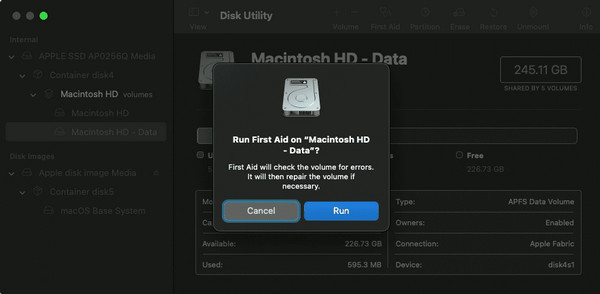
Step 1Ensure your SD card is plugged into your Mac, then open Disk Utility from Applications > Utilities. When the utility window is displayed, choose your SD card from the sidebar.
Step 2Afterward, select the First Aid option on the uppermost part, then hit Run to begin the repair process. Once complete, any errors will be fixed, making the SD card usable again.
Part 3. Recover Lost Data with FoneLab Data Retriever
As mentioned, SD card recovery may be your priority instead of a repair. You may have run the repair process, but it may have caused data loss. Luckily, recovering your data is entirely possible with FoneLab Data Retriever. It can thoroughly scan storage devices and recover lost or deleted data, including photos, emails, documents, audio, etc., even after deletion, formatting, or corruption.
Additionally, what makes this program especially suitable is its flexibility. In addition to computers’ internal drives, it also supports SD cards, USB flash drives, digital cameras, and more. Additionally, you can rely on FoneLab Data Retriever’s user-friendly design and functions that allow even beginners to recover files with ease.
FoneLab Data Retriever - recover the lost/deleted data from computer, hard drive, flash drive, memory card, digital camera and more.
- Recover photos, videos, documents and more data with ease.
- Preview data before recovery.
Follow the steps below for a corrupted SD card recovery with FoneLab Data Retriever:
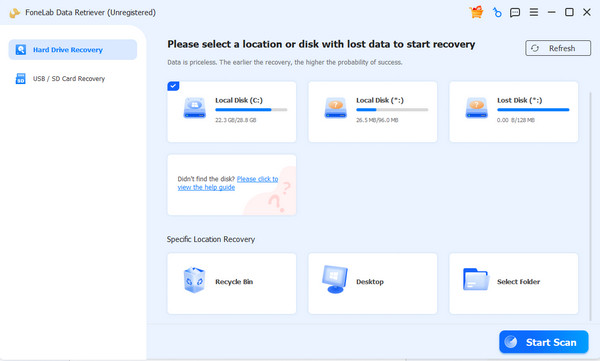
Step 1First, you need the FoneLab Data Retriever file, which you can obtain via the Free Download tab. Once it's in your Downloads folder, open it to install the program. Then, launch the program to display its main interface. So, from there, select your SD card, then Start Scan.
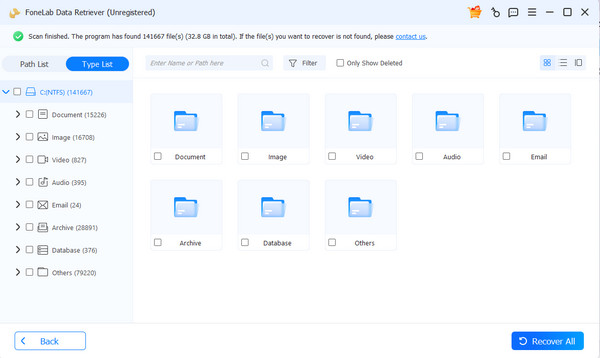
Step 2The following interface will present the results. Open the data type folders and scroll through the items to find the ones you want to recover. After that, check the items, and when you’re ready, choose the Recover All button at the bottom right.
Part 4. Format the Card (The Last Resort)
Formatting your SD card is the last resort we recommend if all other solutions fail. After recovering your data with FoneLab Data Retriever, this is the most effective solution you can have, as it completely erases the SD card's file system and rebuilds it from scratch. Consequently, it wipes everything, including hidden system files and damaged directory structures, which resolves deep-seated corruption that repair tools like CHKDSK or First Aid cannot fix.
FoneLab Data Retriever - recover the lost/deleted data from computer, hard drive, flash drive, memory card, digital camera and more.
- Recover photos, videos, documents and more data with ease.
- Preview data before recovery.
Follow the directions below to fix a SD card corrupted by formatting:
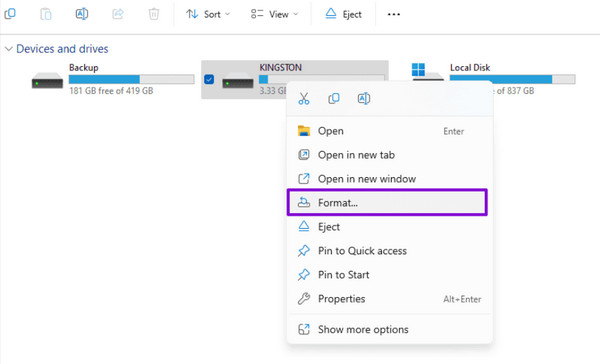
Step 1Insert your SD card and right-click its drive in Windows File Explorer or select it in Mac Disk Utility. After that, select the format option from the menu, such as FAT32 or exFAT.
Step 2Finally, click Start or Erase, then wait for completion before properly ejecting the card.
However, formatting is destructive. As mentioned, all your data will be lost, including apps, device settings, and more that recovery tools can no longer restore. Hence, use this option only if you're willing to sacrifice any leftover data to restore the card's usability.
Part 5. Common SD Card Error Codes
Below are the error codes that may display on your screen when the device refuses to read the SD card.
Error 1: "Card is not formatted. Do you want to format it?" - It means your device cannot recognize the file system, often due to corruption or an incompatible format.
Error 2: "Cannot read from the device" or "Access denied" - It indicates a permission issue or a connection failure, usually caused by a faulty reader or a corrupted partition.
Error 3: "SD card is full" despite having free space - It is often a sign of hidden system files or a corrupted file table that is taking up space.
Error 4: "RAW file system" - The SD card's file system has become unreadable, making it appear empty or inaccessible.
Part 6. FAQs about SD Card Corrupted
Can a physically damaged SD card be fixed?
It depends on how severe the damage is. However, software fixes won't work—professional data recovery services may be your only option.
Is it safe to use the same SD card after formatting?
Yes, it is. Formatting usually resolves the problem, making the SD card usable again, but repeatedly experiencing it may indicate the card is failing,
The key to handling a corrupted SD card is simple: act quickly, repair and recover your files with FoneLab Data Retriever, and format only as a last resort.