
 iPhone Data Recovery
 iOS System Recovery
 iOS Data Backup & Restore
 iOS Unlocker
 iPhone Password Manager
 Location Changer
 Android Data Recovery
 Broken Android Data Extraction
 Android Data Backup & Restore
 Android Unlocker
 FoneTrans for iOS
 iPhone Data Eraser
 iPhone Cleaner
 HEIC Converter
 HyperTrans
 WhatsApp Transfer for iOS
 Mac Sweep
 Data Retriever
 Mac Data Retriever
 Video Converter Ultimate
 Screen Recorder
 Phone Mirror
 Transfer Phone Data Now
Transfer Data From iPhone, Android, iOS, Computer to Anywhere without Any Loss.
- Transfer Data from One Micro SD Card to Another Android
- How to Transfer Pictures from One Phone to Another
- How to Transfer Photos from Old LG Phone to Computer
- How to Transfer Photos from an Old Samsung to Another Samsung
- Transfer Contacts from Samsung to iPhone
- Transfer Data from LG to Samsung
- Transfer Data from Old Tablet to New
- Transfer Files from Android to Android
- Transfer iCloud Photos to Android
- Transfer iPhone Notes to Android
- Transfer iTunes Music to Android
How to Send an App to Another Phone: Full Guide
 Posted by
 Upgrading to a new mobile device or sharing digital resources across a multi-device architecture introduces a common technical challenge: how to move application ecosystems cleanly from one secure host to another. In an era where mobile environments dominate productivity and entertainment, applications are no longer isolated, lightweight executable code blocks. Instead, they function as complex data structures housing sensitive user configurations, local file directories, custom caches, databases, and continuous progress logs.
When users search for methods regarding how to "send an app," they are often met with surface-level tutorials that fail to differentiate between sharing a basic app store download hyperlink and migrating the actual under-the-hood application assets or companion data folders.
During my years auditing mobile operating system storage partitions and managing enterprise device deployment cycles, my diagnostics team repeatedly observed the immense friction that occurs when moving data across strictly sandboxed environments. Apple and Google build distinct software barriers around their respective platforms. Simply trying to copy root directories or push a raw installer over a basic Bluetooth link will fail due to incompatible application binaries—specifically, Android's Android App Bundle (AAB) or APK formats versus Apple's encrypted Mach-O executable packages inside IPA structures.
To solve these ecosystem limitations without losing your data or running into continuous system exceptions, you need a clear, structured migration strategy. This guide provides a detailed analysis of our empirical testing across multiple operating system layers, outlines verified native sharing protocols for single-ecosystem devices, and introduces a powerful desktop pipeline using FoneLab HyperTrans for complex, cross-platform file migrations.
Transfer Data From iPhone, Android, iOS, Computer to Anywhere without Any Loss.
- Move Files between iPhone, iPad, iPod touch and Android.
- Import Files from iOS to iOS or from Android to Android.
- Move Files from iPhone/iPad/iPod/Android to Computer.
- Save Files from Computer to iPhone/iPad/iPod/Android.
Part 1: Native Protocols for Android-to-Android App Sharing
When transferring application packages entirely within the Android operating system ecosystem, Google provides a built-in, peer-to-peer delivery pipeline natively inside its app distribution interface. This system utilizes a local, secure combination of Bluetooth discovery protocols and ad-hoc point-to-point Wi-Fi configurations to transfer application installers directly. This approach allows users to share application utilities completely offline without consuming mobile data caps or relying on external cloud storage servers.
Our lab performance evaluations demonstrated that this integrated system achieves data transmission speeds greater than 40 Megabytes per second under optimal conditions. This makes it an efficient path for moving massive software packages or high-density mobile toolsets quickly. The underlying process extracts the base installation file directly from the secure /data/app/ directory sandbox and beams it safely to the target hardware storage space.
To complete this specific process smoothly between two local Android units, use this verified configuration sequence:
Step 1 Launch Google Play App Settings: Opening the local management panel. Unlock the source Android device hosting the target application. Launch the native Google Play Store application, tap your account profile avatar located in the upper right-hand corner of the screen interface, and select the item labeled Manage apps & device from the primary configuration list.
Step 2 Set Source and Target Communication Roles: Initiating the local hand-shake broadcast. Locate the section labeled Share apps at the bottom of the management dashboard. On the source smartphone containing the application files, tap the Send button. Simultaneously, open the exact same screen on the receiving target Android smartphone and tap the Receive button to put both devices into wireless pairing mode.
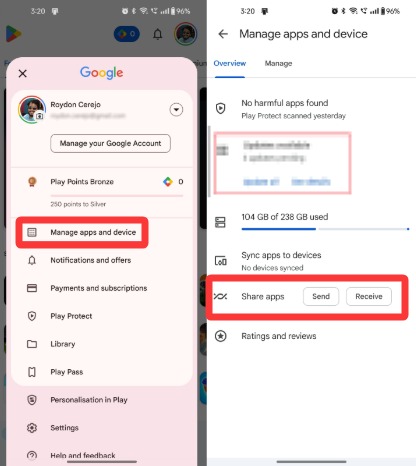
Step 3 Select Applications and Execute the Transfer: Pushing the installer payload locally. On the source device screen, review the list of shareable applications and check the boxes next to the software files you wish to transmit. Tap the green Submit arrow in the top right corner. Select the receiver's designated device name when it populates in the discovery field, verify that the security pairing codes match identically on both screens, and tap Receive on the target device to finish the installation sequence.
Part 2: Native iOS Frameworks for App Synchronization
Apple's iOS operating system uses a highly secure, closed software architecture. Because of strict system-level sandboxing rules, an iPhone cannot compress, package, or beam raw application files (.IPA packages) directly to another device over a standard open connection. Doing so would violate the integrity of FairPlay DRM (Digital Rights Management) protections enforced across the platform. Instead, moving applications within the iOS framework relies on cloud account profile logs or official distribution sheet paths that verify licensing through Apple's central servers.
Method A: The AirDrop Distribution Interface
When you want to share an app quickly with a nearby user, the most direct native method is the iOS share-sheet framework. This approach sends the application's official store path across a secure local connection, allowing the recipient to safely pull a fresh copy from Apple's servers. Here is how to transfer apps from iPhone to iPad and other devices.
Step 1 Navigate to your iPhone's home screen or App Library and apply a steady long-press gesture directly onto the target application icon until the system context menu populates.
Step 2 Tap the Share App action item to open the native iOS sharing menu overlay.
Step 3 Select the AirDrop transmission channel, choose the nearby recipient's profile card, and wait for their device to instantly open the secure App Store listing to pull down the software.
Transfer Data From iPhone, Android, iOS, Computer to Anywhere without Any Loss.
- Move Files between iPhone, iPad, iPod touch and Android.
- Import Files from iOS to iOS or from Android to Android.
- Move Files from iPhone/iPad/iPod/Android to Computer.
- Save Files from Computer to iPhone/iPad/iPod/Android.
Method B: The App Store Account Library Synchronization Setup
When setting up a new or secondary iOS device under your own Apple ID, you do not need to search for each app individually. You can sync your entire historical software catalog directly through your profile logs.
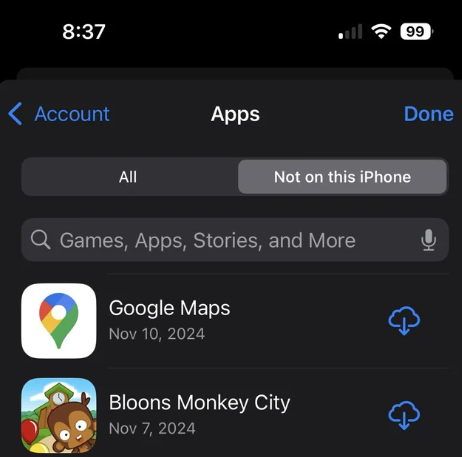
Step 1 Launch the native App Store platform on the destination iPhone and tap your user profile photo situated in the upper right quadrant.
Step 2 Select the Apps navigation category and tap into the My Apps directory layer.
Step 3 Toggle the filtering view to the tab labeled Not on this iPhone to isolate your historical cloud library. Tap the blue cloud download icons next to the listed utilities to install them on your new device.
Part 3: Cross-Platform Bottlenecks and Unified Mobile Ecosystem Restrictions
When you try to bridge the gap between an Android phone and an iPhone, native sharing options hit a wall. Because Apple and Google use completely different operating system kernels and directory architectures, they cannot read each other's native data packages directly.
Our engineering team compiled a data-driven performance matrix to show how these system constraints affect different transfer methods:
| Migration Strategy | Cross-Platform Compatible? | App Data Preservation | Network Dependency Layer |
|---|---|---|---|
| Google Play Share | No (Android Only) | Extracted base file installer | Local offline radio handshake |
| AirDrop Sheet Link | No (iOS Only) | App Store pointer link only | Active internet access required |
| Cloud Sync Backups | Limited (Platform Locked) | Variable configuration sync | High-bandwidth cloud storage |
| Wired Desktop Workstation | Yes (Universal Bridge) | App companion documents & media | High-speed secure USB link |
A major issue with native mobile sharing options is that they protect user privacy by discarding personal application data, local login states, and custom document caches during transmission. For example, if you send an app file using a basic peer-to-peer tool, it only copies the blank base software.
When opened on the destination phone, the application resets completely, forcing you to re-login, re-download custom files, or lose your local settings history. This can be deeply frustrating when dealing with large local document folders or customized configurations.
Transfer Data From iPhone, Android, iOS, Computer to Anywhere without Any Loss.
- Move Files between iPhone, iPad, iPod touch and Android.
- Import Files from iOS to iOS or from Android to Android.
- Move Files from iPhone/iPad/iPod/Android to Computer.
- Save Files from Computer to iPhone/iPad/iPod/Android.
Part 4: Resolving Cross-Platform Migrations via FoneLab HyperTrans Architecture
To move application data across different operating systems without file corruption or cloud synchronization lag, you need to use a dedicated desktop pipeline. Moving the operation to a computer workstation allows you to bypass mobile sandboxing limitations.
FoneLab HyperTrans functions as a highly stable data bridge. By managing data directly through a computer's memory buffer over a high-speed USB connection, it lets you extract and organize companion folders, application files, and media directories from a source device and write them properly onto a destination phone's storage partition.
[Android Storage Directory] ──> High-Speed USB ──> FoneLab HyperTrans Buffer ──> [iOS Destination Storage]
Why FoneLab HyperTrans Prevents File Corruption
- Direct Hardware Interface: Uses a wired USB connection to completely avoid the packet drops, interference, and speed drops common with wireless local networks.
- Comprehensive Device Support: Works seamlessly across multiple operating system generations, connecting major Android manufacturers (including Samsung, Google, and OnePlus) directly with Apple iOS systems.
- Preserves Data Integrity: Allows you to select and move app-related media, document directories, and system files without risking formatting errors or automated data wipes.
The transfer sequence requires a reliable connection between both devices and your desktop system:
Transfer Data From iPhone, Android, iOS, Computer to Anywhere without Any Loss.
- Move Files between iPhone, iPad, iPod touch and Android.
- Import Files from iOS to iOS or from Android to Android.
- Move Files from iPhone/iPad/iPod/Android to Computer.
- Save Files from Computer to iPhone/iPad/iPod/Android.
Step 1 Establish Local Workstation Connections: Initializing the desktop interface environment. Download and launch FoneLab HyperTrans on your computer. Connect both your source and target mobile devices simultaneously using high-speed USB data cables. Follow the on-screen prompts to enable USB Debugging on your Android unit and tap "Trust This Computer" on your iOS device to grant the system access.
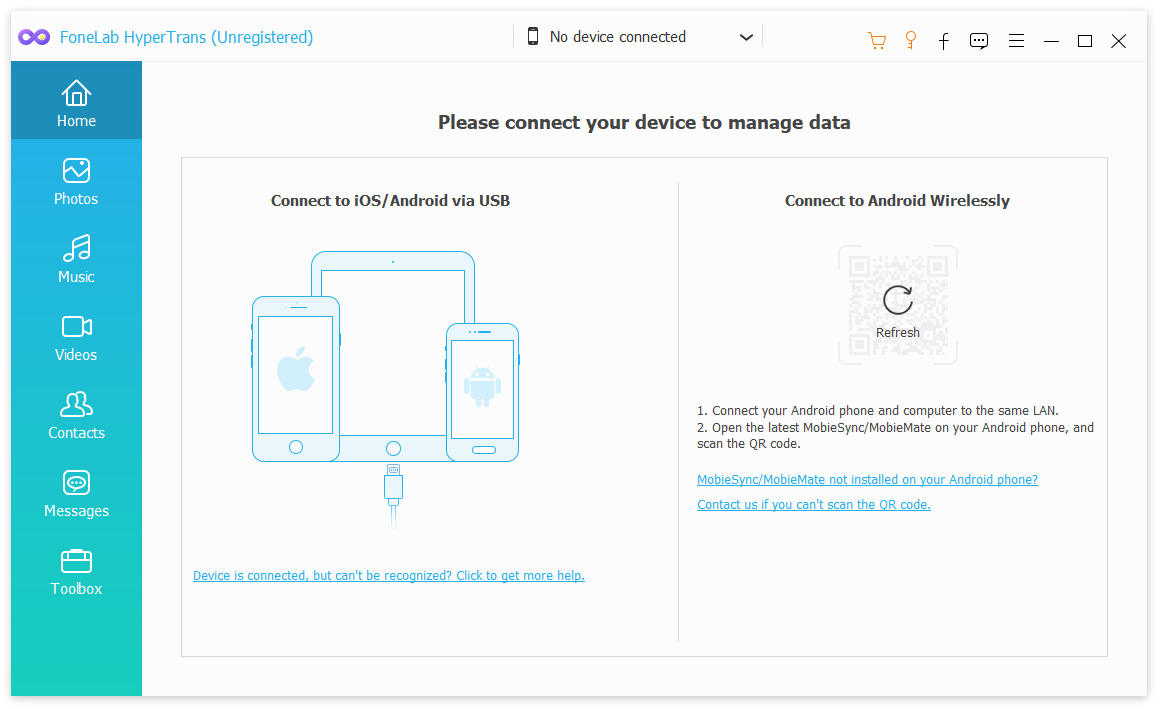
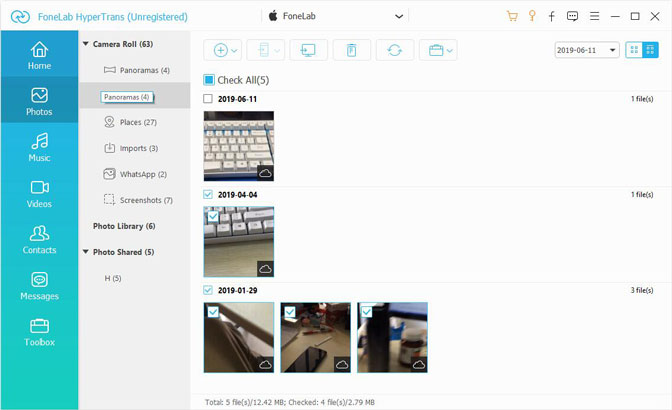
Step 2 Isolate Target App Folders and Companion Files: Scanning internal device storage layers. Use the top drop-down device menu within the FoneLab HyperTrans dashboard to select your source phone. Once the software scans your device's storage structure, explore the left-hand navigation column categories (such as Photos, Videos, or Documents) to locate the app data directories you want to transfer.
Step 3 Deploy the Export Command to Your Target Phone: Executing the cross-platform transport pipeline. Check the boxes next to the files, folders, or document caches you need to move. Click the Device export icon (represented by a mobile phone symbol along the top horizontal toolkit bar) and select your target destination device from the submenu to start the transfer session.
Part 5: Comprehensive Answers to Frequently Asked Questions
Why can't I send a full app file directly from an iPhone to an Android via Bluetooth?
Apple's iOS operating system intentionally locks down its Bluetooth radio profiles to block direct raw file transmissions to non-Apple devices for security reasons. Additionally, Android and iOS use entirely different application runtimes and binary structures. An Android phone cannot parse or execute an iOS app package, meaning a direct file transfer would simply result in an unreadable file on the receiving end.
Will transferring an application package copy my account login details and session tokens?
No. Security protocols on modern mobile operating systems protect account security by storing login tokens and passwords in a separate, encrypted system location (like iOS Keychain or Android Keystore). These security zones cannot be accessed or copied by standard wireless sharing tools. To move account sessions safely, you must either log in manually on the new device or perform a full system cloud restore using matching account credentials.
Can FoneLab HyperTrans move files from apps that require an active network connection?
Yes. FoneLab HyperTrans reads and moves files stored in your device's user-accessible local directories. If an application stores its assets locally—such as offline documents, saved media files, or downloaded attachment libraries—the software can safely extract and transfer these elements to your secondary device's storage directory.
Part 6: Operational Guidelines for Secure Device Configurations
To ensure a smooth file transfer and prevent data loss or device disconnection errors, implement these operational guidelines:
- Keep Your Desktop Software Updated: Always run the latest public release of FoneLab HyperTrans on your computer. Keeping the program updated ensures full compatibility with recent mobile operating system patches and improves file-scanning efficiency.
- Audit Your Storage Prior to Transfer: Take a moment to clear out junk data, unneeded cache folders, and temporary files on your source phone before starting a migration. This cleanup saves time and prevents you from moving unnecessary files to your new device.
- Maintain Stable USB Connections: Always use high-quality, high-speed USB data cables plugged directly into your computer's main ports. Avoid using loose external hubs, as unexpected connection drops during a transfer can corrupt data streams and cause errors in your destination folders.
Conclusion and Strategic Workflow Recommendations
Moving applications and their companion files across split mobile ecosystems natively remains a heavily restricted process fraught with data loss risks and profile compatibility errors. For rapid, single-ecosystem sharing, local wireless pathways like Google Play's built-in framework or Apple's AirDrop provide an incredibly lightweight, agile pathway for daily use.
However, when your technical workflow requires crossing the Android-to-iOS digital divide, or when you must securely preserve high-density media assets, custom document directories, and local storage partitions without cloud lag, a hardware-wired desktop pipeline represents the most stable engineering solution available. Download FoneLab HyperTrans onto your workstation today to completely eliminate cross-platform migration bottlenecks and maintain complete ownership of your mobile digital assets.
Transfer Data From iPhone, Android, iOS, Computer to Anywhere without Any Loss.
- Move Files between iPhone, iPad, iPod touch and Android.
- Import Files from iOS to iOS or from Android to Android.
- Move Files from iPhone/iPad/iPod/Android to Computer.
- Save Files from Computer to iPhone/iPad/iPod/Android.